As part of the exhibition "National motifs of the peoples of Russia in St Petersburg architecture," held at the House of Nationalities, lectures were delivered by Kirill Kozlov and Aleksandra Glukhova—faculty members at the St Petersburg State University of Architecture and Civil Engineering—focusing on the architectural history of the "Northern Capital," the factors that shaped its appearance, and the influence of various cultural traditions on the development of its urban landscape.
Kirill Kozlov, PhD of Architecture, Associate Professor at the SPbGASU Department of Architecture, board member of the Union of Architects of St Petersburg and the Leningrad Region, and General Director of the architectural bureau "Arka", presented a new lecture as part of his original series, "Confused St Petersburg." The talk focused on the patterns of the city’s urban development and the specific factors that have shaped its architectural character.
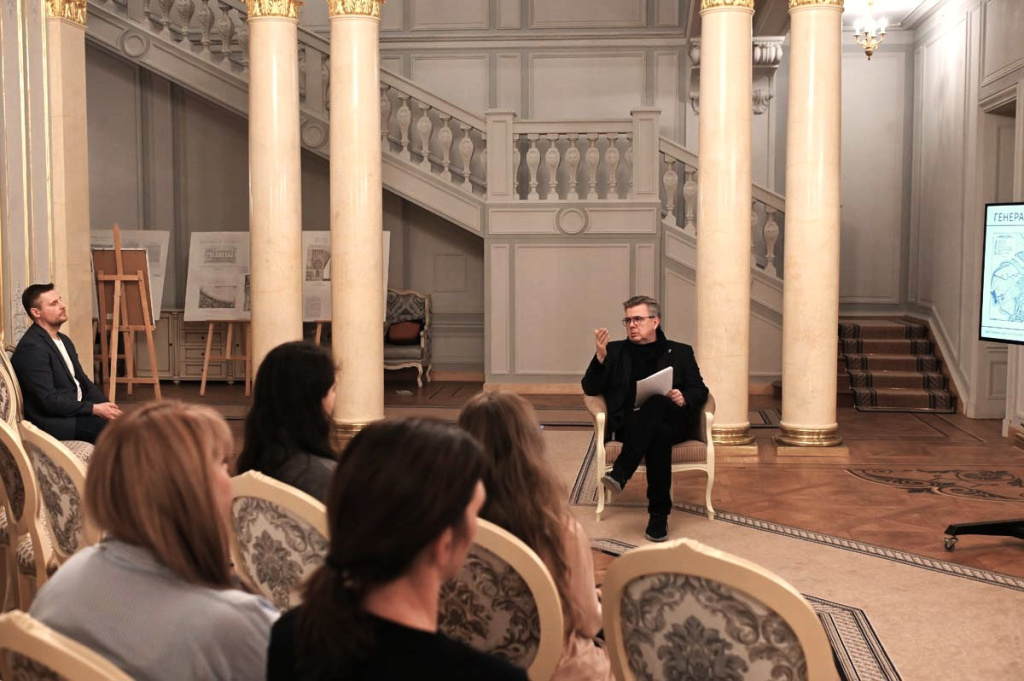 Kirill Kozlov
The scholar traced the evolution of St Petersburg from its founding to the present day, discussing fundamental planning concepts and urban development principles—and how these shifted as the city expanded and its economic model evolved—while also examining landmark architectural structures from various eras and styles.
The lecturer paid particular attention to the prototypes of St Petersburg’s neoclassical structures and the nuances involved in adapting European architectural concepts to the city’s urban environment. In his discussion of St Petersburg’s Art Nouveau style, he highlighted the distinctive way Western architectural ideas were reinterpreted—taking on a unique symbolic quality and a sense of restraint within the city on the Neva. The lecture also included an analysis of constructivist architecture, which reflects a drive to discover new forms and functional solutions.
Concluding his presentation, Kirill Kozlov addressed trends in contemporary architecture and current approaches to urban development. He noted that throughout its history, St Petersburg has not merely adopted global architectural trends, national motifs, and ideological manifestos; rather, it has reinterpreted them in its own way, shaping the city’s distinctive character. This is precisely what defines the architecture of the Northern Capital: its restraint, elegance, and recognizable style.
Aleksandra Glukhova—an architect and engineer, a guide for the educational project "St Petersburg through the eyes of an engineer," an associate professor at the SPbGASU Department of Architectural and Engineering Constructions—delivered a lecture titled "Art Nouveau: an international style in St Petersburg." She discussed the emergence of Art Nouveau at the turn of the 19th and 20th centuries, its spread across various countries, and the unique architectural interpretation of this style in the city on the Neva.
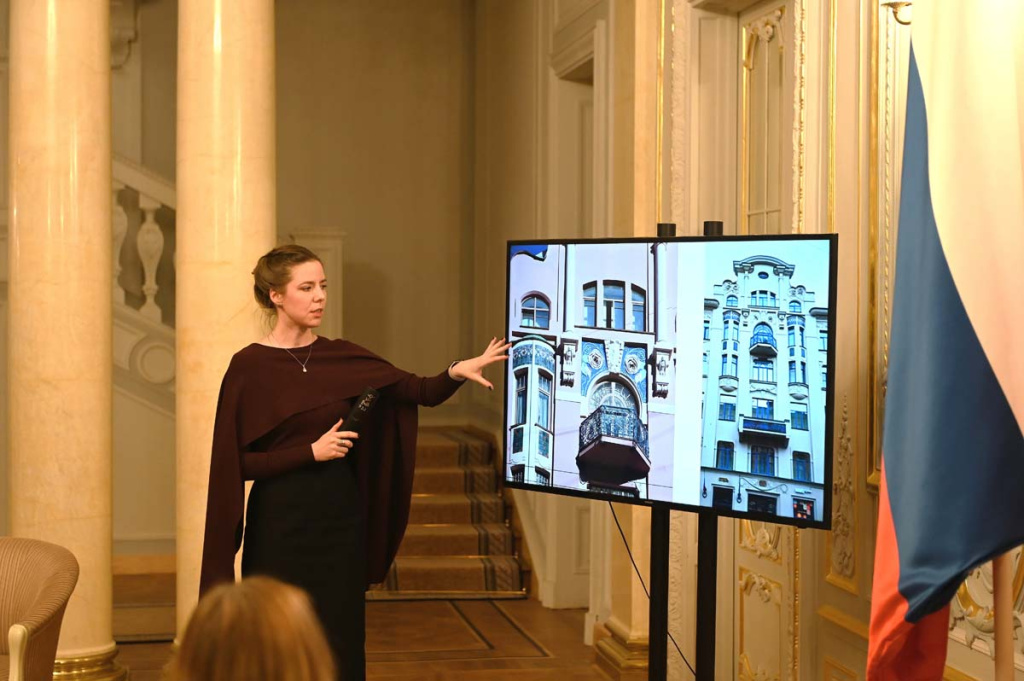 Aleksandra Glukhova
During the lecture, the audience was introduced to various strands of the Art Nouveau movement in European and American architecture—ranging from the fluid, organic forms seen in Belgium and France to the geometric designs of the Vienna Secession and the innovative structures created by American architects.
Aleksandra Glukhova paid special attention to Finland and Vyborg, whose architecture served as a vital link between European trends and St Petersburg. Through the works of Finnish masters, the lecturer demonstrated the expressive potential of natural stone, asymmetry, and motifs drawn from the northern landscape.
In her examination of St Petersburg’s Art Nouveau style, Aleksandra Glukhova explored how European architectural concepts were blended with Finnish National Romanticism and Russian folk motifs. The architectural examples discussed included apartment buildings by Fyodor Lidval, Ippolit Pretro, Alexey Bubyr, and Alexander Lishnevsky, as well as the private mansions of Matilda Kshesinskaya and Sergey Chayev. The lecturer highlighted decorative elements, nature-inspired motifs, specific architectural details, and the interplay between various art forms and emerging technologies.
In concluding her presentation, Aleksandra Glukhova emphasized that the traditions of St Petersburg Art Nouveau continue to influence contemporary architecture: its forms, materials, and distinctive silhouettes are reflected in new urban development projects.