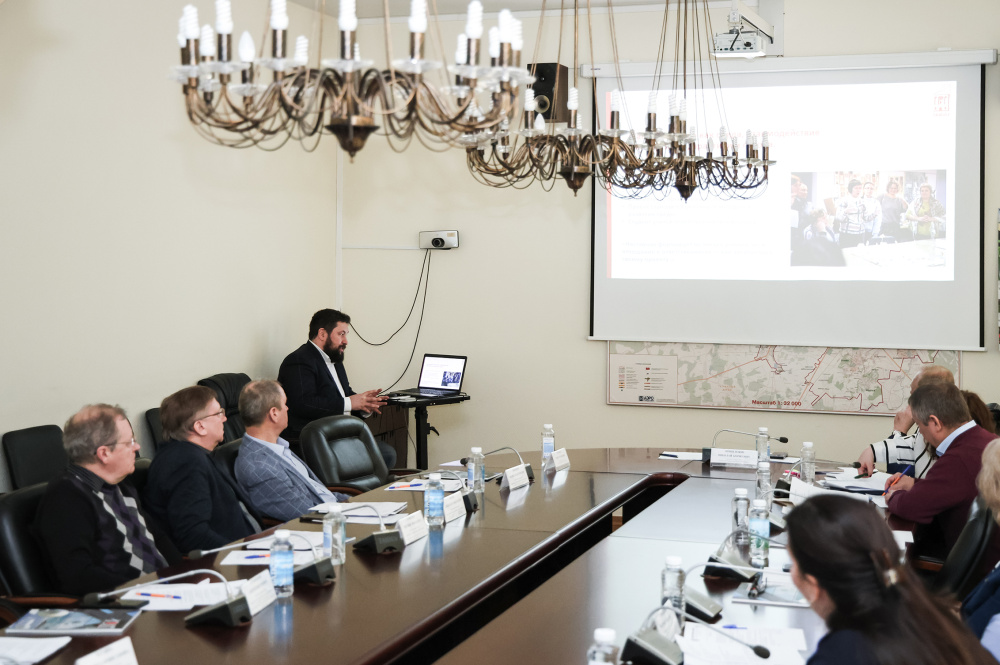
 Presentation by Andrey Surovenkov
Acting Dean of the SPbGASU Faculty of Architecture, Andrey Surovenkov, participated in a meeting of the Public Council of the Committee for the Improvement of St Petersburg. Our university representative leads a permanent working group on engaging senior and graduate students in developing urban planning concepts. At the meeting, he briefed his colleagues on this work.
The St Petersburg school: heritage and modern technologies
The SPbGASU Faculty of Architecture adheres to the principles of the St Petersburg school of architecture—a respectful attitude toward the historical context and a high level of professional responsibility. Priorities include the development of digital architecture, the introduction of new design technologies, and fostering in students a holistic view of the city as a unified ecosystem.
The Faculty is viewed as a student-teacher-graduate-city interaction environment, where the educational process is directly linked to the real-world challenges of St Petersburg and the Leningrad Region. Design workshops, led by practicing architects, are actively integrated into the educational process, and the clients include municipalities, cultural institutions, government agencies, and business representatives.
This mentoring format allows students to work on real projects, consider regulatory and urban planning restrictions, engage in dialogue with the client, and understand the architect's professional responsibility for the outcome.
Improvement projects: from parks to central streets
Andrey Surovenkov spoke about the Faculty's key project areas, which are being implemented in collaboration with the city.
These include the concept for the Linear Park on Vasilievsky Island; the improvement project for Fyodorovsky Square, which served as the basis for the project completed in 2025; improvement concepts for Murinsky and Peizazhny Parks; the transformation of the areas near the Youth Theater and on the Fontanka Embankment in the Semyonovsky Municipal District; and proposals for the renovation of public spaces on Dumskaya Street.
Considerable attention is being paid to creating a comfortable urban environment in the city's historic center. These developments include proposals for alternate routes to Nevsky Prospekt, flower arrangements for the embankments, and library reconstruction concepts, including the Central Children's Library in Sosnovy Bor.
As part of its environmental agenda, the Faculty presented initiatives for creating small architectural forms from recycled plastic, developed in partnership with specialized city organizations. Thus, educational projects become a platform for implementing the principles of sustainable development and a circular economy.
Architectural hackathons, bringing together students, teachers, and representatives of the professional community, have become a new tool for project collaboration. This format allows for the rapid development of concepts for specific areas, promptly responding to the city's pressing needs.
Decisions and plans
In addition to SPbGASU projects, meeting participants discussed the renewal of the Public Council's specialized commissions and working groups. They identified key areas of activity for 2026, related to the development of public spaces, improving approaches to urban development, and incorporating citizen initiatives.
According to Andrey Surovenkov, the participation of the SPbGASU Faculty of Architecture in the public council confirms the university's strategic role in shaping the modern urban environment. The integration of education, research, and real-world improvement projects not only enables the training of sought-after specialists but also makes a practical contribution to the development of St Petersburg.