Oleg Yatskovets, a PhD student and assistant at the Department of Reinforced Concrete and Masonry Constructions at Saint Petersburg State University of Architecture and Civil Engineering, has won a grant from the St Petersburg Committee for Science and Higher Education for 2026. The grant, amounting to 50,000 rubles, was awarded for the project "Statistical Patterns of Resistance Kinetics in Flexural Reinforced Concrete Elements Subjected to Low-Temperature Effects."
The study examines how repeated freeze-thaw cycles affect the performance of reinforced concrete structures. The topic is particularly relevant for St Petersburg, where air temperatures frequently cross the freezing point during the cold season, subjecting exterior structures to repeated thermal stress. Over time, this can alter not only the concrete's strength but also its deformation properties—that is, the material's ability to change shape under load.
When assessing the reliability of buildings and structures, it is important to take such changes into account throughout their service life. Therefore, the project authors investigated how exposure to low temperatures affected the design characteristics of reinforced concrete flexural members with varying amounts of reinforcement.
The work was conducted under the supervision of Vladimir Popov, PhD of Engineering Sciences and Associate Professor at the Department of Reinforced Concrete and Masonry Constructions at SPbGASU. The study combined methods from probability theory and mathematical statistics with a nonlinear deformation model of reinforced concrete.
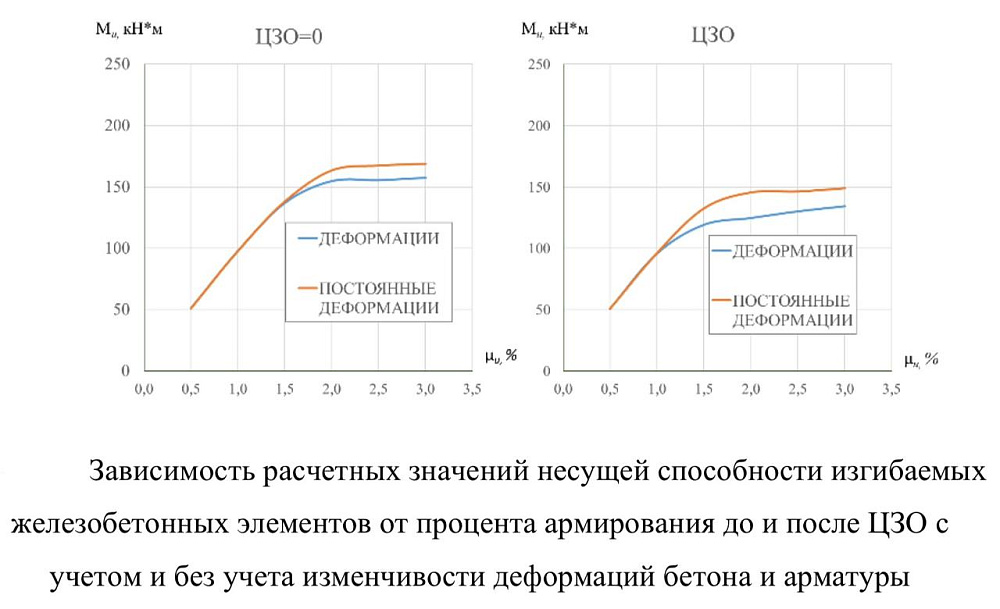
The authors examined flexural elements with a cross-section of 200×400 mm and varying reinforcement ratios. The analysis utilized 5,000 concrete stress-strain curves—both before and after freeze-thaw cycles—as well as data on the deformation of Class A400 and A500 reinforcement. This volume of computational data made it possible to evaluate not only the mean values of the properties but also their variability following exposure to temperature fluctuations.
Calculations showed that the impact of freeze-thaw cycles on load-bearing capacity depends on the amount of reinforcement in the element. In the models analyzed, the effect of the cycles on load-bearing capacity was negligible at a reinforcement ratio of up to 1%. With a further increase in the amount of reinforcement, the effect became more pronounced: at a reinforcement ratio of 1.5%, the calculated load-bearing capacity decreased by 13%, and at 2%, by 20%.
The study also revealed a reduction in the margins associated with certain design parameters linked to the failure mode of the reinforced concrete element. This indicates the need to account for the variability of material deformation properties when assessing the behavior of structures subjected to repeated freeze-thaw cycles.
Based on the results obtained, the authors formulated recommendations for the design of reinforced concrete flexural members subjected to alternating temperatures. In particular, for high reinforcement ratios, calculations should pay special attention to changes in the deformation properties of concrete following repeated freeze-thaw cycles.
The research findings were published in two articles in the scientific journal *Engineering Bulletin of the Don* (VAK, K-2) in 2025. The data obtained are of practical interest to St Petersburg and other regions where structures are regularly subjected to temperature fluctuations across the freezing point.
For Oleg Yatskovets, winning the grant competition was not his only scientific achievement in 2026. That same year, the SPbGASU PhD student received a scholarship from the President of the Russian Federation.
The research was supported by the Committee on Science and Higher Education of St Petersburg under the 2026 grant competition.