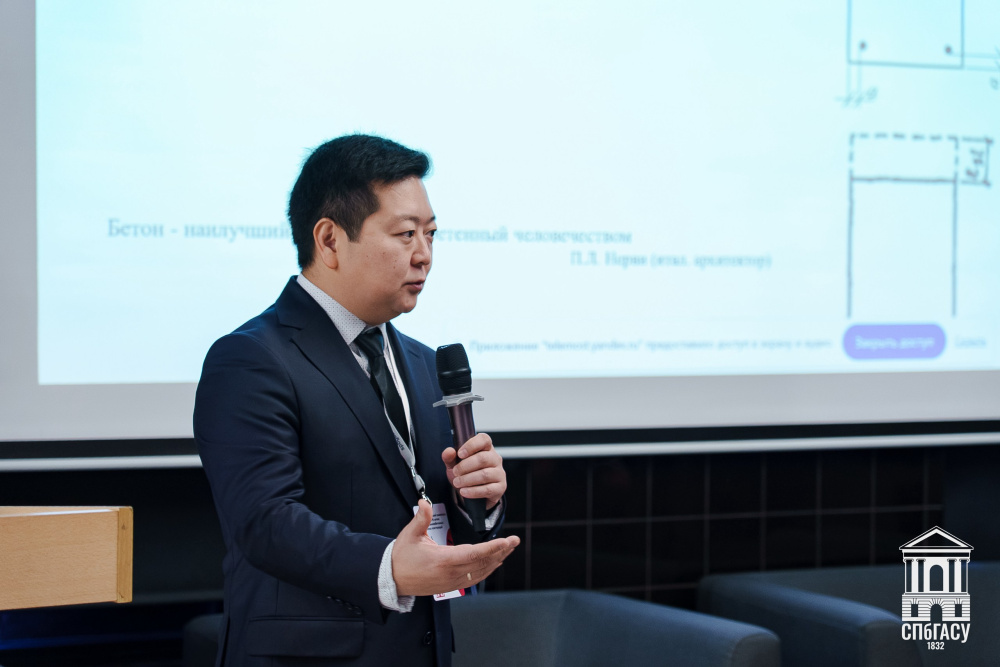
 Presentation by Aleksey Khegai, Head of the Department of Reinforced Concrete and Masonry Constructions
On 12 November, the Saint Petersburg State University of Architecture and Civil Engineering held a scientific and technical symposium to mark the 95th anniversary of the Department of Reinforced Concrete and Masonry Constructions. The event brought together teachers and researchers from SPbGASU, representatives from other universities and construction organizations, as well as undergraduate, master’s, and doctoral students.
The main theme of the symposium was modern advancements in the analysis and design of reinforced concrete structures. Participants presented the results of scientific research, discussed current engineering challenges, and explored the potential for applying new methods for the analysis and testing of structural components.
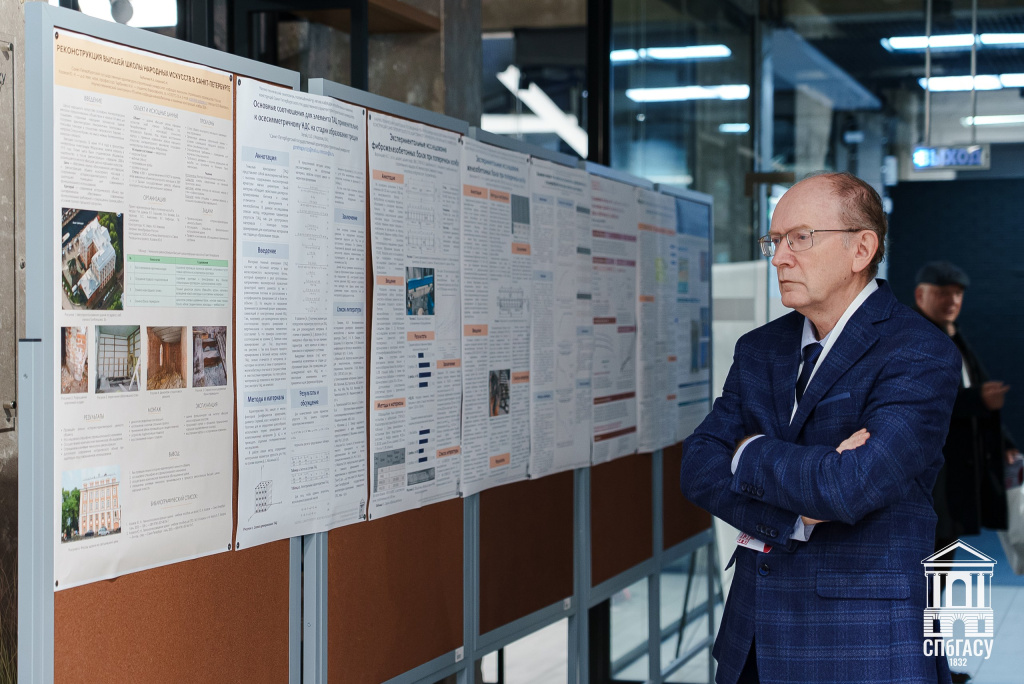
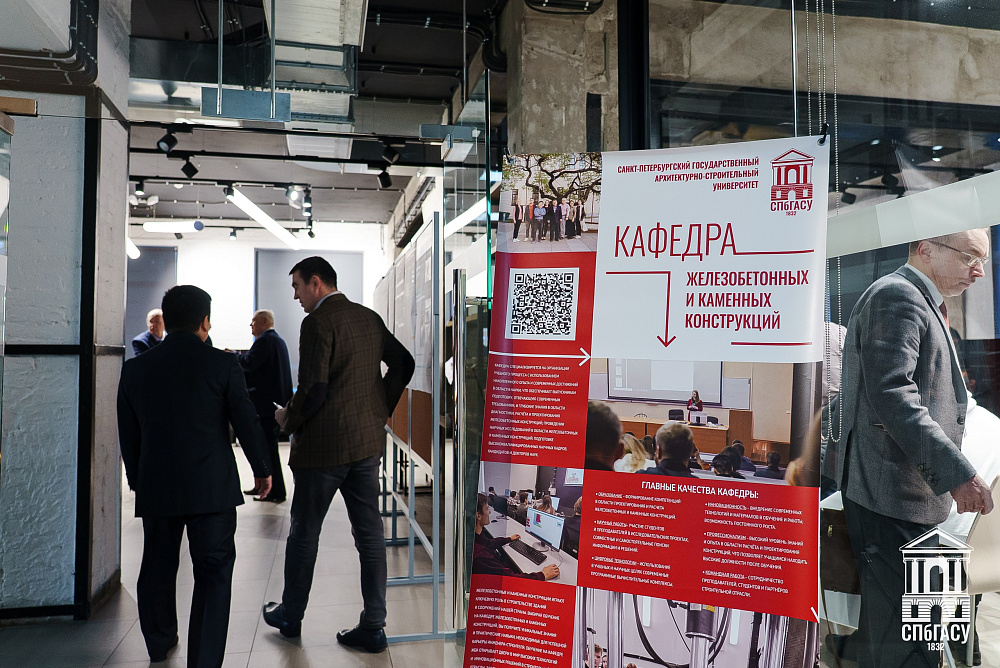
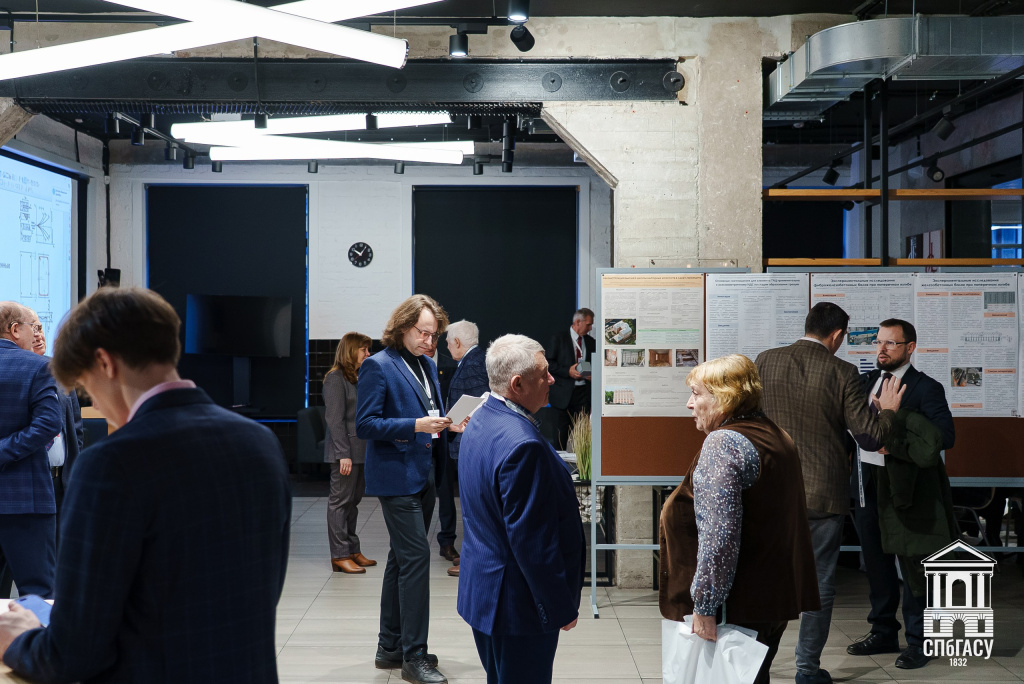 On the sidelines of the symposium
Evgeny Rybnov, SPbGASU Rector, addressed the participants with welcoming remarks. In his congratulatory message, he emphasized that over the past 95 years, the department had made a significant contribution to the advancement of construction science and the training of engineering professionals. Throughout its history, the department has been led by prominent scholars, including Georgy Nikitin, Konstantin Sakhnovsky, Nikolai Panarin, Gennady Shorshnev, and Valery Morozov.
"For decades, the department has remained not only a place for preserving traditions and expanding knowledge, but also a hub for establishing high professional standards—a place where new ideas are born, new horizons for the development of engineering thought are opened, and cutting-edge technologies are implemented," the rector noted.
Vice-Rector for Educational Activity Sergey Mikhailov highlighted the department’s role in training design engineers and planners, as well as academic and research personnel. He noted that many graduates go on to pursue postgraduate studies and remain at the university to work. Key areas of the department’s work include collaboration with leading engineering and technical universities and research centers, as well as participation in international projects.
Vice-Rector for Research Evgeny Korolev highlighted the high demand for graduates of the department within the construction industry in St Petersburg and across Russia. He also noted the achievements of students who engage in research and project work, secure grants and named scholarships, and complete internships at major design and construction firms.
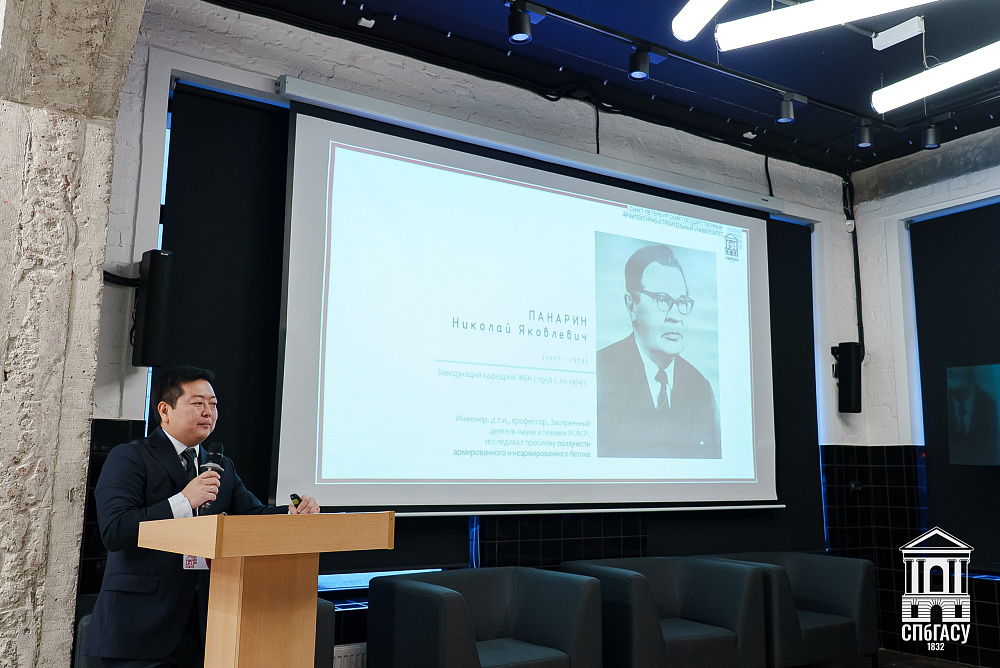
Aleksey Khegai, Head of the Department, PhD of Engineering Sciences and Associate Professor, spoke about the department’s development, its academic schools, and its current research areas. He noted that the department was established as an independent unit in 1930 at the Leningrad Institute of Municipal Construction Engineers (now SPbGASU). Its origins, however, can be traced back to earlier research on reinforced concrete structures conducted by scholars Grigory Perederiy and Nikolai Belelyubsky.
Over the years, the department has developed several significant areas of research. In particular, under the leadership of Nikolai Panarin, studies were conducted on the inelastic deformation of concrete and reinforced concrete. In 1961, a laboratory for testing reinforced concrete and masonry structures was established; it remains in operation today, having since broadened its research scope. The laboratory now investigates not only reinforced concrete structures but also metal and timber structures, as well as the connections used within them.
Research into ferrocement and fiber-reinforced concrete holds a special place in the history of the department. Work in this field began in the second half of the 20th century and subsequently served as the foundation for the development of an independent scientific discipline. In 2007, a research team led by Professor Valery Morozov was awarded the Government of the Russian Federation Prize in Science and Technology for their development of theory, creation of technologies, and implementation of mass production for high-efficiency fiber-reinforced concrete structures.
Among other significant areas of focus developed within the department, Aleksey Khegai highlighted research on the strengthening of reinforced concrete and masonry structures—including the use of prestressing—as well as the development of methods for calculating structural elements that account for the composite action of concrete and reinforcement.
Today, the department continues to develop its established scientific schools while addressing the needs of the construction industry. Key research areas include the study of the behavior of building and structural components, enhancing the durability of reinforced concrete—including in Arctic conditions—refining methods for the inspection and strengthening of structural elements, and developing calculation techniques that account for mechanical, thermal, and moisture-related effects. The department offers doctoral and postgraduate (PhD-level) programs, and each year, it graduates more than 100 students across various levels of study.
Andrey Nikulin, Dean of the Faculty of Civil Engineering, Phd of Engineering Sciences, and Associate Professor, emphasized the importance of further developing the department’s research agenda and holding such meetings on a regular basis. In his view, the symposium could serve as an annual forum for discussing pressing issues in construction science. Furthermore, he noted the need to broaden the scope of research, giving attention not only to cast-in-place reinforced concrete but also to precast reinforced concrete and volumetric reinforced concrete structures.
Andrey Nikulin also highlighted the large-scale objectives facing the construction industry in the coming years: reducing the investment and construction cycle by 30%, increasing construction efficiency, and adopting a comprehensive approach to the entire lifecycle of facilities—from initial construction through to operation. To achieve these goals, he noted, it is essential to more actively foster inter-university and international collaboration, as well as to strengthen ties with industry partners.
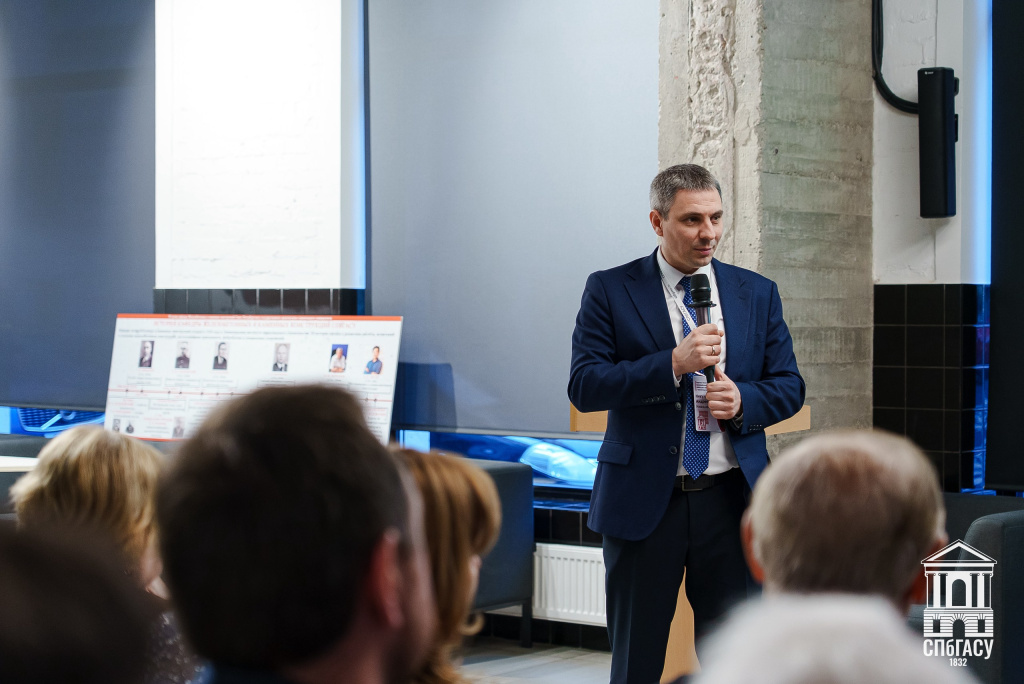 Speech by Andrey Nikulin
He identified the integration of students' final qualifying works with independent qualification assessments as a promising area for such collaboration. The plan is for future thesis defenses to be held at the premises of the university’s industry partners, thereby linking student research to the actual demands of the construction sector.
Following the historical segment, a plenary session took place, during which researchers from SPbGASU and other educational and scientific organizations presented papers on recent developments in the field of structural engineering.
The topics examined include the assessment of concrete strength and deformability, the durability of reinforced concrete structures, the impact of low and high temperatures on the properties of construction materials, the inspection and strengthening of existing buildings and structures, and the application of new computational models.
In particular, Vladimir Korsun, DSc in Engineering, a Professor at the SPbGASU Department of Reinforced Concrete and Masonry Constructions, presented a paper on orthotropy parameters within a dilatational model of concrete deformation. Danil Saradoev, a PhD student at the university, together with Sergey Savin—DSc in Engineering, a Professor at the same department—and the Head of the department, Aleksey Khegai, discussed the use of flexural waves and free vibrations to develop computational models for structures currently in service.
A separate segment of the presentations was devoted to practical construction challenges. Yury Kazakov, DSc in Engineering, a Professor at the SPbGASU Department of Construction Technology, delivered a report on the reconstruction of the Higher School of Folk Arts in St Petersburg. Natalya Vorontsova, PhD of Engineering Sciences, an Associate Professor at the Department of Reinforced Concrete and Masonry Constructions, joined by industry representatives and master’s students, discussed experimental research on reinforced concrete and fiber-reinforced concrete beams subjected to transverse bending.
In addition, the participants discussed the automation of generating structural analysis models for buildings based on BIM models, the behavior of reinforced concrete structures following a fire, the use of non-linear models for the analysis of steel-fiber-reinforced concrete structures, and the impact of thermal effects on the concrete properties.
The symposium program featured research by young scholars from SPbGASU, including postgraduate and undergraduate students. They had the opportunity to present their scientific works to the professional community, receive feedback from experienced experts, and discuss prospects for future research and development.
In total, the program featured over 20 presentations. Some of the research was showcased in the form of poster presentations, allowing the authors to engage with other participants and discuss potential avenues for collaboration.
The symposium served as a platform for exchanging scientific and practical experience, discussing current challenges in the construction industry, and exploring research findings that uphold the traditions of one of the oldest degree-granting departments at SPbGASU.