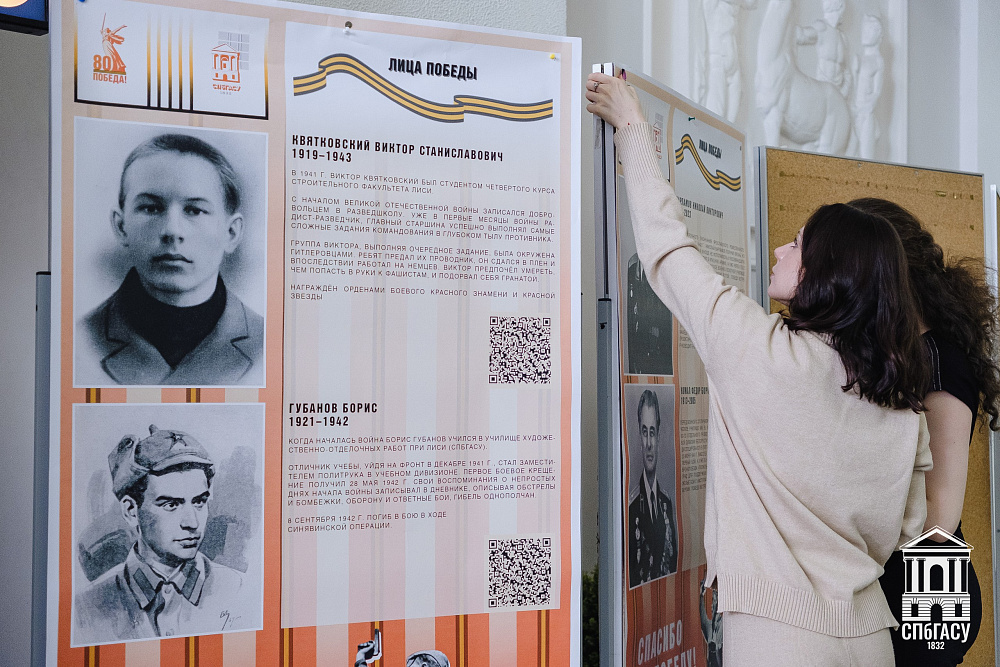
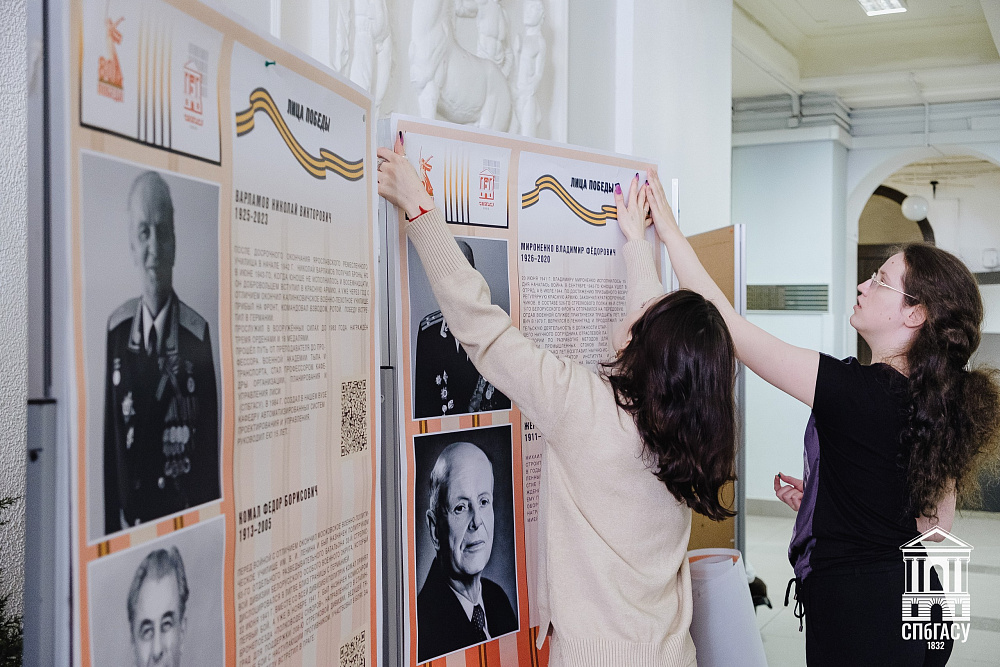
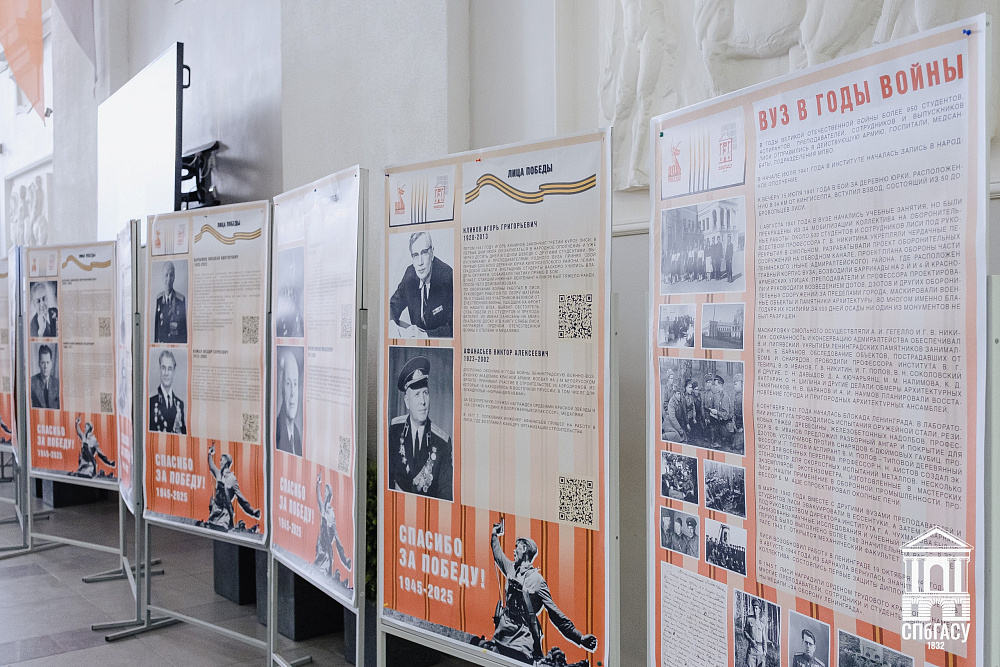
The main hall of the Saint Petersburg State University of Architecture and Civil Engineering is hosting a historical and patriotic exhibition, "Victory Faces," dedicated to the anniversary of Victory in the Great Patriotic War. The exhibition features archival photographs, biographies, and documentary materials about the university's students, teachers, and graduates whose lives were inextricably linked to the war.
The University during the war: mobilization, defense, and heroism
From the first days of the Great Patriotic War, our university joined the fight. As early as July 1941, they began enrollment in the people's militia. More than 950 people—students, PhD students, teachers, and staff—were sent to the front, to hospitals, and to air defense units.
The academic process was interrupted: the institute staff was sent to work on defensive works. Under the guidance of their professors, students built fortifications, designed defensive structures, and participated in camouflaging Leningrad's architectural monuments. Thanks to these efforts, a significant portion of the city's historical heritage was preserved.
During the evacuation, the university continued to operate, with educational and research activities taking place in Barnaul and other cities. After returning to Leningrad in 1943–1944, the institute resumed full operations, and in 1945 it was awarded the Order of the Red Banner of Labor.
Victory Faces: those who went through the war
The exhibition tells in detail the stories of people whose names became part of the university's history.
Igor Grigorievich Klinov (1920–2013)
A student at the Leningrad Institute of Civil Engineering, he joined the people's militia in the war early days. He participated in the battles near Kingisepp and was seriously wounded. After the war, he devoted himself to research and commemorating the fallen students and teachers.
Viktor Alekseevich Afanasyev (1923–2002)
A military engineer, he participated in the construction of airfields at the front, including for the legendary Normandie-Niemen squadron. After the war, he worked at the university, heading a department.
Vladimir Fedorovich Mironenko(1926–2020)
Began the war as a teenager in a partisan detachment, then served in the Red Army. After the war, he continued his scientific work, contributing to the development of engineering.
Mikhail Mikhailovich Zherbin (1911–2004)
A specialist in industrial construction, during the war he participated in the creation of strategically important facilities, including heavy aerial bomb factories.
Nikolay Viktorovich Varlamov (1925–2023)
A volunteer, he served in the war as a unit commander. After his service, he became a professor and founder of the Department of Computer-Aided Design Systems.
Fedor Borisovich Komal (1913–2005)
Political instructor of the reconnaissance battalion, from the first days of the war he took part in heavy fighting and reached Berlin.
Fallen heroes: remembering those who never returned
A special place in the exhibition is occupied by the stories of students who died at the front.
Viktor Stanislavovich Kvyatkovsky (1919–1943)
A scout who carried out the most difficult missions behind enemy lines. He chose death rather than capture by blowing himself up with a grenade.
Boris Gubanov (1921–1942)
A student at the Institute's art school. He died fighting during the Sinyavino Offensive.
Aleksandr Vasilievich Prygunov (1907–1943)
Hero of the Soviet Union. He commanded a sapper unit and distinguished himself during the crossing of the Dnieper.
Architects of Victory: restoring and preserving the city
The exhibition's heroes include outstanding architects and engineers.
Nikolay Varfolomeevich Baranov (1909–1989)
Leningrad's chief architect during the war. He oversaw the city's camouflage, the restoration of monuments, and the development of a master plan for postwar development.
Nikolay Fedorovich Khomutetsky (1905–1973)
An architect and military translator, he participated in military operations and worked with captured documents.
Ivan Ivanovich Solomakhin (1908–1989)
Sapper, participated in Operation Iskra to break the siege of Leningrad, awarded orders and medals.
Leonid Yulievich Galperin (1907–1995)
One of the participants of the "Road of Life" on Ladoga, ensured its uninterrupted operation in the most difficult conditions.
Engineers of the front and science
Nikolay Mikhailovich Nazarin (1909–1993)
Military engineer, engaged in the creation of defensive structures and reconnaissance of enemy engineering systems.
Mikhail Isaakovich Kliot-Dashinsky (1923–2000)
An artilleryman, he taught at the university after the war and contributed to the development of engineering education.
Memory preserved for future generations
The exhibition is not limited to texts and photographs. Each stand is equipped with QR codes leading to additional materials—archival documents, memoirs, and extended biographies. This makes the exhibition interactive and allows for a deeper dive into the lives of the heroes.
The organizers emphasize that the project's main goal is to preserve historical memory and demonstrate that Victory was shaped by the lives of specific individuals—students, teachers, and engineers.
"Victory Faces" is more than just a historical exhibition; it is an important educational and patriotic project. It reminds us of the price of Victory and the contribution of the scientific and student community to the common cause.
Today, walking through the SPbGASU main hall, visitors can literally "meet" heroes of the past—people who studied and worked within these same walls, but at a decisive moment chose their homeland.
The exhibition is open to everyone and will run until May 15.
Learn more about the heroes associated with our university in the "Scientific Regiment" project.