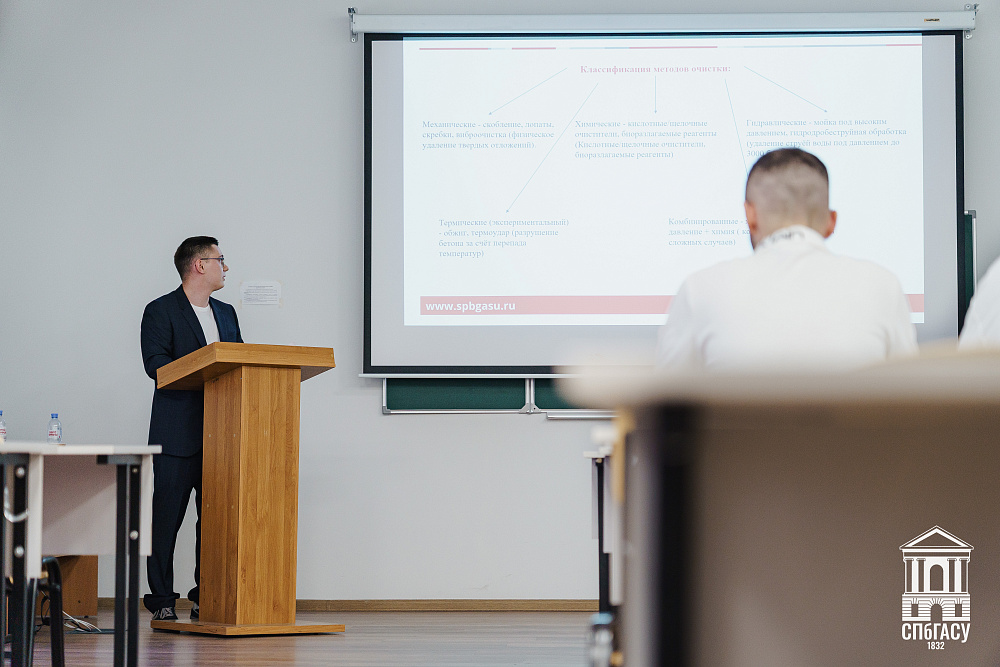
As part of the IV International Scientific and Practical Conference "Transport Accessibility in the Arctic: Networks and Systems," a session of the "Innovative Technologies and Equipment" section was held. It was dedicated to modern engineering solutions for the transport industry, construction, and operation of equipment in the Arctic zone.
The section brought together teachers, PhD students, and young scientists who presented the results of their research related to increasing the reliability of equipment, improving machinery diagnostic methods, and adapting engineering systems for operation in low-temperature conditions.
One of the topics of discussion was geotechnical technologies and the interaction of building structures with soil masses. Participants presented the results of research on the performance characteristics of rock-concrete structures and the influence of their geometric parameters on the effectiveness of soil stabilization.
Participants focused on ensuring the operability of transport and technological vehicles in northern regions. Approaches to diagnosing the power units of road construction equipment were discussed, including the use of acoustic methods for monitoring the technical condition of engines. According to the study authors, the use of sound analysis could become a promising approach to rapid diagnostics of equipment operating at remote sites in the Arctic.
Participants also discussed natural, climatic, organizational, and operational factors affecting the technical readiness of machinery and equipment. Experts noted that improving machine reliability requires a comprehensive approach, including improved maintenance, spare parts logistics, and monitoring systems.
A separate section of presentations was devoted to the safety and working conditions of transport and technological equipment operators. The focus was on research into vibration effects arising during equipment operation in low temperatures. Experts concluded that a more thorough study was needed on the impact of road surfaces, tire characteristics, and powertrain operation on the level of vibration experienced by operators.
One study provided a comparative analysis of mechanical, hydraulic, chemical and combined methods for cleaning concrete mixing equipment from residues of hardened concrete mixtures.
Another topic of the section was utility maintenance technologies. Participants reviewed existing methods for cleaning pipelines of process deposits, discussed their advantages and limitations, and prospects for improving equipment for utility system operation.
Following the session, the speakers noted that operating equipment in northern regions required consideration of specific climatic factors. Low temperatures affect the properties of materials, the operation of hydraulic systems, engines, and other equipment components, which must be taken into account both in equipment design and maintenance.
The experts paid special attention to the scientific novelty of the developments and the possibilities for their implementation in real production conditions.