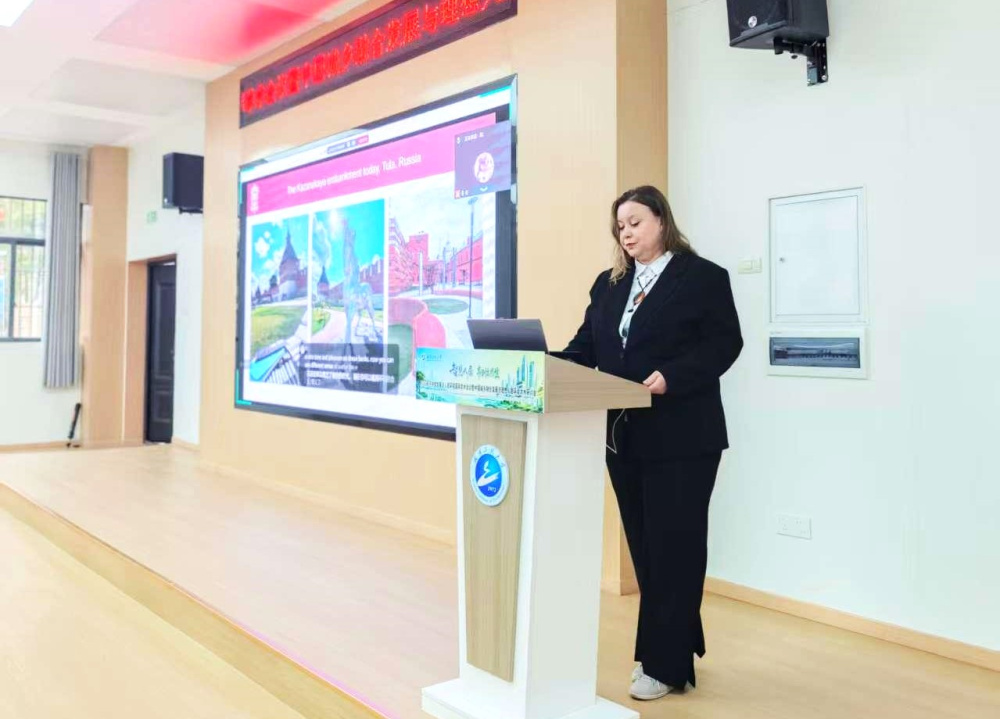
 Presentation by Olga Pastukh
From 23 to 25 October, the Wuhan University of Technology (China) helf the International Scientific Conference on sustainable development and the human settlement environment. St Petersburg State University of Architecture and Civil Engineering was represented by Olga Pastukh, PhD of Architecture, Associate Professor at the Department of Architectural and Engineering Constructions, and head of the university’s new core professional educational program, "Restoration of Buildings and Structures" (within the field of study 08.03.01 "Civil engineering").
The conference brought together experts from China, Russia, Germany, and the United Kingdom. The primary focus of the discussion was the implementation of UN Sustainable Development Goal 11: making cities and human settlements inclusive, safe, resilient, and sustainable. Participants examined approaches to creating a comfortable urban environment, integrating digital technologies, developing territories, and preserving cultural and natural heritage.
A special place in the program was given to issues concerning a comprehensive approach to the sustainable development of urban and rural settlements, while ensuring the preservation of the architectural and cultural heritage of historic localities. This very topic was the focus of a presentation by a SPbGASU representative. Olga Pastukh delivered a talk titled "Exploring opportunities and methods for preserving the industrial heritage of Saint Petersburg and other historic cities in Russia."
In her presentation, she examined the significance of industrial architectural heritage for preserving the historical identity of cities and emphasized the need for a comprehensive approach to the development of the urban environment. According to the researcher, it is important not only to preserve individual historical buildings and structures but also to consider their role within the urban fabric—ranging from entire architectural ensembles to specific facade elements.
"Preserving individual monuments is certainly necessary, but it is far more important to preserve the historic urban environment and adopt a comprehensive approach to its sustainable development. Safeguarding our industrial architectural heritage, as well as training and educating the relevant specialists—architects and restoration engineers—is our primary objective as a specialized university at this time," noted Olga Pastukh.
The issue of training professional personnel is of particular importance to the development of the restoration sector. At SPbGASU, this area is addressed, among other ways, through a new educational program titled "Restoration of Buildings and Structures," which falls under the field of study 08.03.01 "Civil engineering." The program is designed to train specialists capable of working with architectural heritage sites and contributing to the preservation of the historic urban environment.
The conference program also featured research by international scholars focused on the adaptation of human settlements to contemporary challenges, the development of a comfortable urban environment, the integration of urban and rural areas, and the application of digital methods in urban planning. Among the speakers were representatives from Xi’an Jiaotong University, the University of Liverpool, the Chinese Academy of Sciences, Huazhong University of Science and Technology, and the Technical University of Munich.
Participation in the conference provided an opportunity to share the Russian experience in preserving industrial heritage with the international academic community and to discuss prospects for professional collaboration. The event organizers expressed interest in further cooperation with specialists from SPbGASU on research initiatives focused on sustainable urban development and the preservation of historical and cultural landmarks.