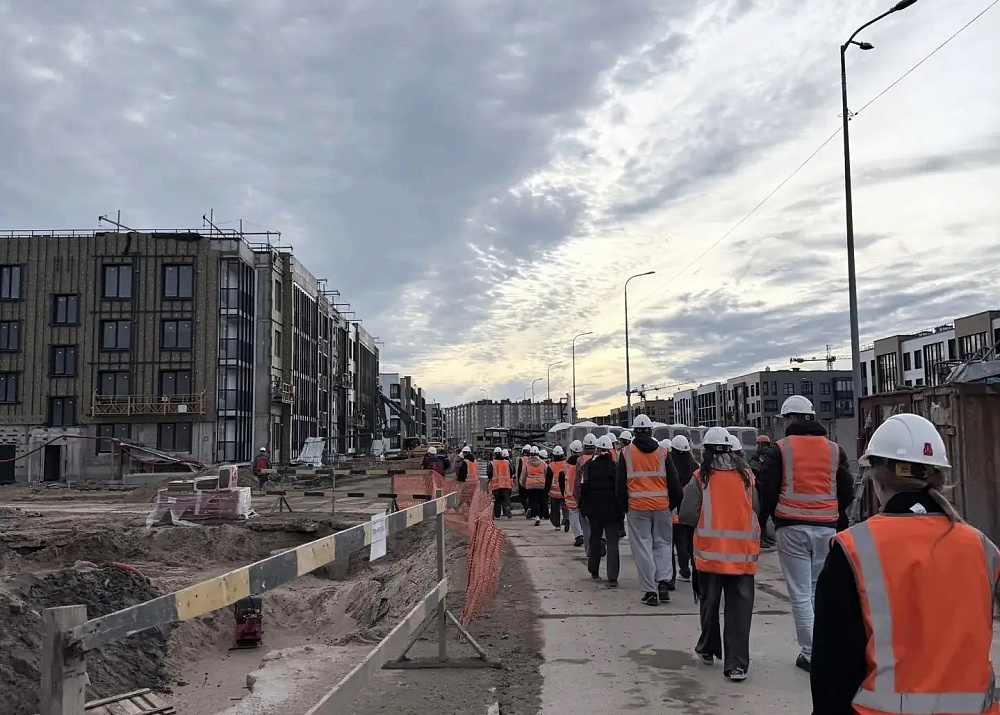
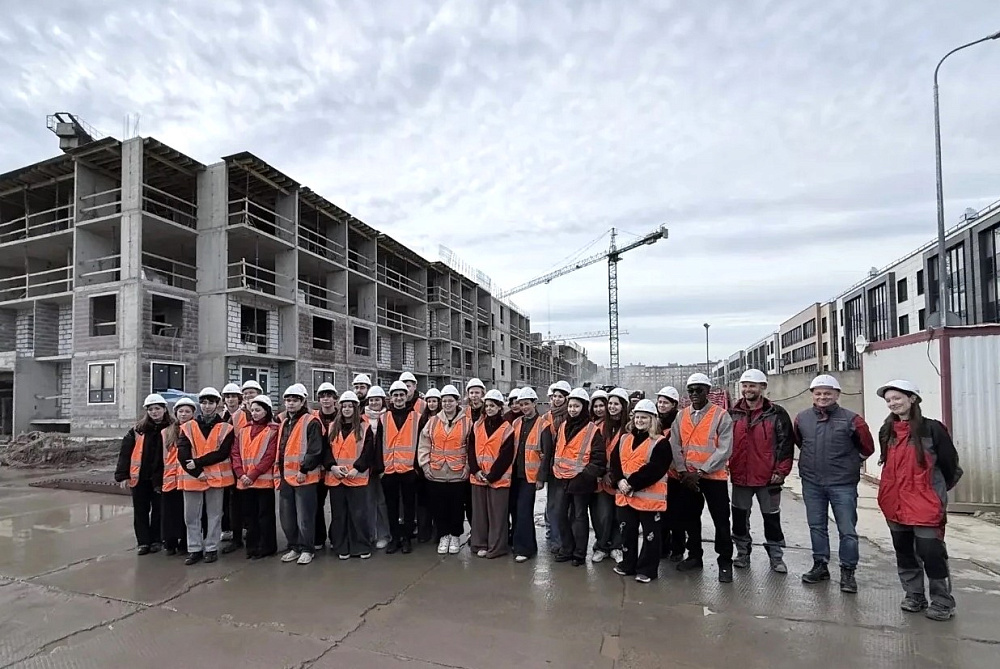
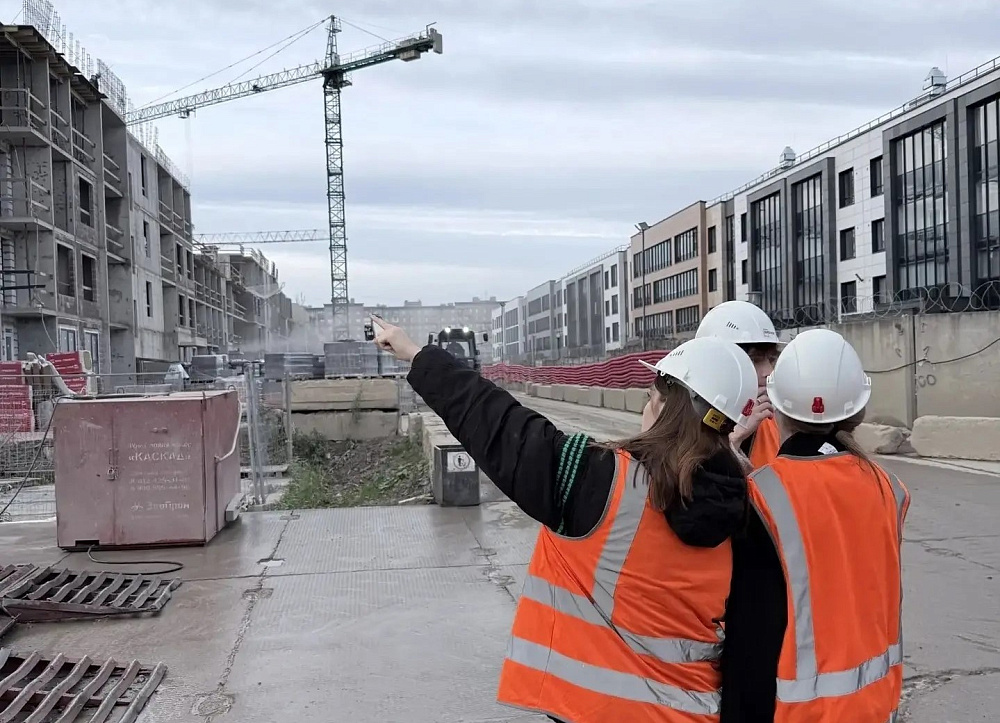
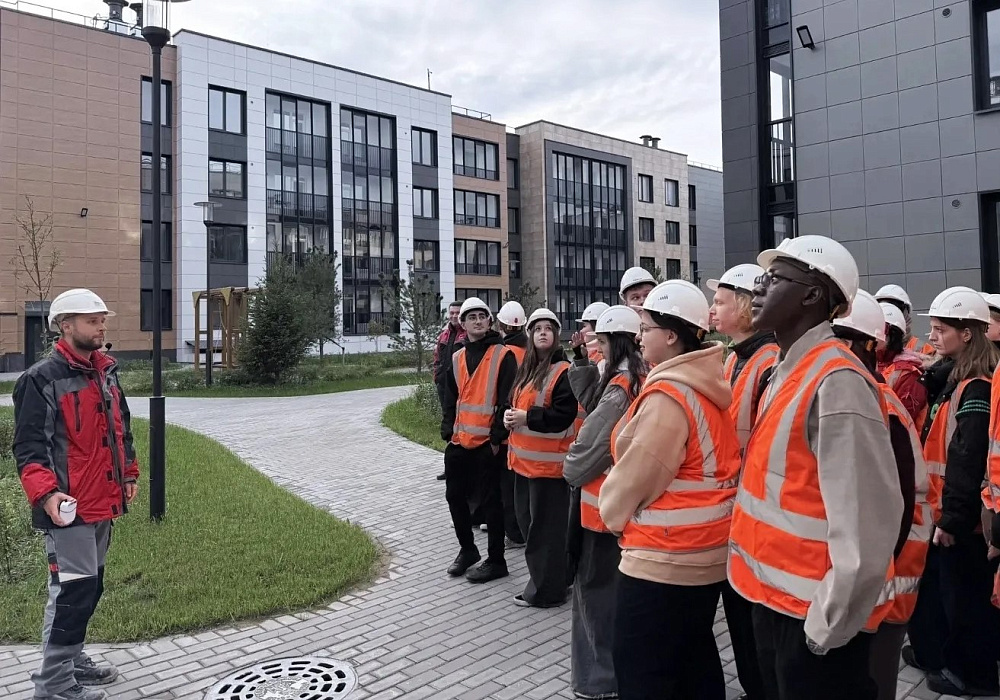
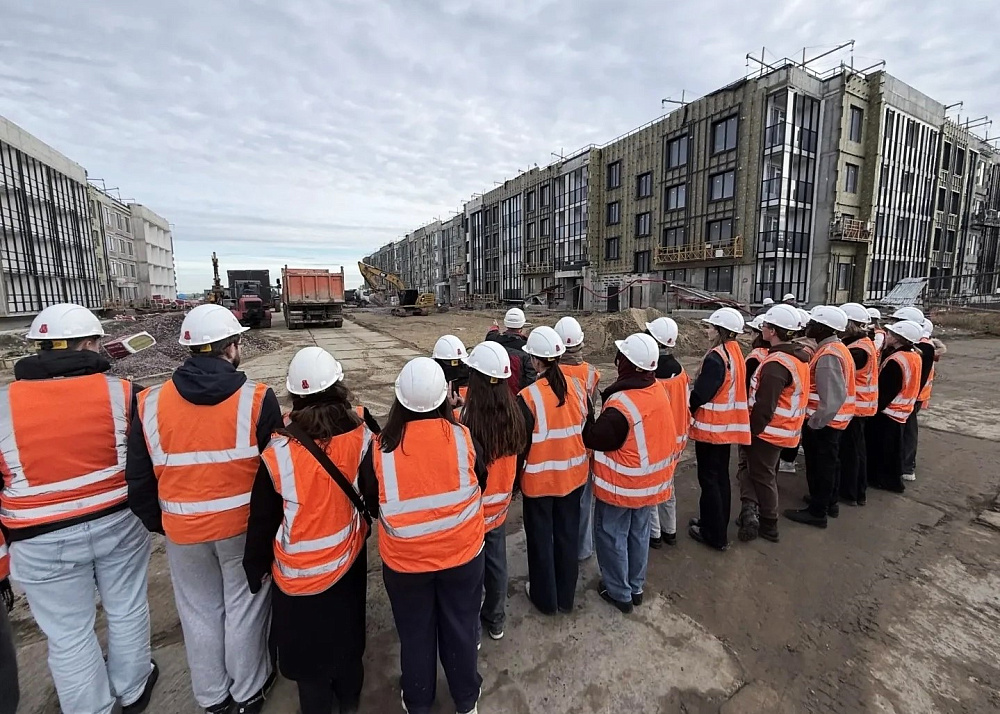
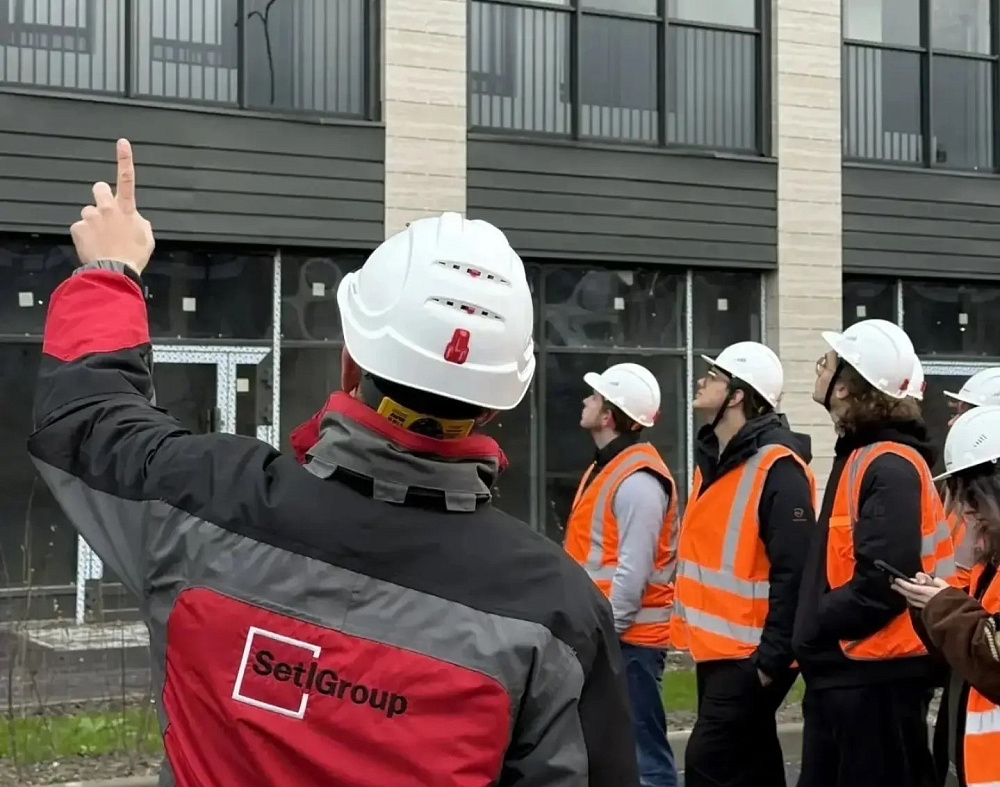
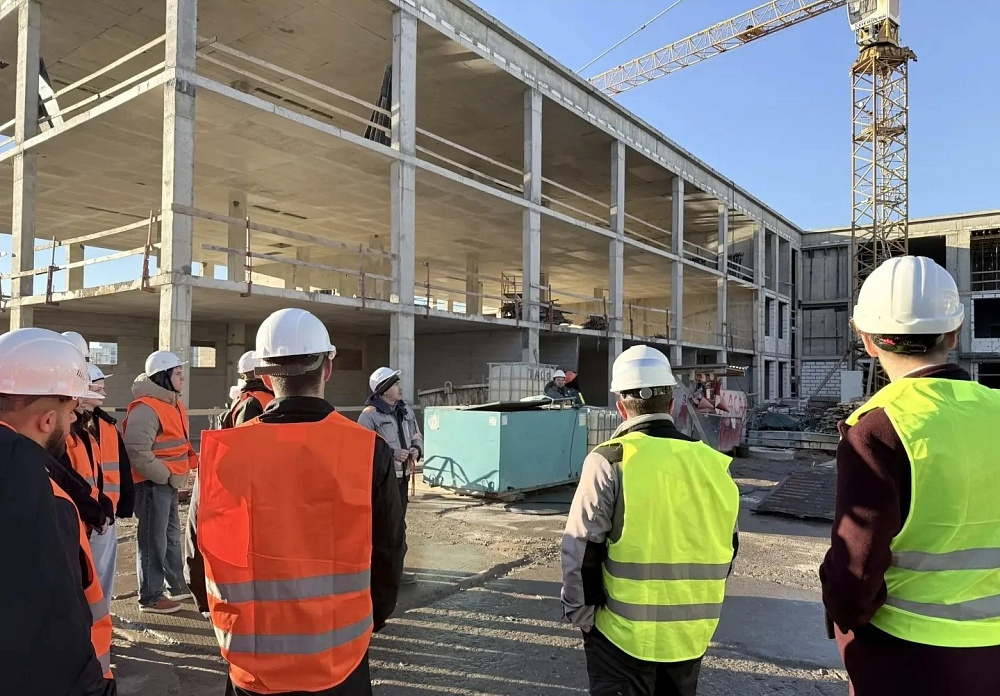
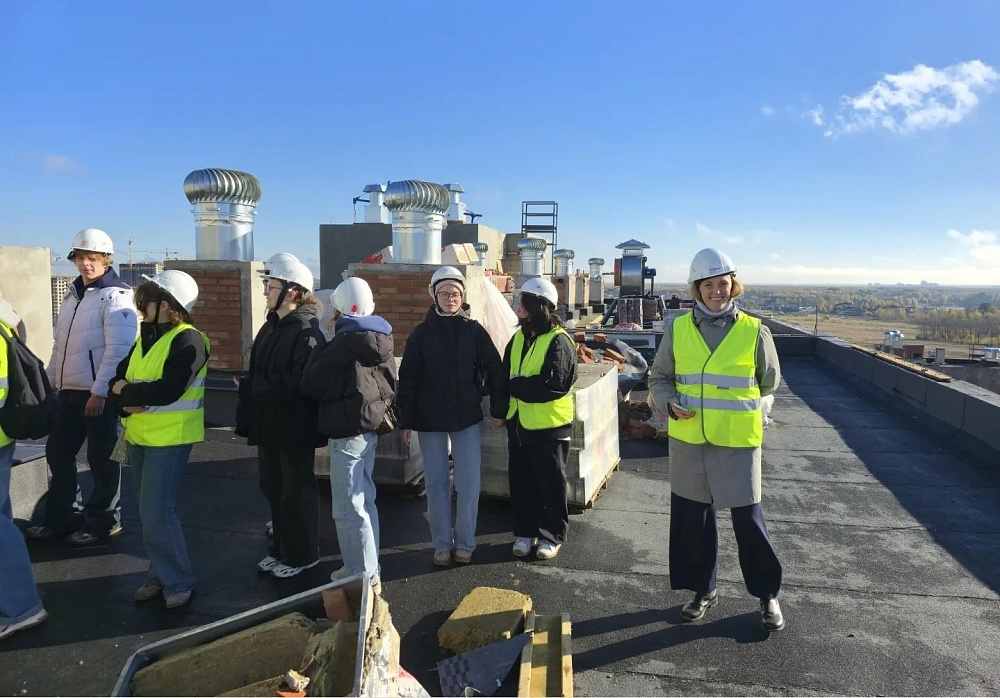
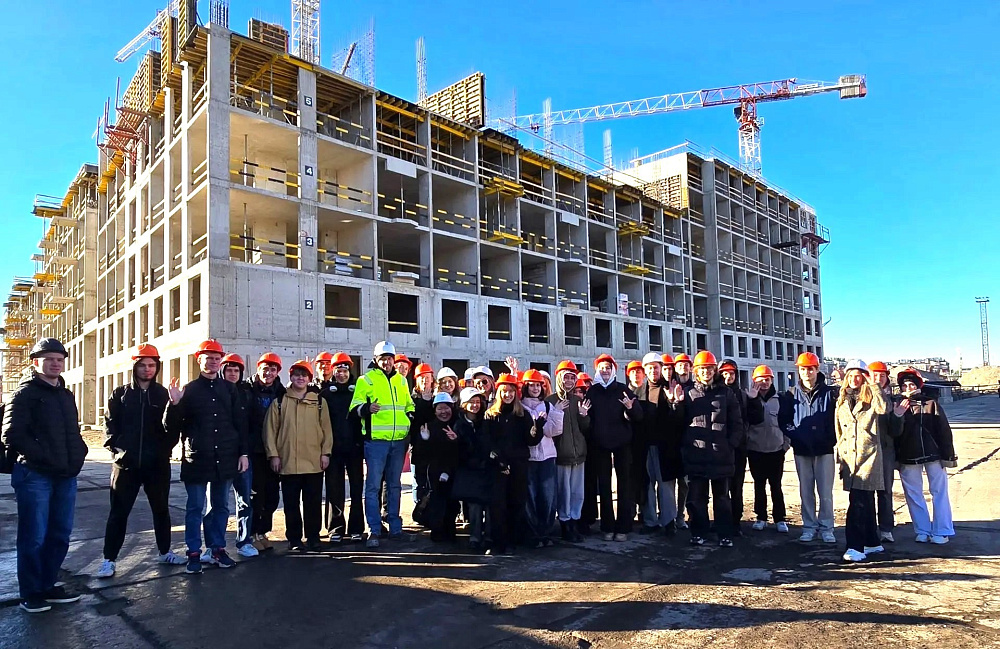
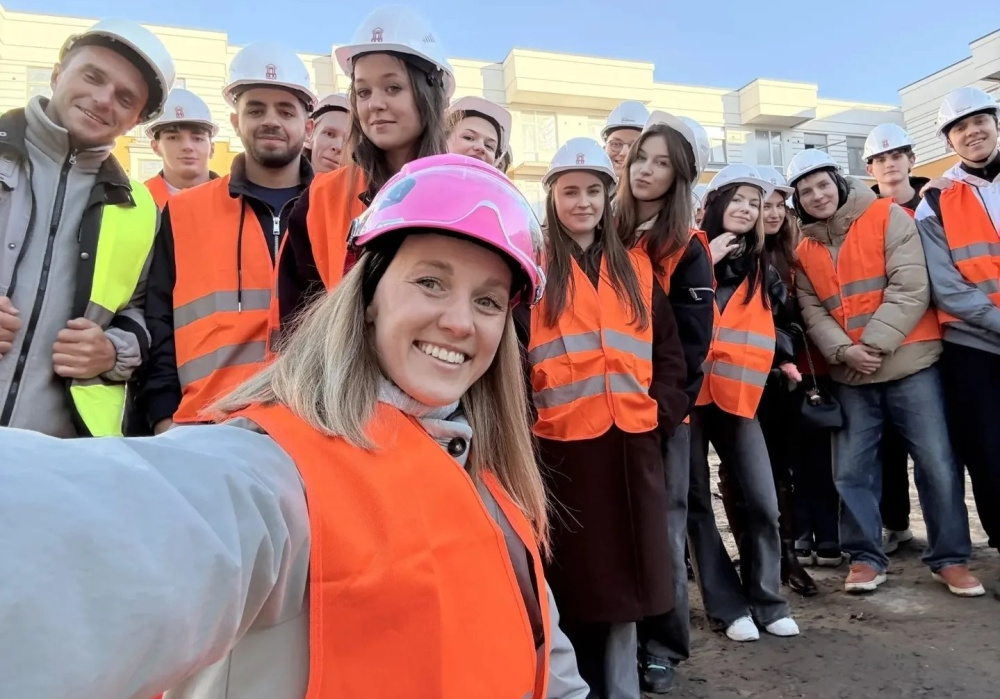
 Anna Tsarenko with students at the "Lyubograd" residential complex construction site
Students from the SPbGASU Faculty of Civil Engineering continue to familiarize themselves with modern technologies and the organization of construction processes. As part of their academic field trips, second-year students visited the construction sites of several residential complexes: "Dvortsovy Fasad," "Novaya Neva," "Univer City," "Lyubograd," and "Ostrov Pervykh." The future engineers observed various stages of building construction, examined technical solutions, and learned about the specific realities of working directly on construction sites.
From site preparation to a finished home
At the construction site of the "Dvorstsovy Fasad" (Palace Facade) residential complex, being developed by Setl Group, students were introduced to the initial stages of construction. They learned about site preparation and geological surveys, and observed the operation of machinery used for pile driving. Together with company representatives, the participants discussed the key phases of building construction—from the creation of the monolithic structural frame to the development of the building's architectural appearance.
Special attention was given to how the "palace facade" concept is implemented, and to the technologies that help combine architectural expressiveness with requirements for construction quality and timelines. Furthermore, the students visited sites nearing completion, where they could see the final results: landscaped courtyards, finished apartments, and the fully developed grounds of the residential complex.
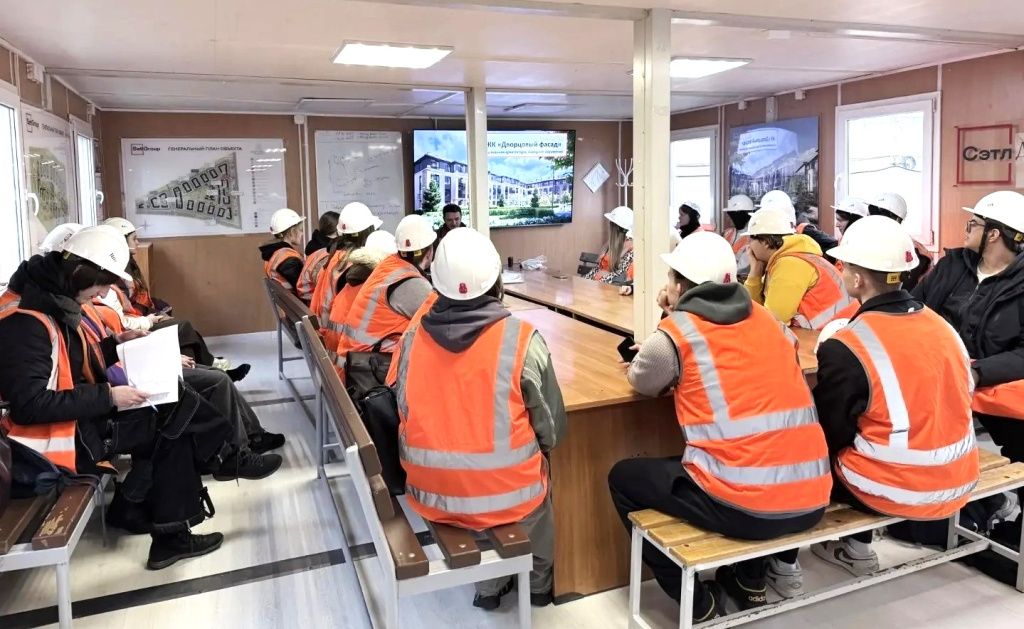 An introductory overview of the "Dvortsovy Fasad" residential complex
The tour was attended by Anna Tsarenko, Deputy Dean for Educational Work at the Faculty of Civil Engineering, and Veronika Bogatova, a personnel development manager at Setl Group. The organizers expressed their gratitude to construction managers Sergey Afanasenko and Aleksandr Sedyuk, as well as occupational health and safety specialist Elena Ruzhentseva, for their assistance in conducting the event.
Monolithic structures and dismantling of a tower crane
On 14 October, second-year bachelor's students visited the construction site of the "Novaya Neva" (New Neva) residential complex—a project by the Samolet Group—located near the village of Novosaratovka in the Vsevolozhsky District of the Leningrad Region.
At the site, the future professionals familiarized themselves with the construction of monolithic walls and floor slabs, as well as with facade, roofing, and interior finishing work. They also inspected two residential buildings and a school currently being built as part of the complex.
One of the most memorable moments was a visit to the roofs of the eighteen-story buildings currently under construction. The students made the ascent twice—once by elevator and once on foot via the stairs. Furthermore, the site visit coincided with the dismantling of a tower crane, which allowed the participants to observe the process firsthand and gain insight into yet another aspect of how construction operations are organized.
The tour was led by Anna Tsarenko. For the Faculty of Civil Engineering, this marked the first time such an event had been held at a construction site belonging to the developer "Samolet."
How the construction of a residential complex is organized
Another site for gaining practical insight into the profession was the "Univer City" residential complex, developed by Setl Group in Slavyanka, located in the Pushkinsky District of St Petersburg.
During the site visit, students from the Faculty of Civil Engineering examined the stages involved in constructing a monolithic frame, including formwork installation and reinforcement. They also observed the coordination between tower cranes, whose synchronized operation is essential for organizing construction processes across different areas of the site.
Of particular interest was the opportunity to compare the complex’s buildings, which were at different stages of construction. Since the construction of each subsequent building begins with a time lag of approximately three months relative to the previous one, the students were able to observe how the state of the structures evolved as work progressed.
Anna Tsarenko and Veronika Bogatova took part in the event. Thanks for organizing the tour were extended to construction manager Vladislav Samuylov, site manager Nikita Salomatin, and occupational health and safety specialist Natalya Popova.
Residential buildings and social infrastructure
Second-year students in the "Civil engineering" field of study, accompanied by Anna Tsarenko, visited the construction site of the "Lyubograd" residential complex, which is being built by the KVS company.
During the site visit, the future engineers were introduced to several construction processes taking place in parallel: they observed the erection of the structural frame for a school—part of the larger complex—as well as the operation of two tower cranes on the same site. Furthermore, the students saw how facade installation work was being carried out simultaneously with the interior finishing of the residential buildings.
Visiting the site allowed the students to observe how work is organized in different areas of the construction project and to learn about the construction of both residential buildings and a social facility within a single complex.
The organizers and participants of the tour thanked the administration of the KVS company for the opportunity to visit the construction site, as well as site manager Denis Kolmakov and construction supervisor Aleksey Karpov for organizing the event.
Engineering solutions for a premium-class property
As part of their career guidance training, students from the SPbGASU Faculty of Civil Engineering also visited the construction site of "Ostrov Pervykh" ("Island of the First"), a premium-class residential complex being developed by Fizika Development on Matisov Island in St Petersburg. The tour was attended by 39 third- and fourth-year students specializing in "Industrial and Civil Engineering."
The event was organized by senior lecturers at the Department of Construction Technology, Anastasia Bondar and Maria Kagan, while the tour was led by Timofey Drovalev, a construction manager at Fizika Development. He introduced the students to the production processes and the specific technological features of the project.
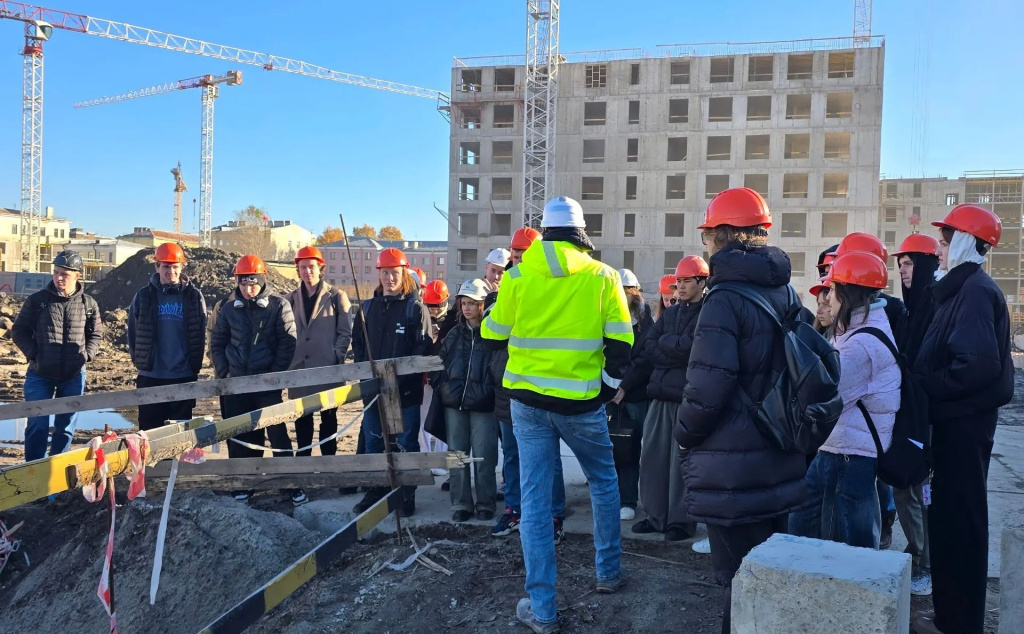 At the construction site of the "Ostrov Pervykh" residential complex
Future specialists studied the design of sheet pile walls and excavation shoring, the specifics of installing a tower crane on a pile foundation, and the organizational and technical solutions involved in integrating the crane into a parking garage slab. Particular attention was paid to PERI formwork systems and cold-weather concreting techniques, including the use of electrodes and heating wires to warm concrete structures.
One of the most interesting aspects of the site visit was an introduction to modular utility units (MUUs). This technology involves the off-site, factory-based fabrication of complete modules with integrated utility systems. Compared to traditional installation methods, the use of such units significantly accelerates construction and improves the building’s sound insulation. For the students, encountering this solution provided an opportunity to see modern engineering technologies being applied firsthand on a construction site.
Third-year student Ekaterina Tomilova shared her impressions of the tour: "The excursion offered a fresh perspective on familiar things, helping me realize just how much hard work, calculation, and behind-the-scenes processes go into an ordinary building. It was fascinating to see it all firsthand, rather than just studying the theory at university."
The organizers and participants of the tour thanked Timofey Drovalev for his detailed account of construction processes, his professional explanations, and his willingness to share practical experience with future specialists.
Visiting construction sites allows SPbGASU students to see how theoretical knowledge is applied in real-world conditions, become familiar with modern technologies, and gain a better understanding of the interconnections between the various stages of the construction process.