 Yury Tsvetkov
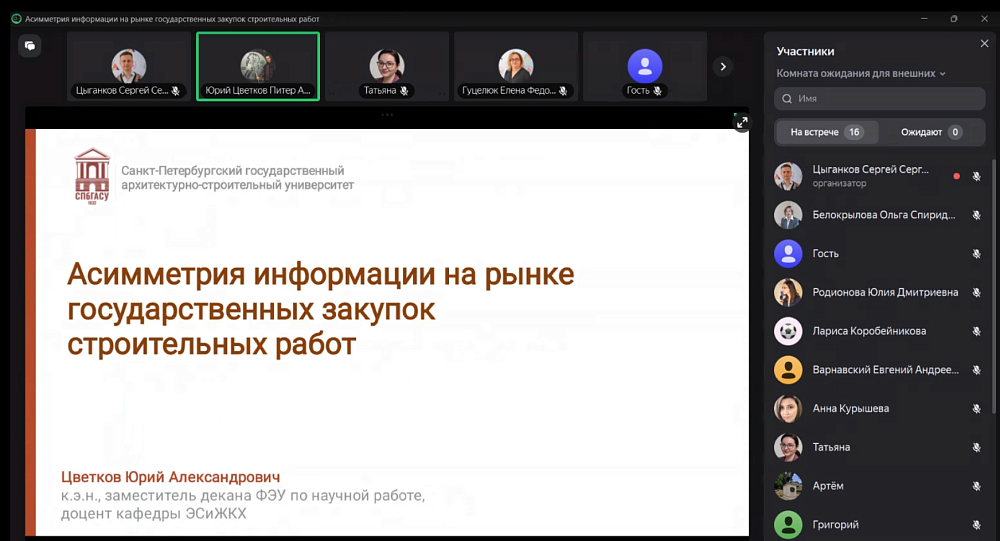
On 13 November, Yury Tsvetkov—PhD of Economic Sciences, Deputy Dean for Research at the SPbGASU Faculty of Economics and Management, Associate Professor at the Department of Construction Economics and Housing & Utility Infrastructure—participated in an ongoing all-Russian online seminar on public procurement. The seminar is organized by the Faculty of Economics at the Southern Federal University (SFedU). It regularly brings together representatives from the academic community, the real economy, and government authorities, as well as international scholars conducting research in the field of public procurement.
In his report, Yury Tsvetkov presented the findings of a study on the issue of information asymmetry in the market for public procurement of construction works. He highlighted key aspects of the uneven distribution of information among parties to contractual relationships—a situation that frequently creates risks during the contractor selection process and diminishes the efficiency of public procurement.
"In the construction industry, information asymmetry is particularly acute: clients often lack reliable data regarding the actual capabilities, financial stability, and professionalism of contractors. Statistical analysis shows that a significant portion of government construction contracts—up to 19.4% of the total—are terminated each year, while the number of unscrupulous suppliers remains consistently high," the expert noted.
Yury Tsvetkov’s study identifies three sets of issues: financial and staffing difficulties faced by contracting organizations, a shortage of qualified professionals and resources among public-sector clients, and flaws in the contract system itself.
To enhance the transparency and efficiency of procurement, it has been proposed to incorporate digital technologies and machine learning methods into the preliminary assessment of contractors, as well as to develop databases of reliable service providers and establish tailored requirements for bidders.
The presentation sparked interest among colleagues, and the proposed solutions could serve as a basis for further improving the public procurement system in the construction sector.