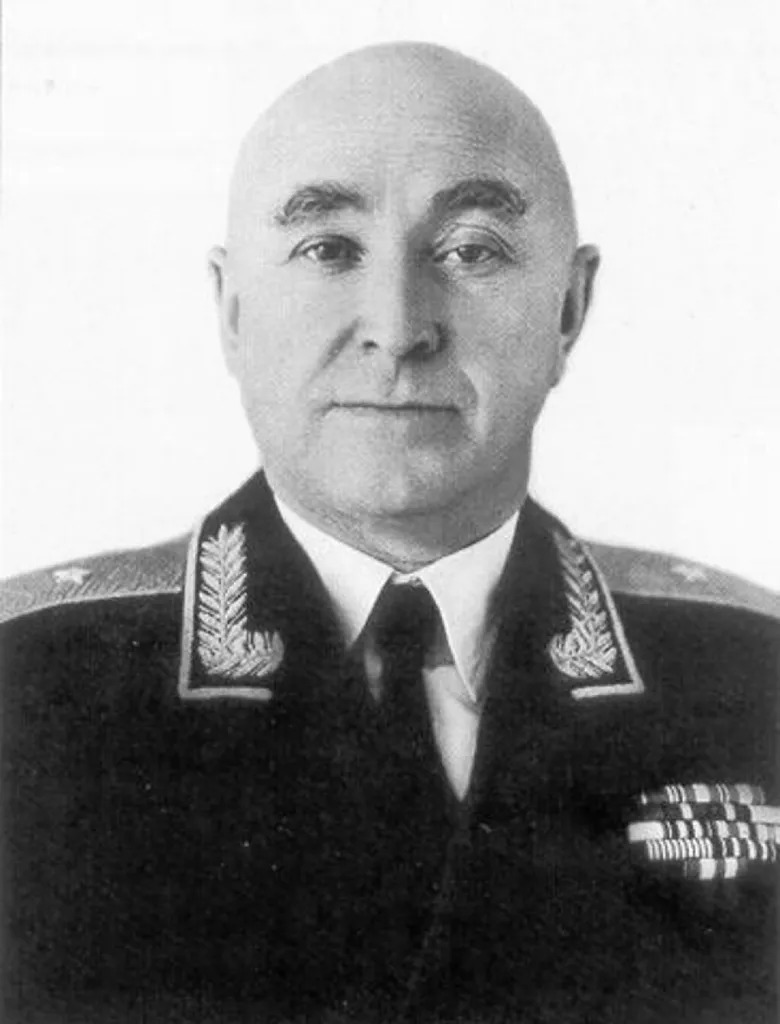
 Georgy Shubnikov
 Georgy Maksimovich Shubnikov (1903–1965), a graduate of the Leningrad Institute of Municipal Construction Engineers (now SPbGASU), fought in the engineering corps during the Great Patriotic War. He led the organization of river crossings in a number of key offensive operations. After the war, he contributed to space exploration.
Georgy Maksimovich was born on 1 May, 1903, in Essentuki. He gained his first experience in construction as a child: together with his father, he built a house for the family, of which he was very proud. After graduating from high school in 1920, he began working as a laborer, while attending evening classes at an architectural and construction technical school, and graduated in 1925. From 1925 to 1929, he served in the Red Army. After demobilization, he worked in construction companies in Essentuki and Pyatigorsk.
In 1930, Georgy Shubnikov enrolled in the Leningrad Institute of Municipal Construction (since 1931, the Leningrad Institute of Municipal Construction Engineers, now SPbGASU), graduating in 1932. In February 1932, he was conscripted into the Red Army for a second time by special mobilization and sent to the Transbaikal Military District. He served there until 1937, working as one of the construction managers for the Transbaikal Fortified Region, which was being built in the event of a Japanese invasion.
In 1937, Georgy Maksimovich was demobilized again and served as chief engineer of the Essentuki Vodokanal Directorate until June 1941. With the outbreak of the Great Patriotic War, he returned to the army and was appointed deputy commander of the 1682nd Separate Engineer Battalion of the 30th Engineer Brigade on the Southern Front, and in February 1942, he became the battalion commander. From the fall of 1941, the battalion was engaged in constructing defensive lines in the Stalingrad direction.
In 1942, Georgy Shubnikov was the head of the 12th Directorate of Military Field Construction in the 8th Engineer Army, participating in the defense of the Caucasus. From 1943 until Victory Day, Engineer Major Shubnikov headed the 12th Directorate of Military Field Construction, part of the 23rd Directorate of Defensive Works of the General Command Reserve.
The Directorate successfully carried out engineering support missions for offensive operations, including building crossings across the Dnieper. During the summer offensive of 1944, troops of the 1st Ukrainian Front, which included Major Shubnikov's construction directorate, reached the Vistula line and captured three bridgeheads on its western bank. Under enemy fire and bombing, Shubnikov's directorate constructed several bridges and floating crossings across these bridgeheads. In 1945, Georgy Shubnikov built bridges across the Oder and was responsible for road construction and mine clearance in the front's offensive zone. He celebrated victory with the rank of engineer lieutenant colonel.
From 1946 to 1949, Georgy Shubnikov was the head of the 23rd Directorate of Military Field Construction and oversaw the restoration of bridges and industrial plants in Germany and Poland. He also oversaw the construction of a number of significant public buildings in Berlin and monuments to Soviet soldiers, including the famous monument to the Liberator Soldier in Treptower Park.
In the late 1940s, Georgy Maksimovich's command was working to restore mines in the Donbass. It was then that they were entrusted with a completely new task: the unit was urgently transferred to the village of Kapustin Yar in the Astrakhan region to participate in the construction of the first Soviet ballistic missile testing site. Space launches were later conducted from here.
From there, Georgy Shubnikov briefly went to Azerbaijan to build a defense complex. But soon, the Soviet government set itself an ambitious goal: the conquest of space. Thus began Georgy Maksimovich's final and most ambitious undertaking: the construction of the Baikonur Cosmodrome.
In March 1955, Georgy Shubnikov arrived at the Tyuratam station in Kazakhstan. Construction of the future Baikonur Cosmodrome was beginning there. Georgy Maksimovich's successful management of this massive construction project played a crucial role in the launch of the first artificial satellite in human history on 4 October, 1957.
Georgy Maksimovich's work didn't end there. He continued to oversee subsequent stages of construction, including the building of auxiliary buildings, utilities, and roads. In 1961, Georgy Maksimovich Shubnikov was among those who saw Yuri Gagarin off into space.
Other materials of the "Scientific Regiment" project
Our Graduate Built the Road of Life
Front Line of the Architect Aleksandr Nikolsky
Researcher who Developed Science in Besieged Leningrad
Fights of Student Klinov
Engineer of the 3rd Belorussian Front
Nineteen-Year-Old Gunner Stormed Berlin
Path of a Volunteer: from Front-Line Roads to Space Development
Ivan Solomakhin: "The Most Memorable Battle was for this Devil's Hill!"
Fiery Dnieper of the Hero of the Soviet Union Aleksandr Prygunov
Approaching to the Victory
Fedor Komal's Front: from the War Start to the Victory
Junior Political Instructor Boris Gubanov: “Shells Were Whizzing, and the Ground Took off Nearby”
Viktor Kvyatkovsky, Radio Reconnaissance Operator of the Baltic Fleet
How the Chief Architect Nikolai Baranov Kept Leningrad "Hidden" from the Enemy
Architect Nikolai Khomutetsky: Four Years at the Forefront
Semyon Shifrin Thwarted Nazi Plans to Leave Leningrad Waterless
LISI in the Post-War Years
LISI Graduate Mikhail Zherbin, Design Engineer and Composer
Abdulla Mangushev: Four Years at the Front and the Whole Life in Science
Architects Zazerskys Built and Defended the City on the Neva River
Worked His Way Up From a Lieutenant Technician to the Galaxy of Mathematicians
Konstantin Sakhnovsky: From Cadet Of the Russian Empire to Academician of the USSR
Military Architect Of The Front Line Defense And Engineering Intelligence
World-famous scientist, outstanding engineer and national champion
An Outstanding Urban Planner Who Lived And Worked In Besieged Leningrad
Projects by Architect Sergey Evdokimov: from Defensive Structures and City Restoration to Metro Stations
Volunteer Mikhail Laletin: “After the front – to the university, and then, perhaps, to become an officer”
Architect Aleksandr Sokolov preserved and restored cultural heritage
David Goldgor, The Architect And The Sapper
Tamara Smirnova: LISI First-Year Student And The Intelligence Officer