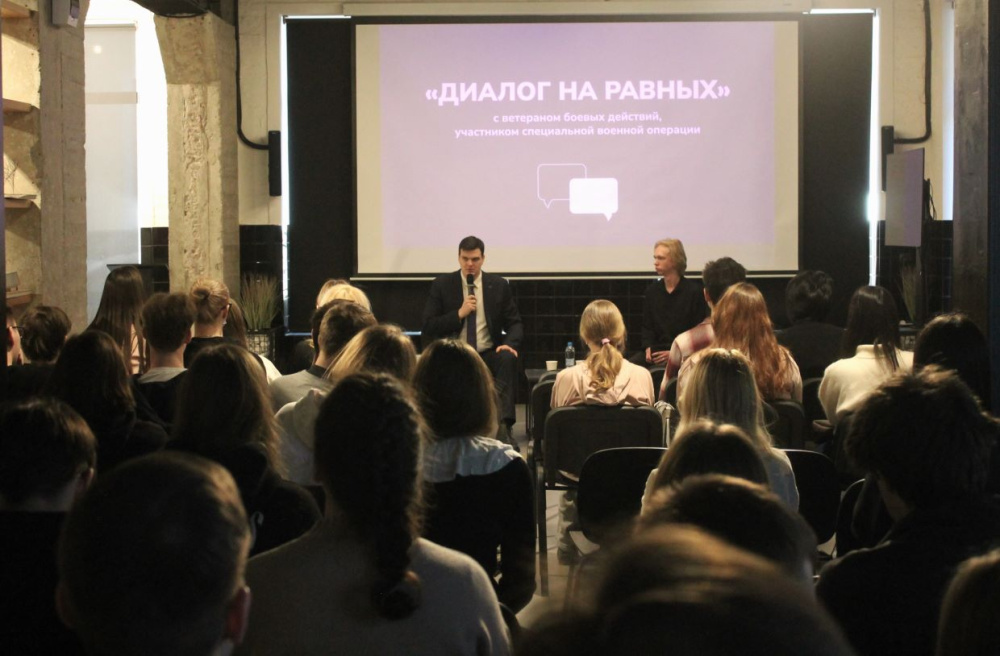
On 25 February, the "Growth Point" educational space of the St Petersburg State University of Architecture and Civil Engineering held a meeting "Dialogue on Equal Terms" with combat veteran, participant in a special military operation, and first deputy coordinator of the St Petersburg regional branch of the Liberal Democratic Party of Russia, Ivan Esipov.
The dialogue was frank, emotional, and largely personal. The students asked questions about service to their country, humanitarian aid, modern technology, and choosing a life path.
"The most important thing is to care"
Answering the question of how one can serve the Motherland on the home front, the guest emphasized that such service begins with personal responsibility: "Being a worthy citizen of your Motherland. For a student, this means studying well, striving to do something for the country, participating, and helping to the best of your ability. The most important thing is not to let your heart burn out."
Ivan Esipov recalled the civilian mobilization during the siege of Leningrad and the first cleanup day in the spring of 1942, when exhausted residents came out to clean the city streets. He said that even in the most difficult periods of history, people were united by a sense of belonging. "Fear the indifferent: all the evil on Earth happens with their silent consent," he added.
Humanitarian aid: from household items to high technology
The students were interested in what kind of aid is most in demand today. According to the guest, this ranges from simple supplies—hygiene products, bandages, and warm clothing—to more complex equipment.
"Aid comes in different forms. There are everyday consumables. And then there are expensive items—drones, communications equipment, especially digital radios. If you help, it's best to be targeted, understanding the needs of a specific unit," said Ivan Esipov, noting that volunteer work requires compassion and a willingness to endure emotional strain.
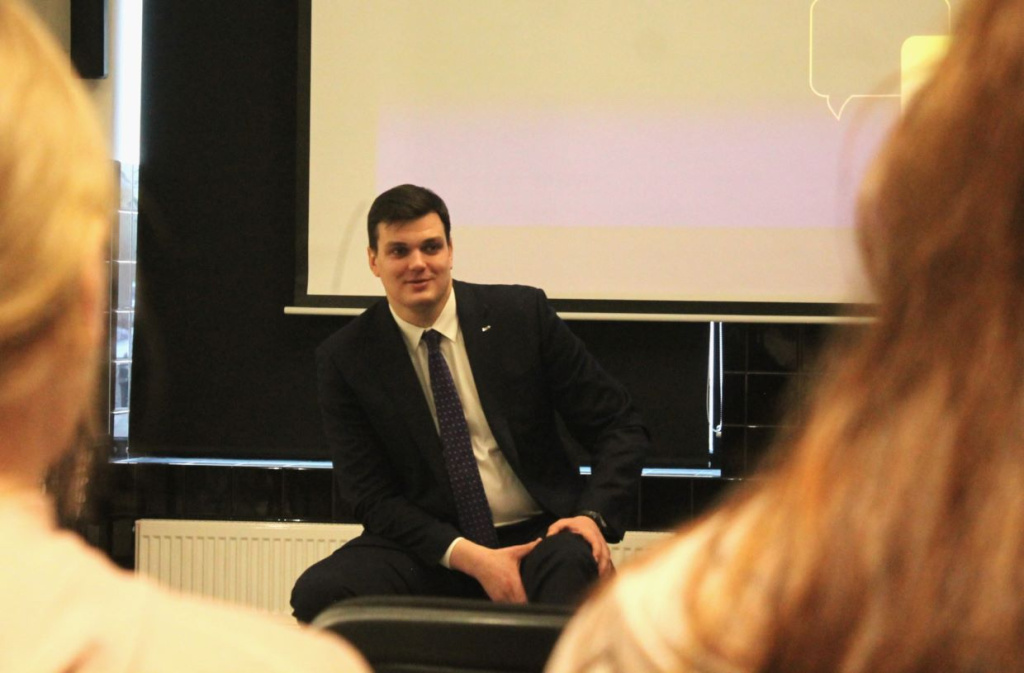 Ivan Esipov
Technologies that change reality
A separate section of the discussion was devoted to unmanned aerial vehicles. Ivan Esipov emphasized that the development of UAVs has significantly changed the nature of combat: "War today is largely a system and a mathematical process. Thanks to drones, we can see movements, we can see locations, tactics change, and depth changes. It's a completely different reality."
According to him, the operators' work requires high concentration, technical training, and responsibility. The system is evolving rapidly, and new challenges and new competencies are emerging.
For SPbGASU students, the topic of unmanned technologies is especially relevant: the Russian Armed Forces offer students the opportunity to serve in the unmanned systems forces under a special annual contract. The service includes mandatory training in the UAV specialist training program within the Russian Ministry of Defense's training network.
Over the course of a year of service (including the training period), students can earn over 7 million rubles. Of this, 4.5 million is a one-time payment upon enrollment. Such conditions for joining the unmanned forces are unique to St Petersburg.
Learn more about the program and how to participate on the SPbGASU website.
"Modern technologies open up broad professional opportunities both in the civilian sector and in high-tech solutions that require engineering thinking and accuracy," noted Ivan Esipov.
"Fear is inevitable – the important thing is not to break down"
Answering a question about his service, Ivan Esipov said frankly: "Fear will always be there. That's normal. But the worst thing is to break down. You need to think about your comrades, about those around you. Then the fear becomes manageable."
He shared a personal story about restoring field communications under fire and emphasized: "We must always remember: there is a way out of any situation. Even the most impossible."
Loyalty story
The story of a dog the soldiers found at their position was especially touching.
The dog joined the unit, survived the winter with the soldiers, and was then sent to St Petersburg. It was the dog who welcomed Ivan Esipov home after being wounded and hospitalized,. "He saw me—and it was such a joy... We don't have children now, but we have a dog. And that, too, is responsibility and love." A video of this meeting, according to the speaker, later went viral on social media and has gained tens of thousands of views.
"The glass is always half full"
In closing, Ivan Esipov addressed the students: "No matter how difficult it is, think positively. The glass is always half full. Try not to lie to yourself and be better. And love your homeland: it is only one, there will be no other."
At the end of the meeting, students were able to ask questions about teamwork, technology, personal choice, and civic engagement. The event gave students the opportunity to discuss complex topics honestly and informally and reflect on their role in a changing world.
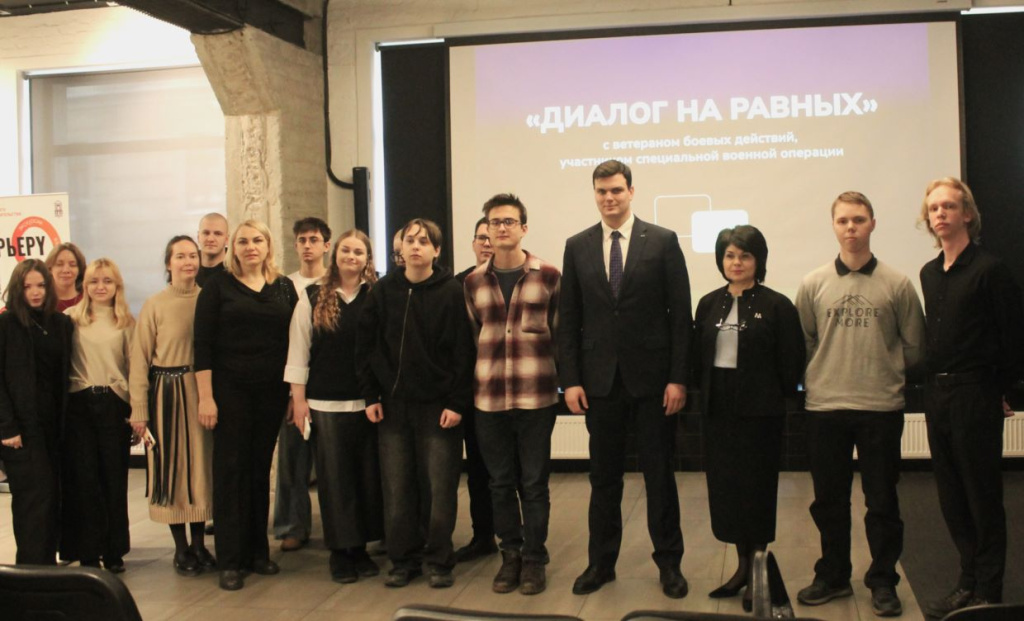 Participants of the "Dialogue on Equal Terms"