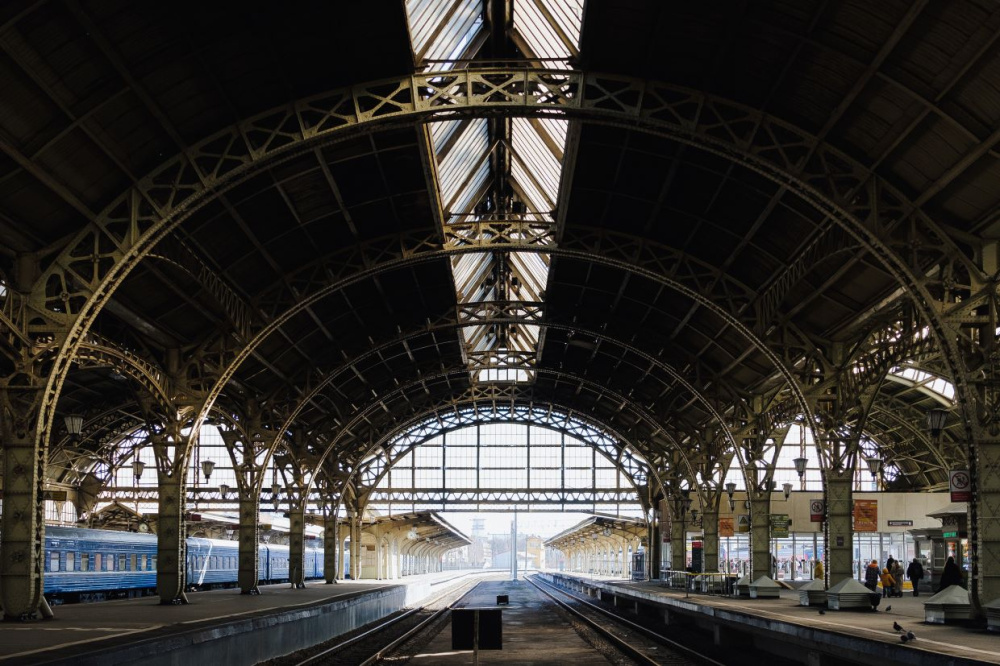
 Vitebsk Station, St Petersburg. Designed by architect S.A. Brzhozovsky with the assistance of civil engineer S.I. Minash. 1904
The Saint Petersburg State University of Architecture and Civil Engineering continues to develop educational programs in architectural heritage preservation. Beginning 1 September, 2026, a new program, "Restoration of Buildings and Structures", will be launched within the field of study "Civil engineering". Its goal is to train in-demand restoration engineers.
This work is being carried out as part of improving the higher education model and implementing the state program "Preservation of cultural heritage sites of the peoples of the Russian Federation" for 2025–2045. The educational program is being developed in close collaboration with industry partners.
Responding to the challenges of time
Today, the restoration industry is actively developing, with major programs to preserve historic buildings being implemented. However, a shortage of qualified specialists remains. SPbGASU, as one of the key training centers for the construction and restoration industries, offers a systemic solution to this problem.
Aleksey Mikhailov, Chairman of the Committee for State Control, Use, and Protection of Historical and Cultural Monuments of St Petersburg, noted the significance of the university's contribution: "SPbGASU is one of the main training grounds for specialists in the restoration field. Certainly, for St Petersburg, a city with a rich cultural heritage, issues of restoration quality and the training of highly qualified specialists are extremely pressing. It is important to adapt promptly to changes and develop educational programs."
Interdisciplinary approach
The new program reflects the current trend toward integrating architectural and engineering education. As Andrey Nikulin, Dean of the Faculty of Civil Engineering, emphasized, the program would integrate a unified social and humanities component and a block of fundamental professional disciplines in the first years of study, which would allow for a comprehensive understanding of the profession.
The new educational model will place particular emphasis on engineering training for restorers, including the study of theoretical mechanics and the principles of structural operation.
Andrey Nikulin notes that in practice, situations often arise where architectural solutions fail to take into account engineering constraints.
"A beautiful architectural design may fail to take into account basic engineering principles. Combining training will help avoid such problems and improve the quality of design. Historically, our university, the Institute of Civil Engineers, has always combined engineering, construction, and architecture in its educational programs. Thanks to this approach, our graduates have become versatile urban planners, and as a result of their work, we today have the unique historical St Petersburg we love and admire. Now the time has come to preserve it and restore it properly," the dean asserted.
Practice-oriented learning
Within the new program, students will study a wide range of disciplines – from the history and methodology of restoration to modern building survey technologies, materials science, and the engineering protection of cultural heritage sites.
The training includes:
- working with real architectural heritage sites;
- mastering information modeling technologies (TIM);
- studying modern restoration materials and solutions;
- developing skills for comprehensive building surveys.
Graduates will be able to work in design studios, restoration and construction companies, as well as in government agencies involved in urban development and the protection of historical and cultural monuments.
Consortium as a growth point
The development of the new direction is closely linked to the creation of the "Preservation of Architectural Heritage" consortium, an agreement on which was signed on 24 March at the VI National (All-Russian) scientific and practical conference with international participation "Reconstruction and Restoration of Architectural Heritage", held at SPbGASU.
The consortium brings together representatives from science, education, government and business and aims at:
- development of scientific research;
- implementation of innovative technologies;
- improvement of educational programs;
- training of highly qualified personnel.
SPbGASU Rector Evgeny Rybnov emphasized: "Today, we are creating a unified platform for interaction between government, science, and business. This will allow us to build a sustainable system for preserving architectural heritage."
Development prospects
The launch of the new profile is seen as the first step towards the further development of the educational model, including a possible transition to a five-year specialist degree and deepening interdisciplinary training.
The university is confident that the combined efforts of the professional community, educational organizations, and government agencies will elevate the training of restoration specialists to a qualitatively new level and ensure the preservation of Russia's unique architectural heritage.
Recruitment of applicants for the "Restoration of Buildings and Structures" profile within the "Civil engineering" training program begins in 2026. Applicants are provided with 50 budget-funded places and 70 places under a contract.