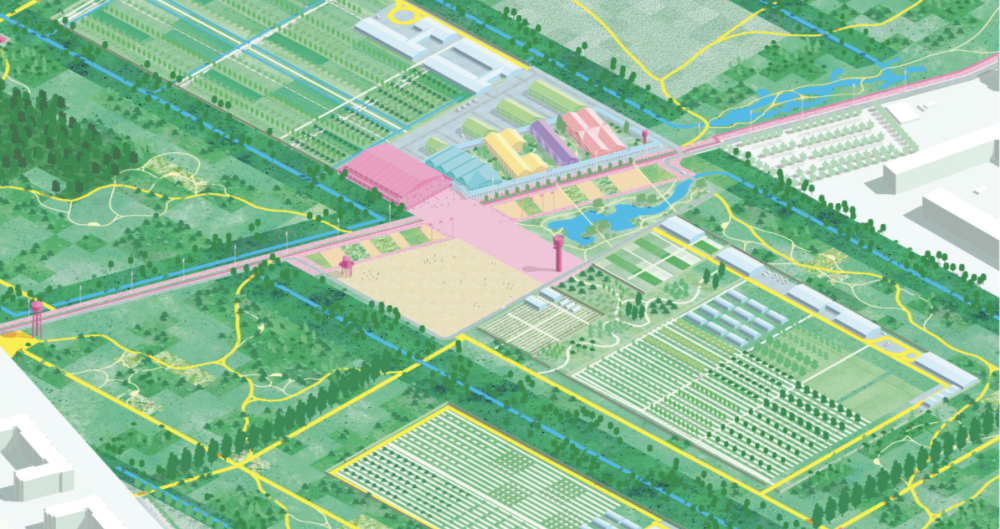
 From the project by Bogdan Lobanov and Daria Manakova, "Landscape organization of the territory of a former field between the towns of Murino and Bugry, Leningrad Region"
The Department of Landscape Architecture at the Saint Petersburg State University of Architecture and Civil Engineering emerged as one of the leaders at the XXXV International Review-Competition organized by the Interregional Public Organization for the Promotion of Architectural Education (MOOSAO) in Kazan. The department secured the highest number of first-degree diplomas among all participating Russian universities in the "Landscape Architecture" (bachelor’s degree) category. These outstanding results achieved by the students attest to the high professional standard of training provided to future landscape architects, as well as the relevance of the department’s research and design methodologies.
In Kazan, the SPbGASU students' works were presented by Aleksandr Demin, Head of the Department of Landscape Architecture, and Svetlana Bochkareva, an Associate Professor at the same department and the university’s chief architect. Furthermore, over the course of several days, representatives from the department served as experts at the exhibition-competition, reviewed projects from other universities, and took part in professional discussions regarding current issues in architectural and landscape education.
From urban fields to ecological rehabilitation: the current agenda in landscape architecture
One of the leading entries in the competition category was the project "Landscape organization of the former field between the towns of Murino and Bugry, Leningrad Region," developed by Bogdan Lobanov and Daria Manakova under the guidance of Senior Lecturer Elena Kutaliya and Associate Professor Irina Shkolnikova.
The project proposes an alternative development model for the 172-hectare Bugrovskoye Field, located within an area of intense urbanization in the St Petersburg metropolitan region. Instead of continuous residential development, the authors suggest creating a multifunctional landscape that integrates public park space, agricultural fields, a tree nursery, and conservation zones. The concept is rooted in preserving established local pathways, supporting biodiversity, and making careful, sustainable use of the site’s existing natural potential.
The work presents an innovative perspective on the role of landscape architecture in the development of modern urban areas, where natural and agricultural lands can become an integral part of public infrastructure.
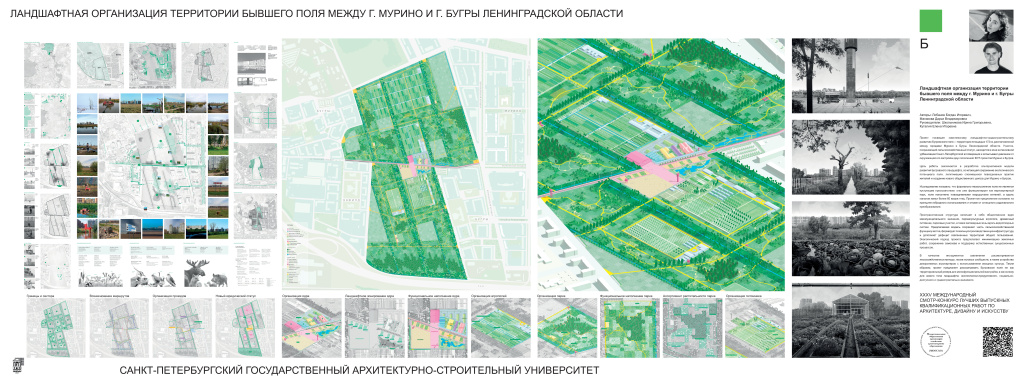 A project by Bogdan Lobanov and Daria Manakova: "Landscape organization of the territory of a former field between the towns of Murino and Bugry, Leningrad Region"
The project “Renovation of the city park in Termez”, authored by Elizaveta Kirilina, headed by Associate Professor at the department Svetlana Bochkareva, also aroused the interest of the professional community.
A key design decision was the creation of a unified natural-recreational framework featuring a flexible, seasonal water system. A central water body and a network of channels form a striking spatial composition; they provide an additional cooling effect during hot weather, while in the colder season, they transform into pathways reminiscent of "dry streambeds." The landscape concept includes the preservation of existing tree groves and the integration of traditional national ornamental motifs into the structure of the formal garden.
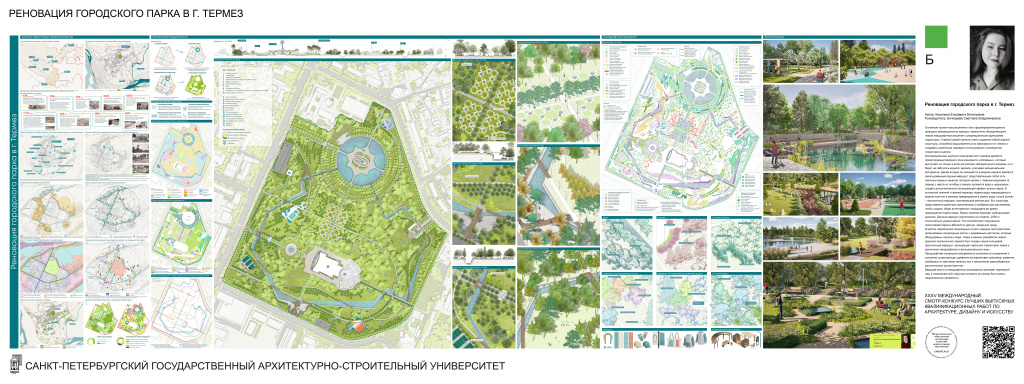 Elizaveta Kirilina’s project “Renovation of the city park in Termez”
A project titled "Landscape organization of a recreational and tourist natural area in Syktyvkar, Komi Republic"—developed by Alina Ziben under the supervision of department Assistant Pavel Ostapchuk—became a focal point of professional discussion.
The project aims to integrate the natural landscape with the urban environment by creating a multifunctional recreational and tourism cluster. Particular attention is given to establishing connections between Syktyvkar’s main urban axis, the railway station square, and the adjacent forest area, as well as to revealing the natural identity of this northern city.
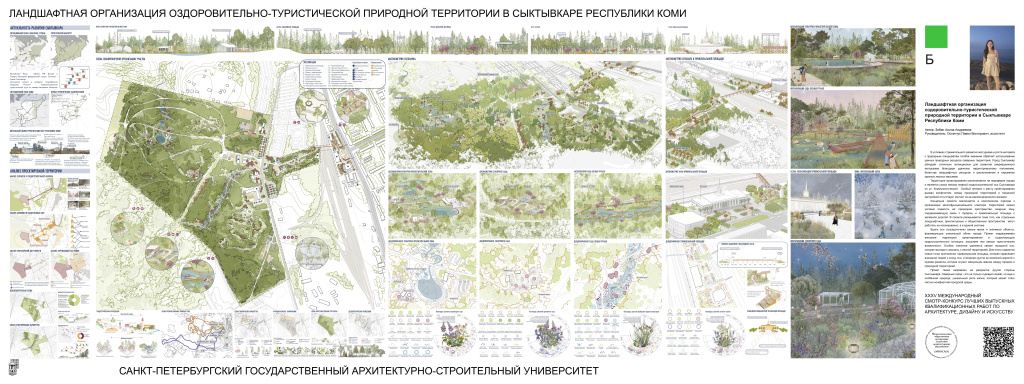 Alina Ziben’s project: “Landscape organization of a recreational and tourist natural area in Syktyvkar, Komi Republic”
Among the winners is the project "Comprehensive landscape organization of areas along the Krasnenkaya river in St Petersburg," authored by Polina Serednyakova under the supervision of Senior Lecturer Elena Bogomaz.
The "Voilé" (Veil) park concept proposes integrating ecological restoration with contemporary leisure activities across a 41-hectare site. The project’s central motif is a "green veil"—a landscape buffer designed to provide protection between residential areas and the industrial zone. A system comprising eight types of "bioplateaus" facilitates natural water purification, while a network of nature trails, walking paths, and recreational spaces allows the site’s natural potential to unfold without requiring radical alterations to the existing landscape.
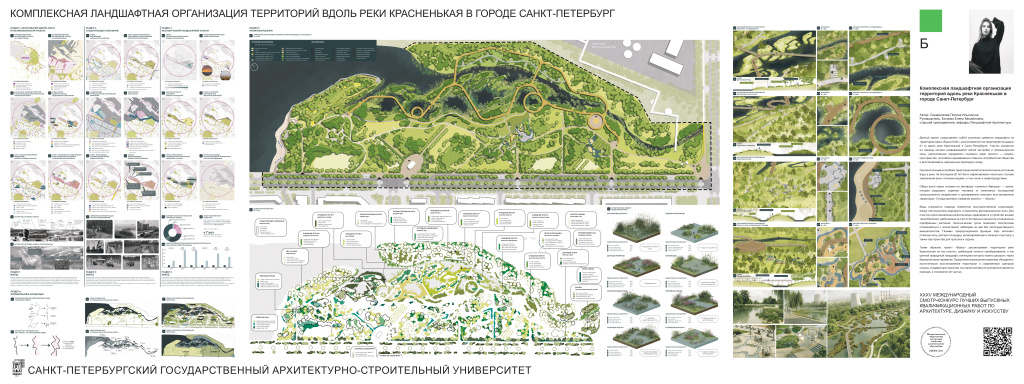 Polina Serednyakova’s project: “Comprehensive landscape organization of areas along the Krasnenkaya river in St Petersburg”
Overall strategy – diverse territories, a unified professional approach
The works presented here reflect several consistent areas of design activity within the SPbGASU Department of Landscape Architecture.
One of these approaches involves reimagining former state-farm fields and agricultural land within the framework of new residential districts. Such areas are viewed not merely as a reserve for development, but as a foundation for creating new agrarian parks, public spaces, and ecologically productive urban landscapes.
A second area of focus involves the renovation and reconstruction of parks dating from the Soviet era. These projects entail a rethinking of existing spatial layouts and a gradual departure from outdated compositional models—characterized by a rigid, formal organization of the environment, excessive symmetry, a predominance of hard surfacing, the use of obsolete small-scale architectural forms, and poor-quality landscaping. At the same time, efforts are underway to identify modern approaches for integrating these areas into the city’s green infrastructure, while enhancing their ecological resilience, functional diversity, and social relevance.
A third area of focus is the landscape organization of territories located within sanitary-protection zones and in the vicinity of major engineering facilities, including combined heat and power plants. In these contexts, ecological rehabilitation, the creation of protective green infrastructure, and the enhancement of the urban environment take on particular importance.
What these approaches have in common is the endeavor to view landscape architecture as a tool for integrated territorial development—one capable of simultaneously addressing social, environmental, and urban-planning challenges.
First-degree diplomas: awarded not only for projects, but also for educational literature
A significant outcome of SPbGASU’s participation in the XXXV International Review-Competition was the recognition of the scholarly and methodological work produced by the university’s faculty. Within the framework of the competition for academic and educational literature in the fields of architecture, design, and art, two textbooks authored by Svetlana Bochkareva and Aleksandr Demin were awarded first-degree diplomas:
- "Designing a comfortable environment for public spaces in small towns and settlements. Pre-design analysis. Section 1: Justification for site selection and project demand";
- "Designing a comfortable environment for public spaces in small towns and settlements. Pre-design analysis. Section 2: Analysis of the existing situation. Preparation of the 'Pre-design Analysis' document."
The textbooks sparked professional interest among representatives from the V. G. Shukhov Belgorod State Technological University and Komsomolsk-on-Amur State University (KnASU). The authors shared their methodological resources with their colleagues for potential use in the educational process—specifically, in teaching the course "Pre-project analysis."
According to Svetlana Bochkaryova, the professional exchange of teaching and methodological materials creates additional opportunities for inter-university cooperation and the dissemination of effective educational practices. The Interregional Public Organization for the Promotion of Architectural Education (MOOSAO) considers the exchange of effective teaching methodologies to be one of its primary objectives. The expertise of leading universities should be promoted and utilized by regional schools of architecture to enhance the quality of education. Familiarity with modern pre-design research methodologies enables teachers and students to approach the study of a site systematically, provide well-founded justifications for design decisions, and place greater emphasis on the analytical components of competition entries. Such an approach contributes to improving the quality of architectural and landscape education and fostering a unified professional design culture.
Victory as the result of systematic work
The results of the 2026 MOOSAO competition served as a significant confirmation of the professional potential of the SPbGASU Faculty of Architecture.
The success of students in the "Landscape Architecture" project category, combined with the recognition of the teaching and methodological materials developed by faculty members, demonstrates that the department is advancing two interconnected objectives: training competitive professionals and refining educational tools that address the current needs of the industry.
For SPbGASU, participation in the international review-competition is not only an opportunity to showcase the best student works, but also a platform for professional dialogue, the exchange of experience, and the development of cooperation with the country’s leading architectural schools.
Kazan is a symbolic setting for a professional dialogue about the future of landscape architecture
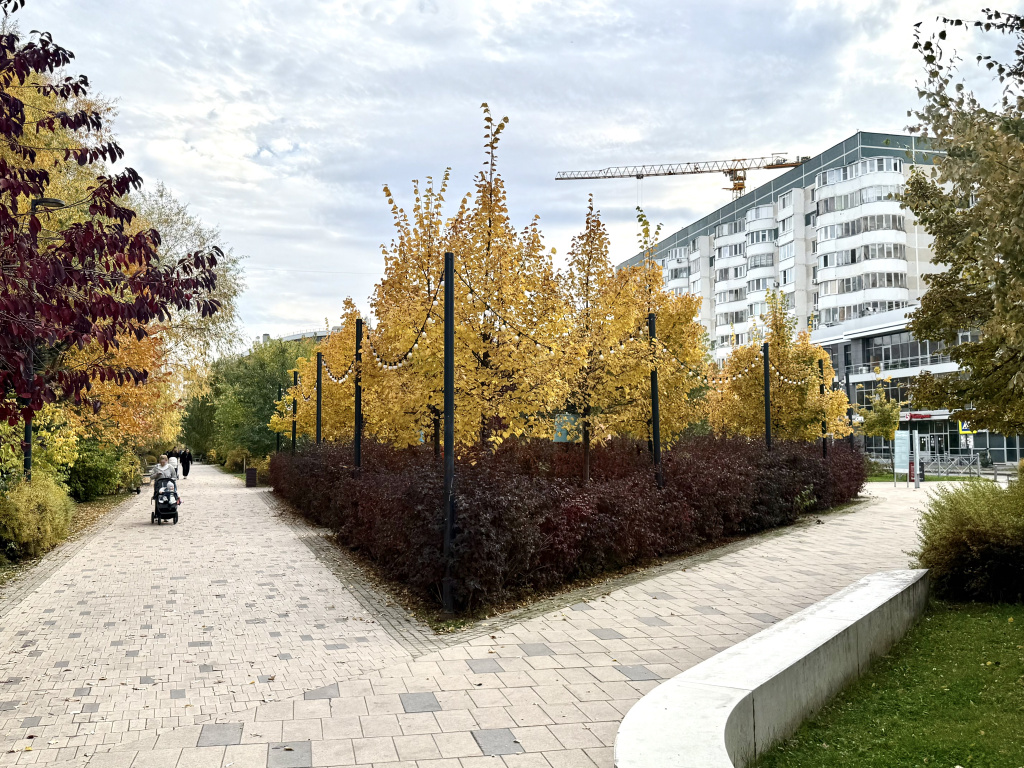 Kazan. "White Flowers" Boulevard
It was here, in 2017, that projects aimed at transforming public spaces—now iconic for modern-day Russia—began to take shape. These include the "White Flowers" Boulevard, the embankment of Lake Kaban, and other areas that have since become benchmarks for the high-quality renewal of the urban environment. During the initial years of the federal competition for "Small Towns and Historical Settlements"—organized by the Russian Ministry of Construction—Kazan and the Republic of Tatarstan achieved outstanding results, presenting a number of striking, winning projects and establishing significant standards for the development of public spaces in Russian cities.
In this regard, the hosting of professional competitions, exhibitions, and educational events in Kazan takes on particular significance. Such platforms not only showcase best design practices but also help shape the professional agenda, facilitate the exchange of experience among architectural schools, and foster discussion on new approaches to working with landscapes and public spaces. For students and teachers, this offers an opportunity to see how design concepts are transformed into tangible urban changes; for the professional community, it serves as a vital tool for advancing the field and enhancing the quality of architectural and landscape education.
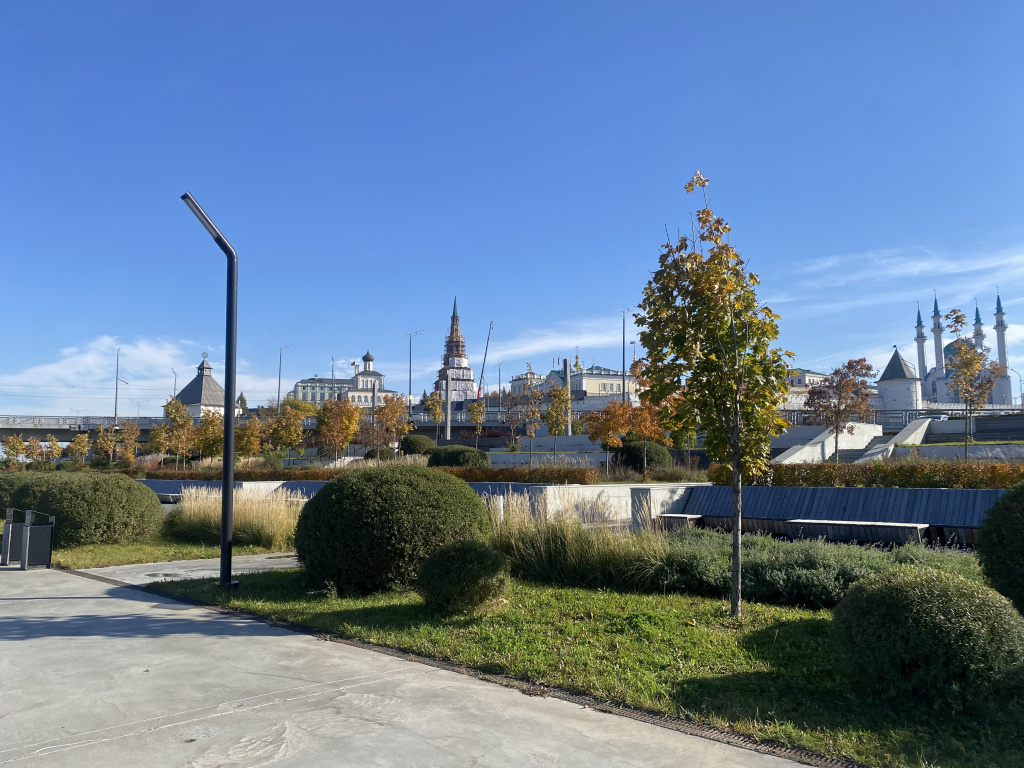 Kazan. View of the Kremlin from the Kremlin Embankment
Read about the achievements of graduates from the Department of Architectural Environment Design at the XXXV International Review-Competition (MOOSAO 2026) in Kazan in the article "Graduation Projects from the Department of Architectural Environment Design Recognized at an International Competition."