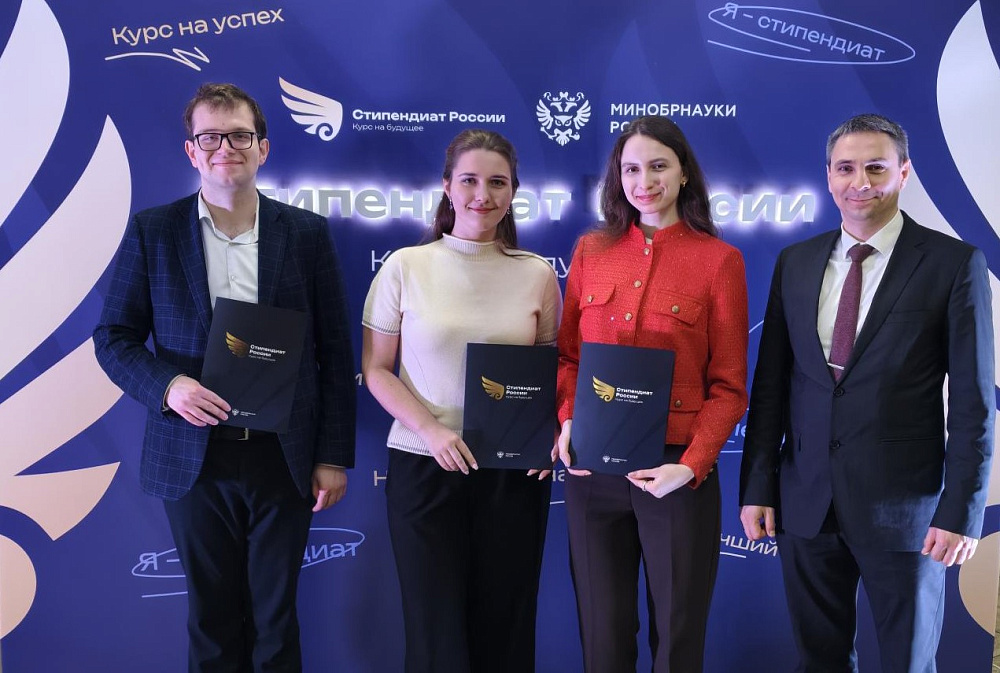
 Scholarship recipients from the Faculty of Civil Engineering at the Russian Government Scholarship Awards Ceremony: Oleg Yatskovets, Ekaterina Buryak, and Zlata Zolotykh. Dean Andrey Nikulin is on the right.
Oleg Yatskovets, a sixth-year specialist's student in the SPbGASU Department of Reinforced Concrete and Masonry Constructions, is conducting research on "Statistical patterns of bending reinforced concrete elements resistance kinetics under low-temperature impacts." The research was supported by a 2025 grant from SPbGASU. Oleg's supervisor is Vladimir Popov, Associate Professor at the Department and PhD of Engineering Sciences.
"Alternating freezing and thawing of concrete affects not only its strength but also its deformation properties. Current standards don't adequately address the variability of concrete's deformation properties, despite the fact that nonlinear deformation model calculations use both the strength and deformation properties of concrete. Moreover, when exposed to alternate freezing and thawing cycles, these properties are significantly degraded," Oleg noted.
The study, conducted using methods of mathematical statistics and diagrammatic calculation, allowed to draw the following key conclusions:
- The type of concrete stress-strain diagram has little effect on the statistical distribution of the bearing capacity of flexural reinforced concrete elements under alternating temperature conditions;
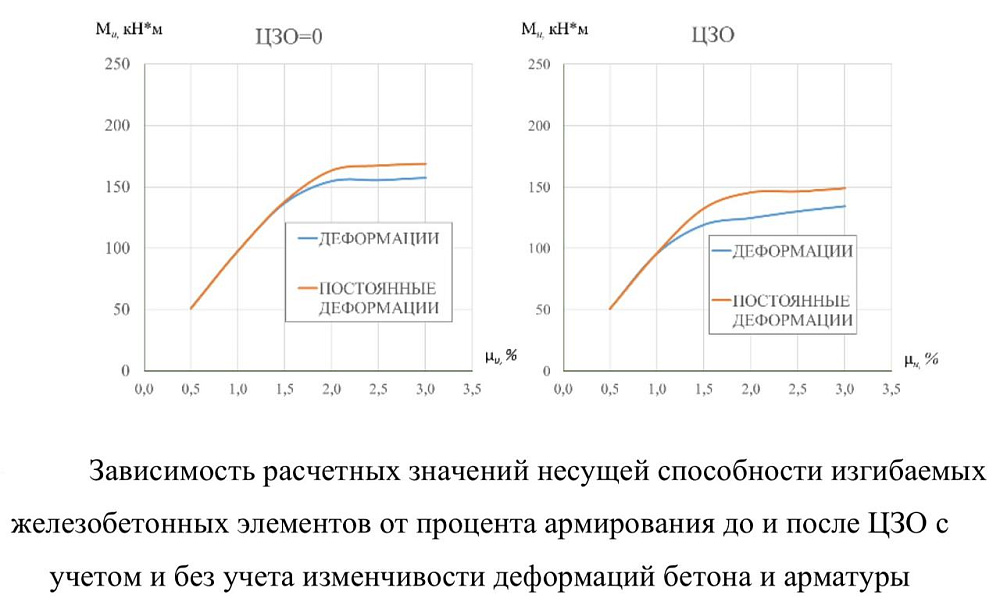
- At low reinforcement percentages (up to and including 1%), exposure to alternative freezing and thawing cycles (FTC) has no practical effect; at high reinforcement percentages, taking into account alternating temperature conditions leads to a significant reduction in bearing capacity compared to the standards;
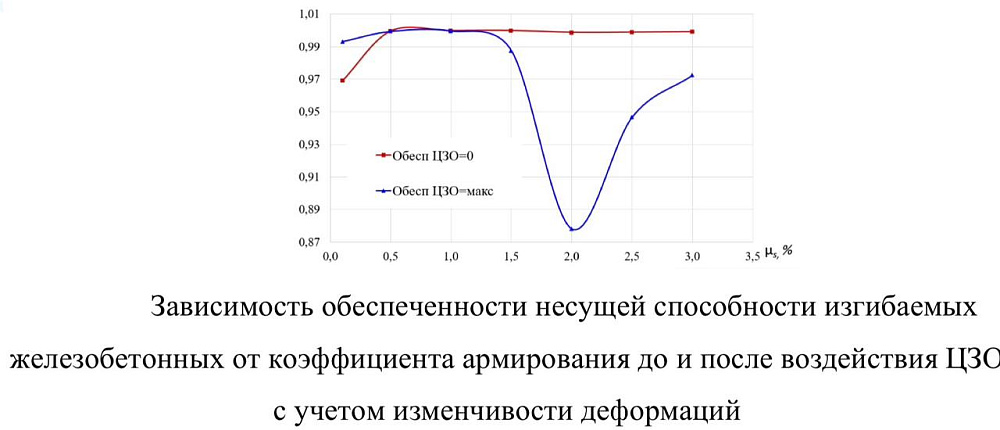
- In the absence of FTC at any reinforcement percentage and under FTC at low reinforcement percentages (up to 1.5%), the bearing capacity is not lower than the required values. Under FTC at high reinforcement percentages, the bearing capacity becomes lower than required;
- Taking into account the variability of concrete deformation characteristics at low reinforcement percentages (up to 1%) under alternating temperature conditions has virtually no effect on the bearing capacity, but at high reinforcement percentages, it leads to a decrease in bearing capacity;
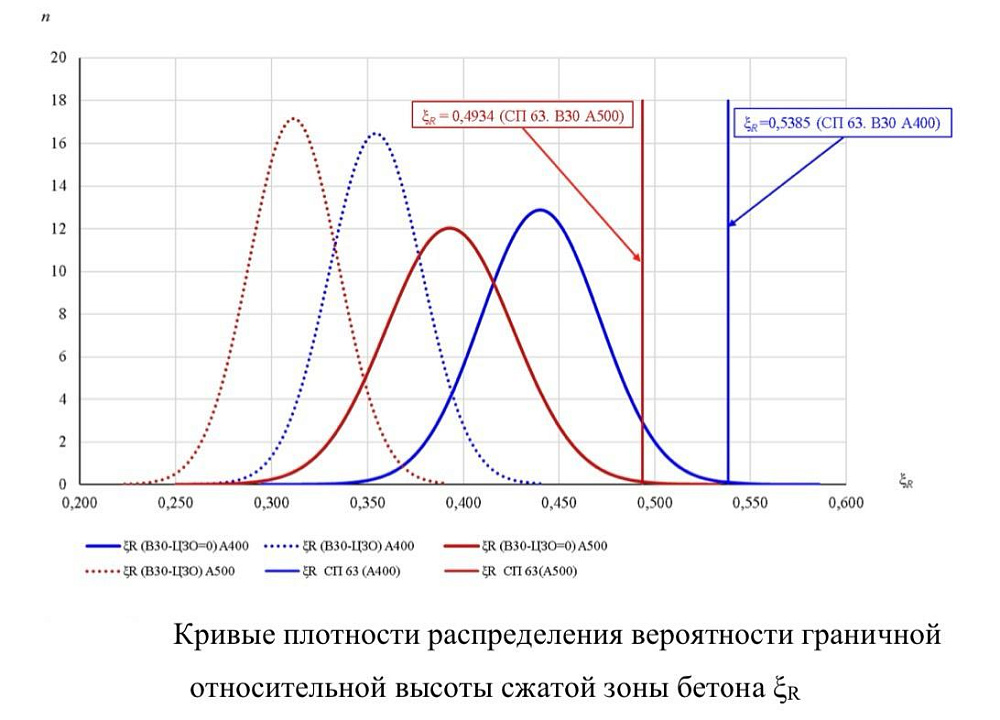
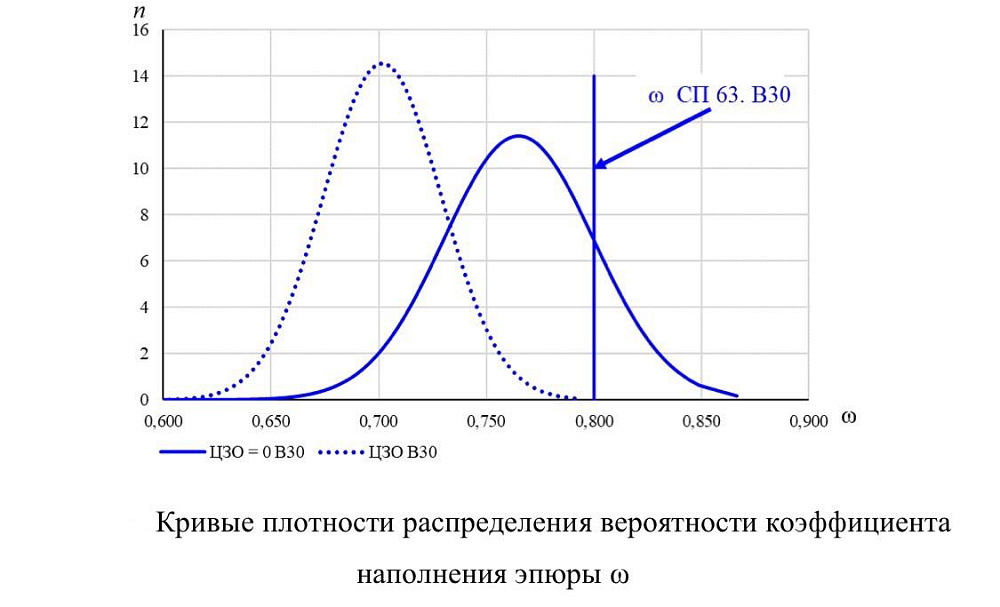
- The provision of the maximum reinforcement coefficient μR and the parameters associated with it (ξR, ω) before the central heating is already insufficient according to regulatory documents, and after exposure to alternating temperatures it decreases to almost zero for various classes of reinforcement, which significantly increases the risk of brittle fracture and the occurrence of emergency situations.
The obtained results confirm the need for further study of the variability of the deformation characteristics of concrete and its influence on the performance of bending reinforced concrete elements under conditions of alternating freezing and thawing.
The research results were presented in two articles published in journals included in the Higher Attestation Commission (HAC) list. Furthermore, a state registration certificate was obtained for the SIGA 61 computer program, which enables calculations of the load-bearing capacity of flexural reinforced concrete, steel fiber reinforced concrete, and composite flexural elements in normal sections using the diagrammatic method, using various types of material stress-strain diagrams.
Publication in the HAC journals confirms the scientific significance of the work. The articles also received the highest expert praise, winning two first-place laureate diplomas at the 48th International Competition of the All-Russian Society of Scientific Researchers.
Currently, other recipients of presidential and government scholarships among SPbGASU students include Ivan Beshentsev (fourth-year student of the Faculty of Automobile and Road Building, recipient of the President of Russia scholarship); Anna Andreeva and Denis Astapov (both fourth-year students of the Faculty of Forensics and Law in Construction and Transport), Evgeny Anufriev (fifth-year student of the Faculty of Automobile and Road Building), Ekaterina Buryak (fourth-year student of the Faculty of Civil Engineering), and Zlata Zolotykh (first-year master's student at the Faculty of Civil Engineering) – recipients of scholarships from the Government of the Russian Federation.For outstanding achievements in his academic and research work, Oleg Yatskovets was awarded a Russian Government scholarship. Furthermore, his research was awarded a third-place diploma at the IV International Competition of Scientific, Methodological, and Arts Works "Knowledge. Innovation. Priorities."