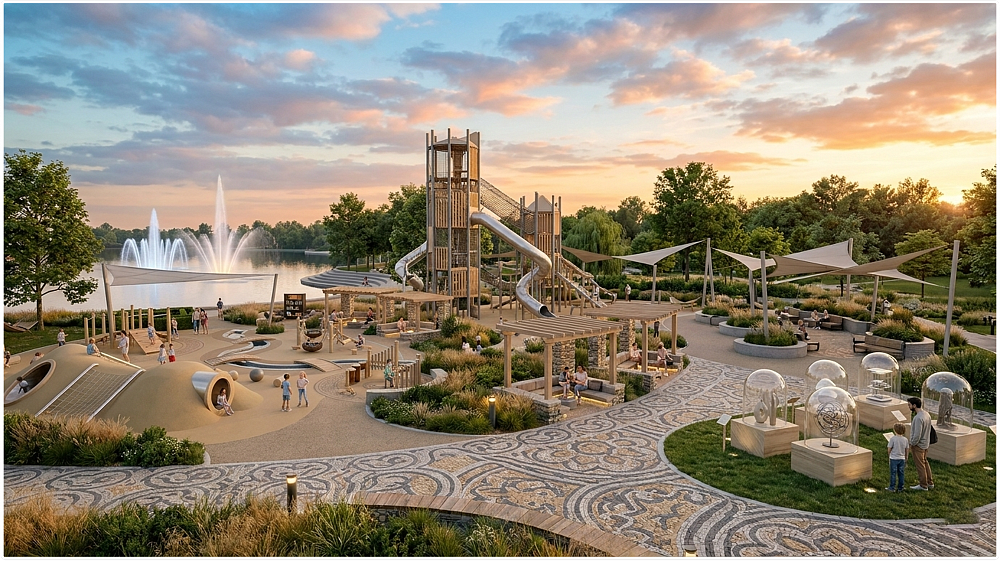
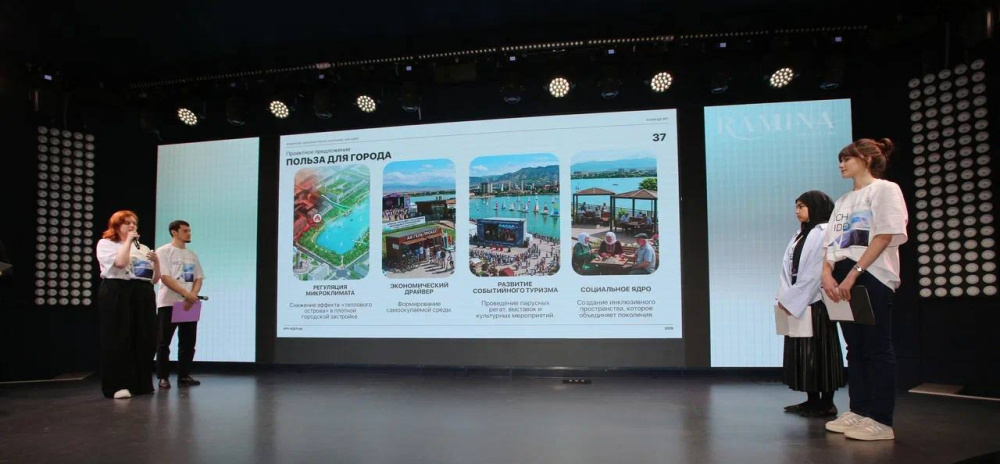
 Team No. 1 presenting its project. From left to right: Maria Efimova, Kamil Khabibulaev, Rukaya Muhammad and Angelina Pushkareva
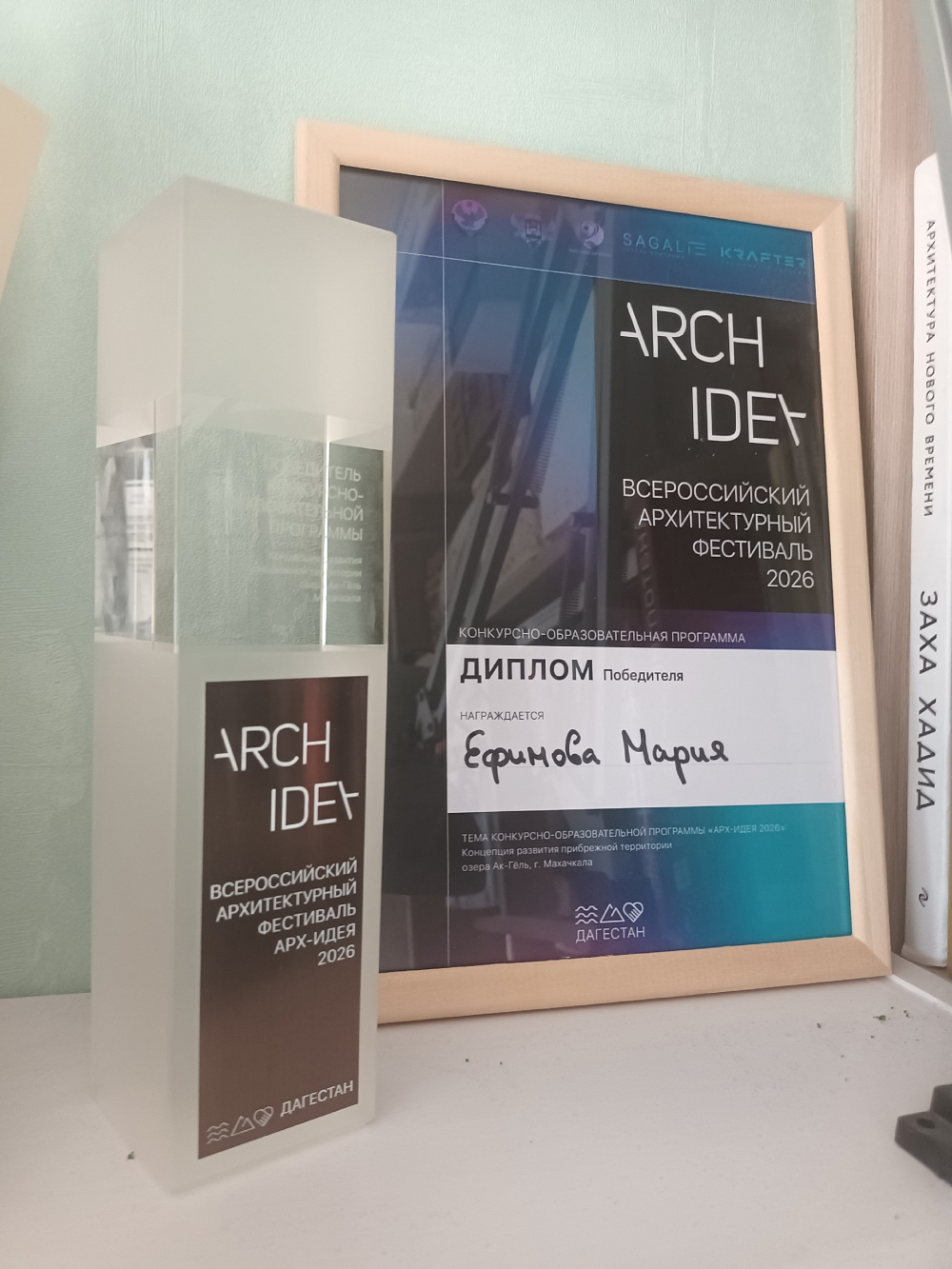
The All-Russian architectural festival "ARCH-IDEA 2026" has concluded in Dagestan. This year, the event was held in the region for the first time and was timed to coincide with the Year of Unity of the Peoples of Russia. The festival programs were supported by the leadership of the Republic of Dagestan, the Ministry of Construction, Architecture, and Housing and Public Utilities of Dagestan, and the Makhachkala administration.
As part of the competition, young architects presented conceptual development projects for the coastal area of Lake Ak-Göl in Makhachkala. Five teams presented coastal revitalization projects. First place was won by Team No. 1, which included Maria Efimova, a third-year student of the SPbGASU Faculty of Architecture, majoring in Architectural Environment Design. The winning team also included Angelina Pushkareva (a fourth-year student of the State University of Land Management), Rukaia Muhammad (a fifth-year student of the Moscow Humanitarian and Technological University – Moscow Institute of Architecture and Civil Engineering), and Kamil Khabibulaev (a graduate of the Dagestan State Technical University). The curators of the group were Andrey Shirokiy and Igor Zvyagin from the architectural consulting bureau Seven Solar Studio (Voronezh).
The team developed a comprehensive improvement project called "Ak-Göl. Heritage Territory."
The design project focused on the coastal area of Lake Ak-Göl in the southeastern part of Makhachkala. This regional natural landmark currently faces a challenging environmental situation: its water area is shrinking, and the shoreline is fragmented and lacks a unified development concept.
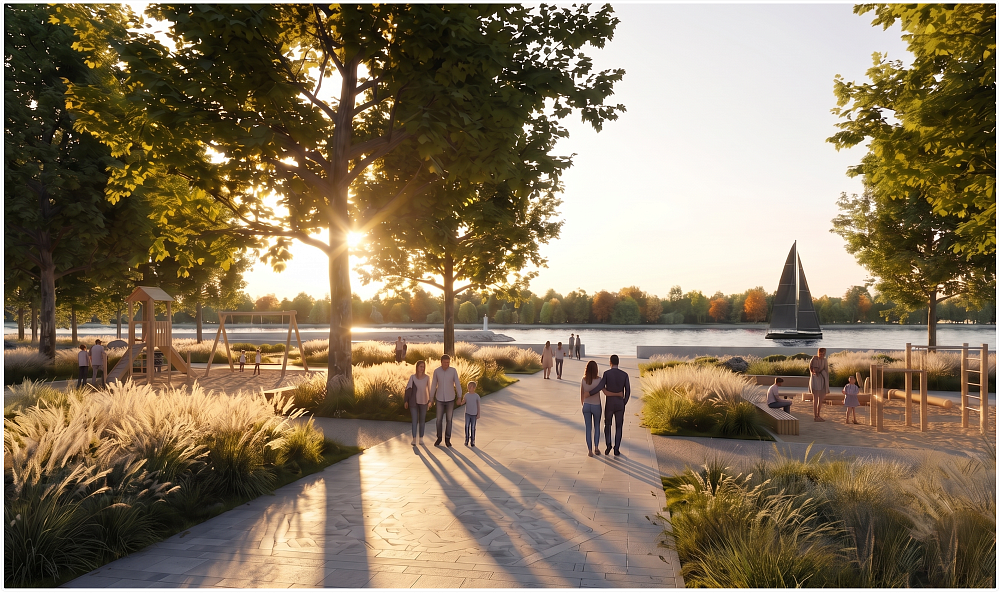
The architects' task was to propose a revitalization strategy for a 55-hectare area, creating a continuous four-kilometer pedestrian route. The design proposal was based on the principle of integrating Dagestan's local identity into the modern urban environment through the development of public, sports, and landscape spaces.
Based on urban planning analysis and a study of local residents' needs, the authors divided the embankment into four thematic zones with individual use scenarios.
-
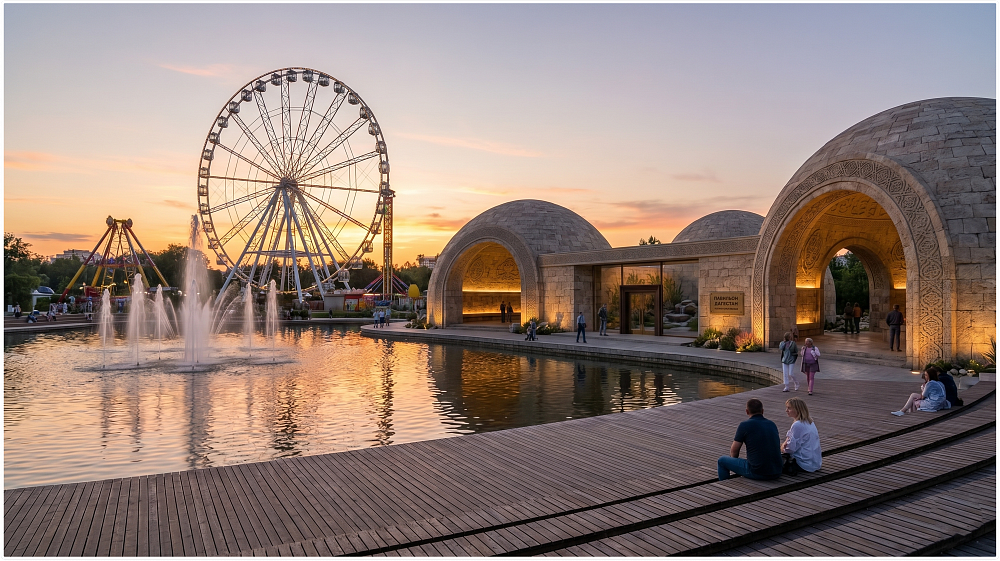
The first of these is the Artisans' Park: a central public hub that will house a Cultural Pavilion, a lecture amphitheater, and open-air spaces for traditional craft workshops.
-
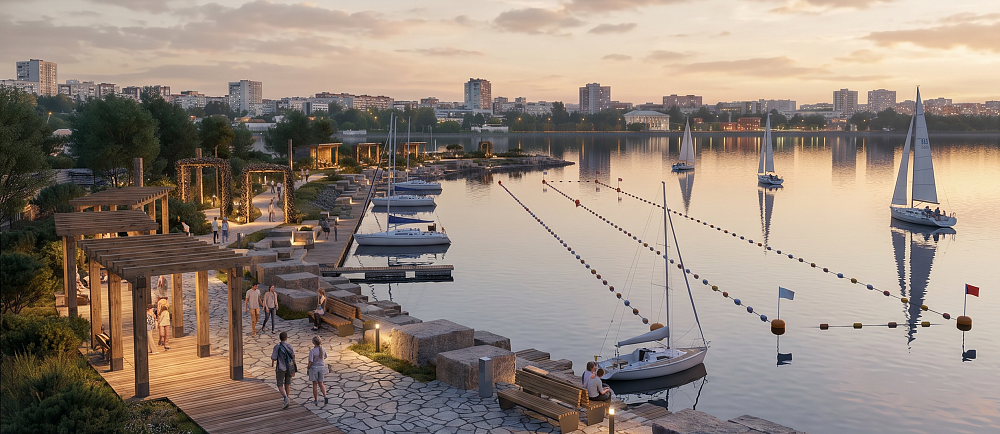
The second zone is the Sports Harbor: a specialized cluster for water sports, including a rowing center, piers, spectator stands, equipped waterways, and a skate park.
-
The third zone is the Quiet Shore: it features a recreational area for quiet relaxation, convenient piers for fishermen, and a landscaped labyrinth.
-
The fourth zone, called the Space of Impressions, includes an event area equipped with a singing fountain, an amphitheater, and the Alley of Heroes of the Special Military Operation.
An important part of the project was the implementation of "symbiotic ecology" methods for the natural purification of the reservoir. The project involves the creation of artificial bioplateaus with higher aquatic vegetation, which act as natural filters, as well as the installation of local settling basins and forced aeration systems.
The visual language of the landscaping elements references traditional Dagestani crafts. The small architectural forms utilize local materials—stone, wood, and reed. The parametric forms of the gazebos, the perforated awnings, and the mosaic elements on the benches interpret motifs of traditional stone and wood carving.
The expert jury highly praised the project's thoroughness. The proposed solutions not only create an accessible and inclusive environment for Makhachkala residents but also address related environmental and economic challenges: they improve the microclimate by reducing the "heat island" effect in densely populated areas and create infrastructure for the development of domestic tourism.
We congratulate Maria Efimova and her team on their winning title and wish them continued success in their professional endeavors!