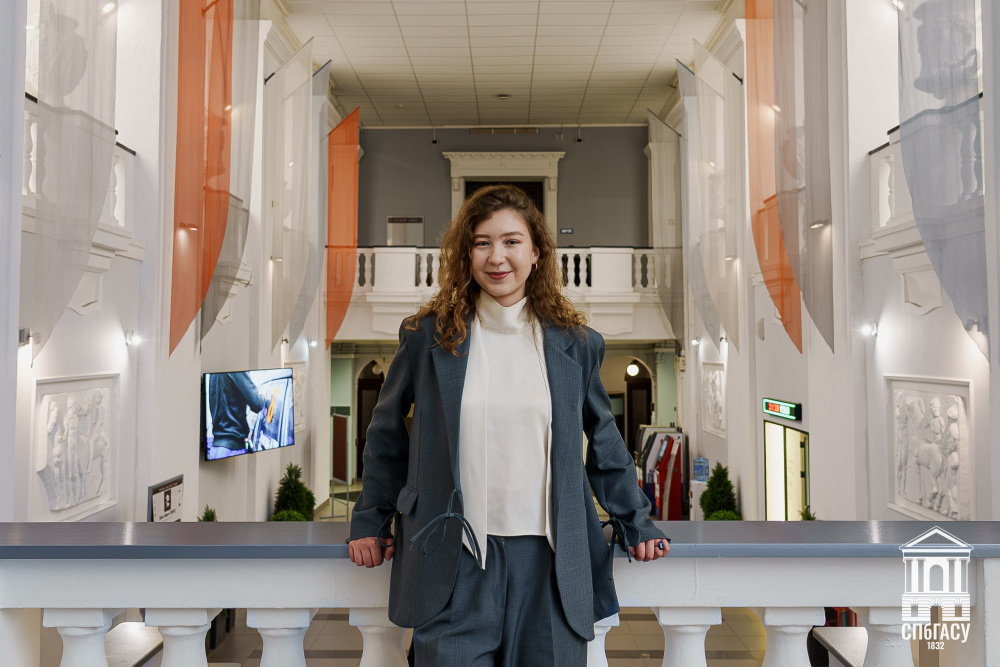
 Anna Kozhemyak
Urban noise is more than just an unpleasant backdrop to daily life; it affects human well-being. Consequently, when designing residential areas, it is essential to consider not only the external appearance of buildings and the convenience of infrastructure but also acoustic comfort. Anna Kozhemyak, a fourth-year student in the Faculty of Civil Engineering at the Saint Petersburg State University of Architecture and Civil Engineering, dedicated a research project to this issue. She presented her work at the XV Forum of Engineering and Technology Universities of the Union State, held in Kazan.
Anna’s interest in this subject stemmed from two of her passions: music and architecture. A significant role was played by her coursework on architectural and building structures, taught by Aleksandra Glukhova—a lecturer at SPbGASU—who introduced students to the role of acoustics in the design process.
"I wanted to explore what else could be taken into account during the design process—beyond the basic requirements—to create spaces truly tailored to people. The goal is for everyone to be able to find a sense of calm and recharge at home, even amidst the fast-paced rhythm of city life," explains Anna.
In her research, the student examined factors affecting the acoustic environment during the stages of urban planning and the detailed layout of residential areas. Her objective was to determine which noise-mitigation methods currently used in practice are the most effective and how their performance can be improved.
Three cities – different solutions
For her analysis, Anna selected sites in Orenburg, Nizhny Novgorod, and Moscow. It was important to her not to rely solely on theoretical material, but rather to examine urban spaces firsthand and evaluate how various architectural and planning solutions function in practice.
In Orenburg, the student explored a new, developing residential complex, combining a visit to her parents with work on her project. In Nizhny Novgorod, her attention was drawn to the Meshcherskoye Lake district—an area she had previously encountered in academic literature on acoustic ecology. Later, while traveling to a gathering for the 2025 World Festival of Youth, Anna was able to visit the district in person and speak with local residents. In Moscow, she studied the so-called "book-style" apartment buildings and the P-55 series of residential structures while on a trip to attend an acoustics conference at the Bauman Moscow State Technical University.
Each of the projects examined is notable for its design solutions. These include the specific shape of the buildings, which helps to shield against noise; the positioning of residential floors above commercial spaces—featuring concrete and glass structures—as well as dense greenery and the routing of major traffic arteries around the residential area.
Anna pays special attention to materials and technologies that can expand the possibilities for noise protection. For instance, she considers "green facades"—structures covered with vegetation that can scatter and absorb sound waves—to be a promising solution.
Another area that caught the student’s interest is the use of rubberwood to create sound-insulating materials. In her view, such solutions are not yet widely used, partly due to the high cost of the raw material. However, developing new materials based on it could open up further possibilities for the acoustic protection of buildings.
Комфорт начинается с проектирования
According to Anna’s observations, there is a growing focus on acoustic comfort in contemporary architecture. This is evident both in new urban planning approaches and in the development of facade systems. She was able to see this firsthand during her internship, while reviewing the architectural and building acoustics (ABA) section of the project documentation for a residential complex located on reclaimed land on Vasilevsky Island in St Petersburg.
As part of the Forum of Engineering and Technology Universities of the Union State, Anna presented her research at a round table on industrial design. The participants highly commended her work and noted the relevance of the topic addressed.
At the forum, Anna was able not only to present the results of her research but also to engage with colleagues. In particular, a representative from the Institute of Design at Kazan Federal University (KFU) proposed involving acoustics specialists from the Saint Petersburg State University of Architecture and Civil Engineering in joint research using new equipment recently acquired by KFU.