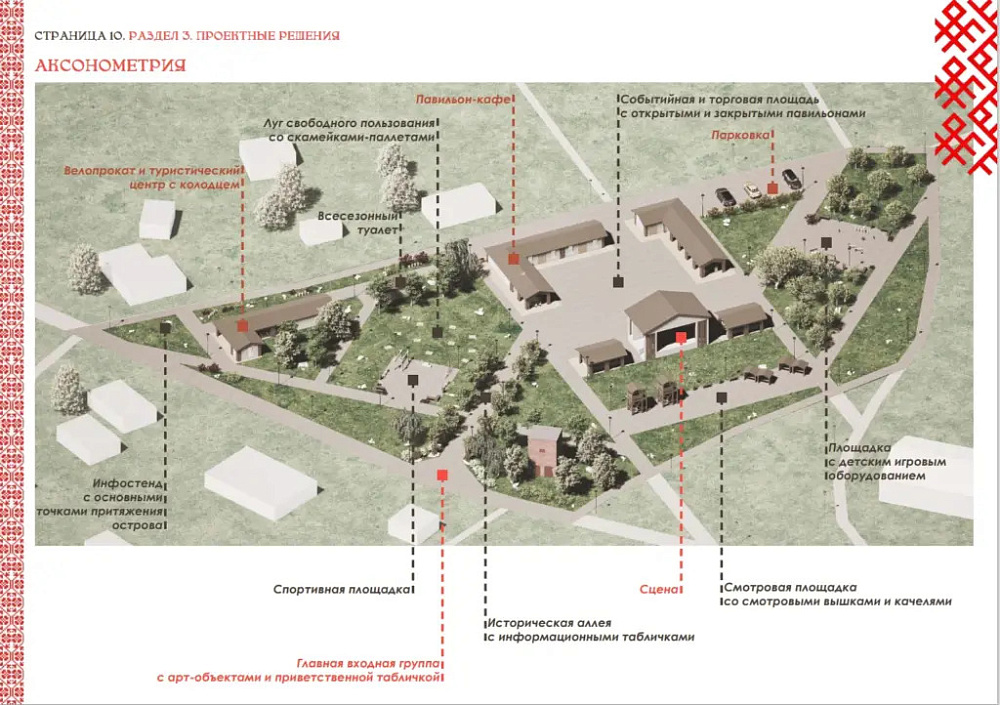
St Petersburg State University of Architecture and Civil Engineering students Ulyana Motorina and Alina Leonti won an open architectural competition to develop a design project for the improvement of a retail space in the village of Solovetsky on the Solovetsky Islands. The competition, held among students studying at architecture and civil engineering universities, sought to find modern solutions for public spaces in a unique historical and cultural environment. Participants were tasked to develop a concept for a space that would combine retail, social, and event functions.
The competition was organized by the Solovetsky Archipelago Development Agency of the Arkhangelsk Region and the ANO "Directorate of the Solovetsky Archipelago." The jury included representatives of the competition organizers, the Solovetsky Monastery, the Primorsky District Administration of the Arkhangelsk Region, and architectural experts, including the Deputy Minister of Construction and Architecture – Head of the Department of Architecture and Urban Development of the Arkhangelsk Region and the Chief Architect of the Foundation for the Preservation and Development of the Solovetsky Archipelago.
The jury praised the work of SPbGASU students, "Solovki Trading Square," for its conceptual integrity and architectural design. The project envisions a flexible public space that can be transformed to accommodate various uses, including everyday retail, fairs, and public events. The solution is based on a modular system of pavilions that reinterprets the traditions of northern wooden architecture, as well as an open public core that preserves the village's visual connections and panoramas.
Other students from our university also won prizes in the competition. Second place was shared between four projects, including those by SPbGASU students: "Design project for the 'Northern Ornament' Retail Space" (Anna Vasyanovich and Ekaterina Chepur) and "Solovetsky Posad" (Vasilina Vlasova, Anna Maizels, and Zoya Tomilova). Sofia Glushenkova's "Pomorskie Stalls" was one of the projects awarded third place. According to experts, the submitted works share a common goal of creating an adaptive and functional environment that takes into account the seasonality of the area's use, the natural context, and the possibility of phased implementation.
According to the jury, the victory of SPbGASU students confirms the high level of architectural training at the university and the students' ability to offer comprehensive architectural solutions that combine functionality, respect for the historical environment, and a modern urban planning approach.