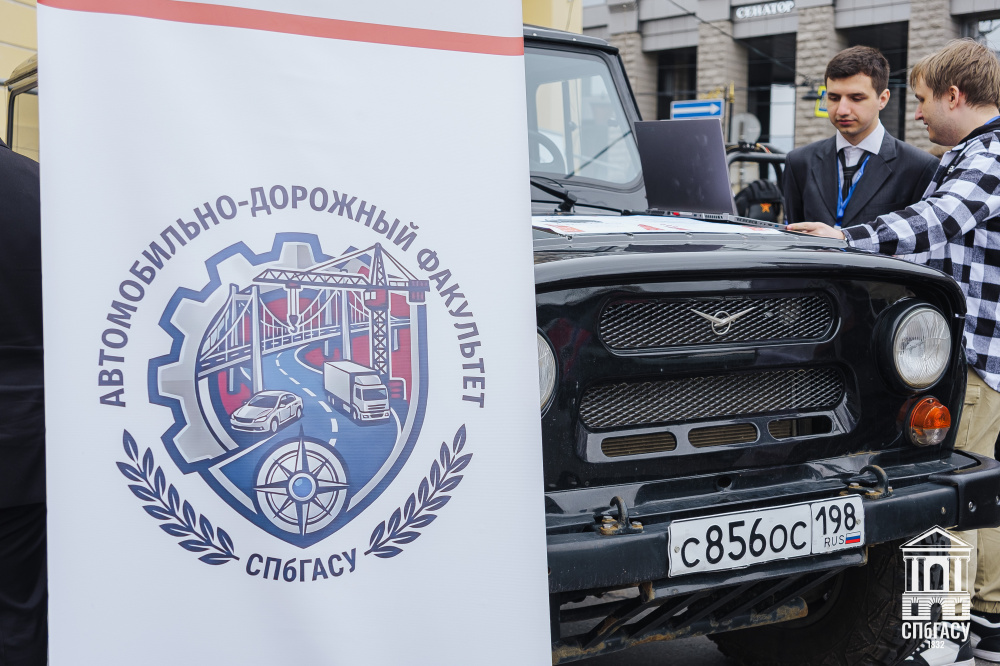
 Artem Timofeev and Anton Veselov presenting their development at the exhibition
At the VII International Transport Festival "TransportFest" in St Petersburg, the SPbGASU students presented their own development in the field of intelligent transport technologies: the "SmartUAZ" project. This is a telematics system for predictive analytics of vehicle technical condition, developed as a startup thesis and aimed at the early detection of vehicle malfunctions using artificial intelligence.
The authors of the project are fourth-year students majoring in Operation of Transport and Technological Machines and Complexes: Anton Veselov (development and training of the neural network), Artem Timofeev (analysis of the market and competitive environment), and Dmitry Ein (creation of the mobile application).
The system is based on a complex of three elements:
-
CDB (common data bank) scanner that connects to a car;
-
a mobile application that provides data transfer;
-
a server with a Transformer-type neural network that analyzes incoming telemetry.
The system collects vehicle parameters in real time—on-board voltage, coolant temperature, and other indicators—after which the neural network identifies hidden anomalies and predicts potential malfunctions before they become critical.
According to Anton Veselov, the key difference between this development and traditional on-board diagnostics lies in its predictive capabilities: "Traditional diagnostics report a malfunction only after it occurs. Our goal is to predict the problem in advance and help the owner avoid serious breakdowns and expensive repairs."
Pilot testing of the system was conducted on a UAZ Hunter vehicle. According to the developers, the technology can be adapted to virtually any vehicle equipped with an CDB port: cars, buses, and specialized equipment. However, the neural network algorithms require additional tuning for the specific vehicle type.
At the current stage, the system analyzes the operation of two main vehicle subsystems—the cooling system and the electrical system. In the future, the team plans to scale up the development and expand the number of monitored parameters.
The project has already generated interest from festival attendees and potential users. According to the students, the interest from private car owners, who were previously considered the wrong target audience for such solutions, has been particularly significant.