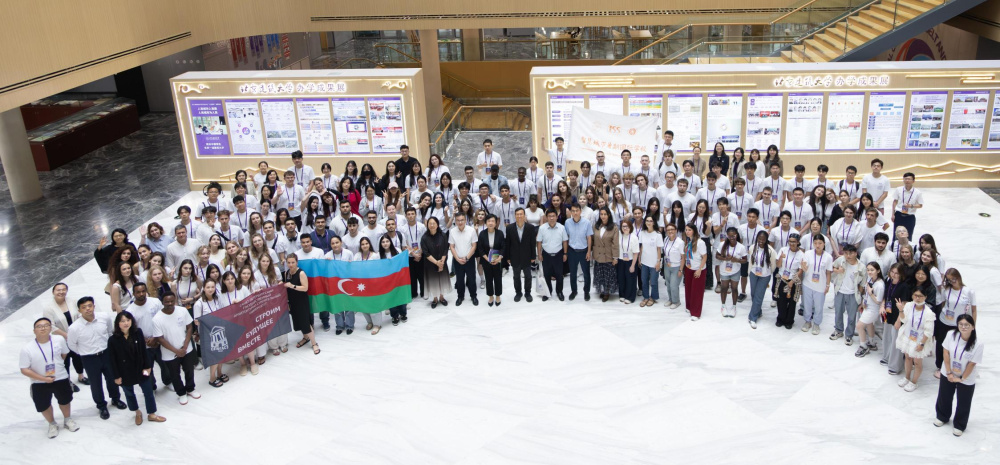
In July, 24 students from the SPbGASU faculties of Architecture and Civil Engineering completed training at the Smart Cities 2026 international summer school, organized by the Beijing University of Civil Engineering and Architecture (BUCEA) in collaboration with the Belt and Road Architectural University International Consortium (BRAUIC).
The program brought together over 180 students, young professionals, and experts from 14 countries, including China, Russia, Azerbaijan, Kazakhstan, Canada, and others. Participants completed an educational, cultural, and social program aimed at developing professional competencies, expanding international cooperation, and gaining insight into Chinese history and culture.
SPbGASU was represented at the summer school by junior students from the faculties of Architecture and Civil Engineering, who were proficient in English, had high academic achievements, and demonstrated an interest in intercultural interaction. The delegation was led by Daria Boytsova, Associate Professor at the Department of Architectural Design, and Ksenia Yakovleva, Associate Professor at the Department of Landscape Architecture.
Over the course of nine days, participants attended a series of lectures on current issues in architecture, urban planning, and modern urban development. Experts presented innovative practices in preserving tangible and intangible cultural heritage, discussed the conservation of sections of the Great Wall of China, development strategies for Chinese megacities, econometric models for forecasting urban transport demand, the use of artificial intelligence systems in urban management, the revitalization of former industrial sites, and international scientific cooperation with UNESCO.
The theoretical classes were complemented by visits to iconic sites in Beijing and its environs. The SPbGASU delegation visited the Forbidden City, the Beijing Urban Museum, the Summer Palace, Shougang Park, the Mutianyu section of the Great Wall of China, and the historic village of Beigou.
Particular attention was paid to the study of contemporary global architecture. Students and teachers visited the National Stadium in Beijing, the Galaxy Soho and Leeza Soho complexes, the Maritime Museum in Tianjin, The Eye Library in Binhai, the library in Beijing's Tongzhou district, the Apple Store in Beijing, and other renowned architectural sites designed by leading global architectural firms.
The practical part of the program included a series of master classes. One of them took the form of a Fun Run quest using the Beidou global satellite navigation system. SPbGASU student Maksim Klochko achieved the best result among all participants. Elizaveta Gimanova was also recognized among the winners, and Kirill Yaroshenko was named a prize winner.
The summer school concluded with the BRAUIC forum, where international student teams presented projects and presentations on smart city development. Each team included representatives from SPbGASU. The university's speakers were Aleksandra Grinenko, Adriana Smolenskaya, Viktoria Boytsova, Ekaterina Chepur, and Maksim Klochko. Ksenia Yakovleva, Associate Professor at the Department of Landscape Architecture, gave a presentation on the department's main areas of work and achievements.
Following the program, all participants received personalized certificates. Representatives of the SPbGASU delegation thanked the organizers, volunteers, and the university's International Relation Division for the opportunity to participate in this international educational program.
Participation in the Smart Cities 2026 summer school allowed students not only to become familiar with modern approaches to urban development and global architectural practices, but also to gain experience working in international teams, establish professional contacts with colleagues from different countries, and broaden their understanding of global trends in architecture, construction, and urban development.
.jpeg)
.jpeg)
.jpeg)
.jpeg)
.jpeg)
.jpeg)
.jpeg)
.jpeg)
.jpeg)
.jpeg)
.jpeg)
.jpeg)
.jpeg)
.jpeg)
.jpeg)
.jpeg)