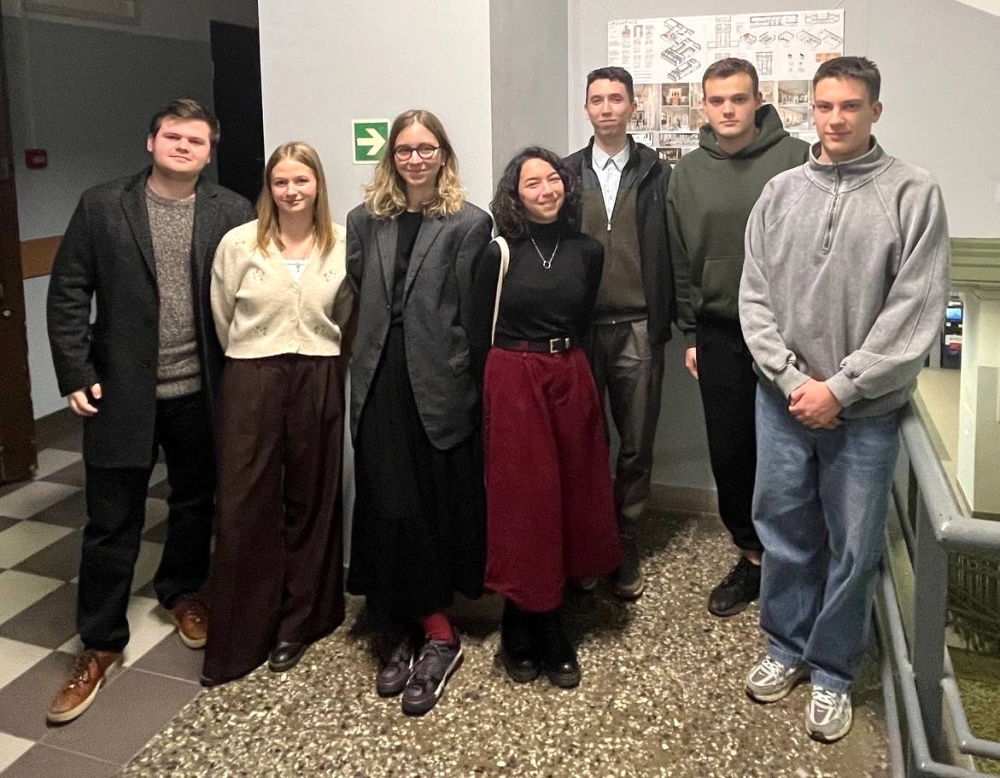
 Project team
Students from the Saint Petersburg State University of Architecture and Civil Engineering are developing a design for the second phase of the Far Eastern Federal University (FEFU) campus on Russky Island in Vladivostok as part of the interuniversity competitive educational program "Project Bureau." The program was organized by the public-law company "Ediny Zakaznik" (Unified Customer) on behalf of the Russian Ministry of Construction.
The student team is supervised by Aleksandra Masyonene, senior lecturer at the SPbGASU Department of Information and Mathematical Modeling Technologies.
The project began as part of the "Project-Based Activity" elective course at the SPbGASU Educational Center for Project-Based Learning (ECPBL). The first draft was presented in December 2025, after which the team began refining and improving it.
Following the successful defense of projects as part of the elective course the ECPBL continued collaborating with the students, providing support for their further development. The team plans to submit the design to a competition and then defend it as a joint final qualifying work.
The project is distinguished by its significant scale and high level of complexity. The total development area is approximately 76,000 square meters. The campus includes:
- comfort hotel-type hostels for 3,000–4,000 people;
- public building – a body of creative ideas.
In addition, design documentation s being developed for one section of the hostel with a capacity of 300–350 rooms.
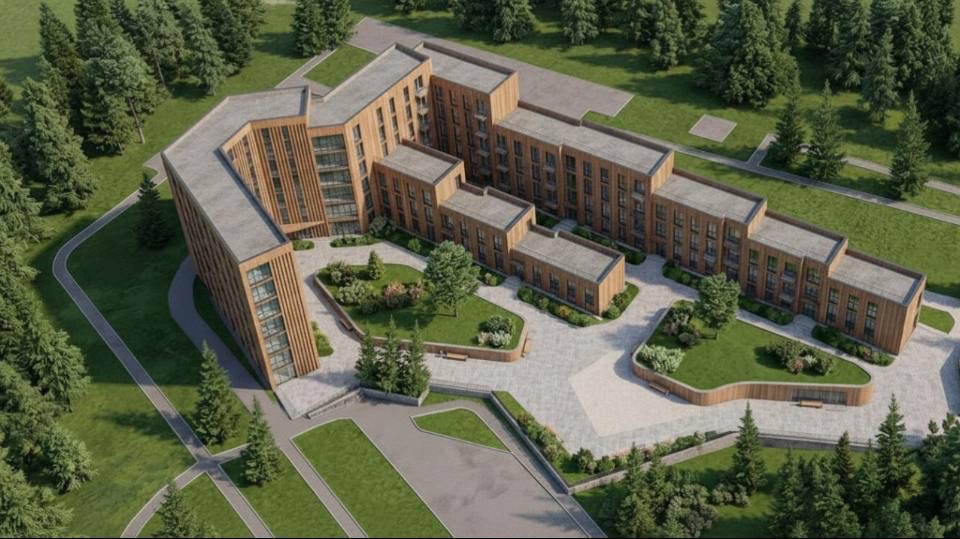
What makes this project unique is that it requires participants to possess not only architectural skills but also the ability to work at the intersection of several professional disciplines. Designing a campus on a seismically hazardous site with complex terrain requires a comprehensive approach, encompassing architecture, urban planning, residential and public space planning, functional zoning, engineering design, consideration of economics and regulatory requirements, and the use of modern digital modeling tools.
For students, participation in the program becomes a full-fledged professional experience, allowing them to work on real-life problems at the national level.
As Aleksandra Masyonene notes, the key value of the project lies in its practical focus:
"For students, this is an opportunity to go beyond the academic assignment and engage in a real professional process. It's important not only to propose an architectural concept but also to consider the specific features of the site, the functional structure of the campus, and environmental requirements. This is a comprehensive project that fosters responsibility for the decisions they make."
According to the teacher, modern design is impossible without an interdisciplinary approach: "Today, architecture is developing in conjunction with digital modeling, analytics, and teamwork. It's important for our department to show students how information modeling technologies are becoming part of real-world practice."
Inna Sukhanova, Director of the Educational Center for Project-Based Learning, also emphasized the significance of the work accomplished: "During the development phase, the team considered several architectural solutions and consulted with teachers from the Department of Architectural Design. The team included students from the Faculties of Architecture, Civil Engineering, and the Faculty of Environmental Engineering and Municipal Services. They accomplished a great deal of work, and we eagerly await the results of this large-scale project."