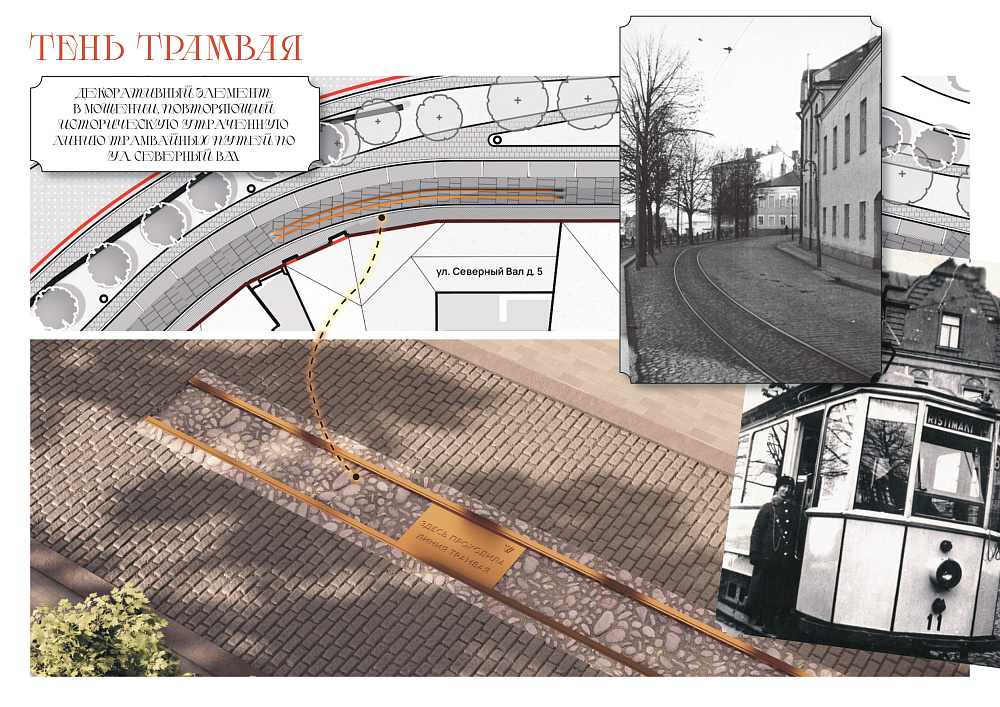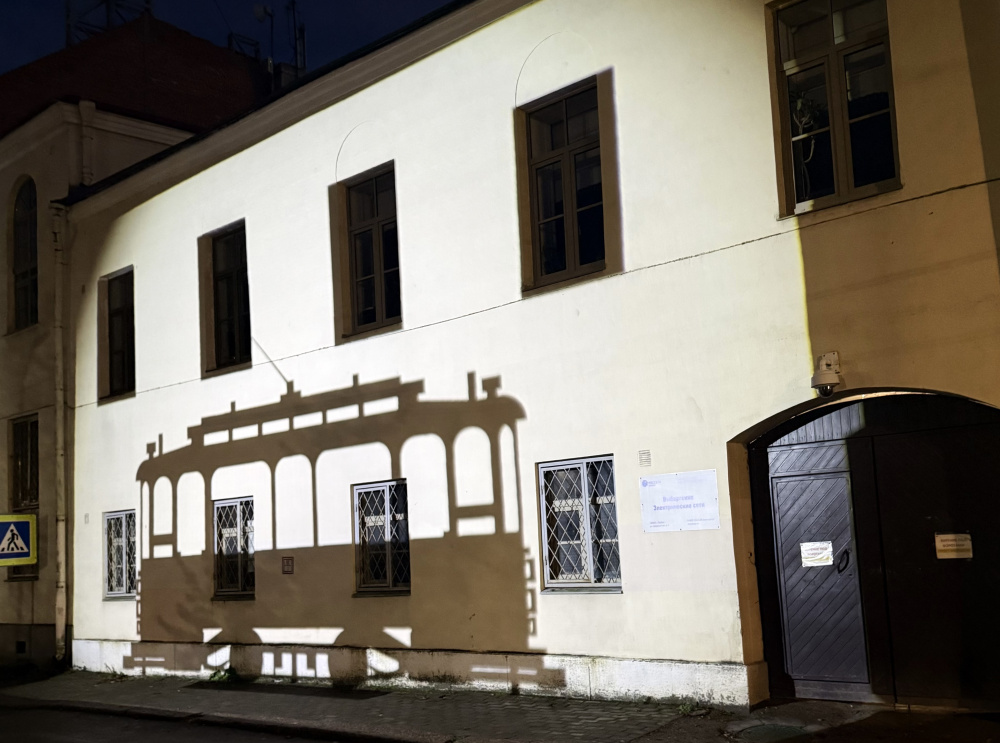
A light installation titled "Tram's Shadow" has appeared in Vyborg; it uses a gobo projector to cast the image of a historic tram onto the facade of a building. This installation is the first completed element of the "Seafront of Old Vyborg" project, developed by an interdisciplinary team that brought together city officials, local residents, experts, professional designers, and SPbGASU students. The project team was led by Aleksandr Demin, an Associate Professor, Head of the SPbGASU Department of Landscape Architecture.
The project took first place in terms of points scored in the "Historical Settlements" category of the All-Russian competition for the best projects for creating a comfortable urban environment in small towns and historical settlements, organized by the Russian Ministry of Construction.
The installation appeared in October as part of the initiatives outlined in the tourism master plan for Vyborg. The silhouette of an old tram seems to emerge upon the wall of a building, bringing an image from the past back into the contemporary urban environment. This approach engages with historical memory without altering the architecture itself: light becomes an independent artistic tool, helping people perceive a familiar space in a new way.
An important feature of the design is its accessibility and emotional expressiveness. The project concept also incorporates an audio component, evoking the sounds of an old-fashioned tram. The combination of light and sound creates a small urban tableau that captures the interest of both residents and tourists. The installation is intuitive and requires no further explanation; consequently, ever since its debut, "Tram's Shadow" has become popular among the people of Vyborg and visitors alike.
From a light installation to a new public space
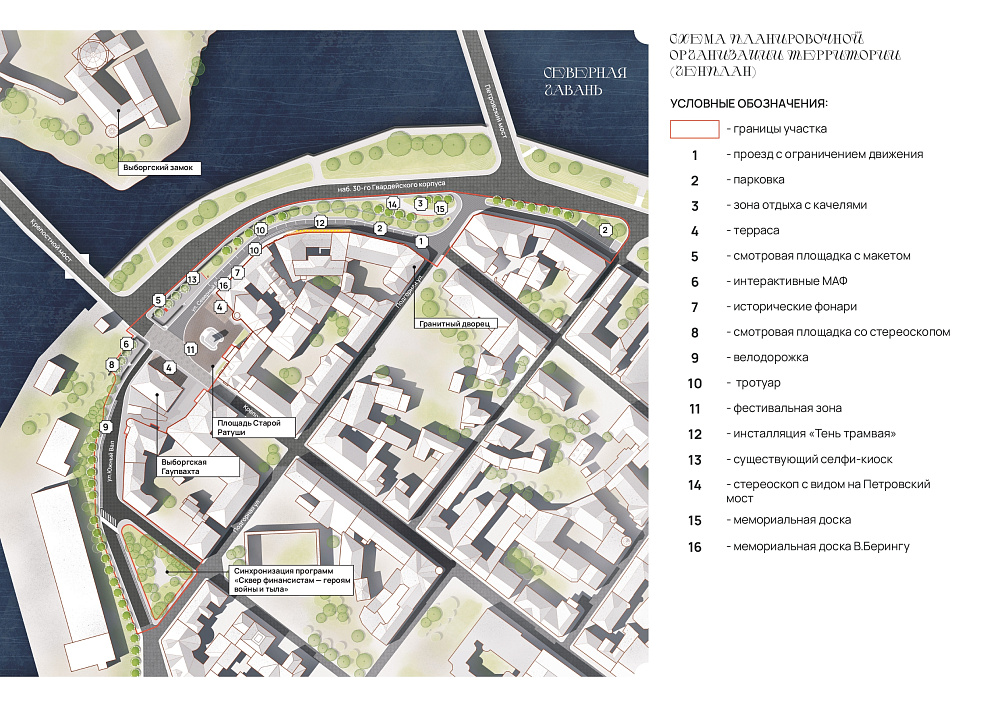
"Tram's Shadow" is part of a broader concept for the improvement of Vyborg’s historic center. The project encompasses an area of approximately 0.9 hectares, situated between Severny Val, Vodnaya Zastava, Yuzhny Val, and Podgornaya streets.
This area retains traces of medieval fortifications, architectural landmarks, and the Old Town Hall Square. At the same time, the space is in need of convenient pedestrian routes, areas for relaxation, and solutions that will help reveal its historical and cultural significance.
The concept envisions the development of pedestrian pathways, the creation of viewing points and recreation areas, and the organization of spaces for festivals and fairs. Interactive elements and historical motifs will help make the experience of exploring the city more meaningful, combining walks through the historic center with an exploration of its heritage.
The full implementation of the "Seafront of Old Vyborg" project is scheduled for completion in 2027. Funding for this initiative is being provided through federal, regional, and local budgets. The unveiling of the first installation already offers a glimpse of how contemporary artistic solutions can become part of a sensitive transformation of a historic environment.
Education and professional practice
Daria Barkeeva, an architect and lecturer at the SPbGASU Department of Landscape Architecture, worked on the project alongside Aleksandr Demin. University students Taisia Kiryanova, Elena Nikulinskaya, and Anastasia Gnedenkova also joined the team to help prepare the competition entry. As part of their practical training, they carried out design tasks, applying the knowledge they had acquired to develop a landscape improvement concept for the historic site.
Work on the project brought together representatives of the Vyborg Municipal District administration, experts in architecture and urban planning, local residents, and a professional design team. This collaboration made it possible to take into account both the unique characteristics of Vyborg’s historic environment and modern approaches to the organization of public spaces.
"It is fundamentally important to us that the improvement of historic areas does not boil down to mere infrastructure upgrades. The goal of landscape architecture is to reveal the character of a place, making its history both intelligible and emotionally resonant for people. 'Tram's Shadow'—modest in scale, yet a telling example of this approach—demonstrates how modern technology can help restore a recognizable historical image to the urban environment, integrating it into the contemporary life of Vyborg," noted Aleksandr Demin.
The "Seafront of Old Vyborg" project demonstrates how landscape architecture can not only enhance the urban environment but also reveal a place’s identity—not by competing with its historical character, but by amplifying its expressive quality. "Tram’s Shadow" served as the first notable realization of this concept. It illustrates how contemporary artistic approaches create opportunities for new ways for people to engage with the city.
The upcoming transformations will integrate historical landmarks, pedestrian routes, and public spaces, preserving the connection between Vyborg’s past and its contemporary life.