Saint Petersburg State University of Architecture and Civil Engineering has completed a research project titled "Development and Modeling of Construction Process Parameters for the Modernization of Hazardous Industrial Facilities, Accounting for Technical and Environmental Risks." The study was conducted by Aleksandr Rudenko, a Professor at the SPbGASU Department of Construction Management, who holds a Doctor of Economic Sciences degree and a Candidate of Engineering Sciences degree.
Modernizing existing hazardous production facilities is a complex industrial undertaking. Carrying out construction and repair work at such sites entails the risk of disrupting hazardous production processes and triggering accidents. Moreover, the parameters and conditions governing construction activities during the modernization of these facilities have not been sufficiently studied, and existing regulatory and methodological approaches require significant supplementation.
Post-accident repair and restoration works present particular challenges. At facilities critical to life support and sustained operation during emergencies, the need to carry out such works may persist even in conditions of man-made contamination.
The aim of the study was the computational-analytical and experimental substantiation, as well as the modeling of production parameters for modernization under normal, hazardous, and dangerous working environment conditions.
In the first stage, specialists conducted an analytical assessment of the potential consequences of accidents at hazardous industrial facilities, taking into account various layout options for buildings and structures relative to the accident source. Specifically, they examined scenarios involving emergency situations at facilities within the nuclear fuel cycle and the chemical industry.
The results demonstrated that, depending on environmental conditions, contamination in the area of an accident can persist for an extended period. At the same time, current regulatory and technical documentation lacks a sufficient set of provisions defining the procedures, organizational and technological solutions, and tariff and technical standards for construction processes carried out under such conditions.
Furthermore, current practices for responding to man-made emergencies focus primarily on addressing immediate crisis situations and do not fully ensure the execution of subsequent repair and restoration work. There has also been insufficient study of the patterns governing the restoration of facilities damaged—specifically by explosions—particularly in environments affected by man-made contamination.
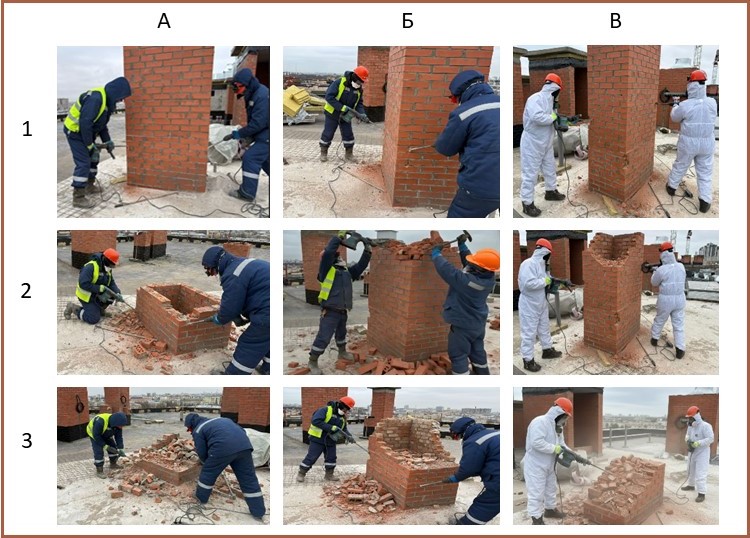 Photographic documentation of the step-by-step dismantling of walls made of small-sized elements: 1st row – at the start of work, 2nd – during the process, 3rd – at the end of work; under various workplace conditions: A – normal, B – hazardous, C – dangerous.
The second stage of the study focused on an experimental-statistical assessment of the impact of workplace environmental factors and the use of personal protective equipment on labor productivity. The experiments examined the efficiency of performing construction, loading/unloading, and unpacking operations under various workplace environmental conditions. Photographic documentation of one of the experiments illustrates the step-by-step dismantling of walls made of small-sized elements under normal, hazardous, and dangerous conditions.
The study yielded results from numerical-analytical calculations and the assessment of emergency scenarios associated with the modernization of hazardous industrial facilities. Criteria and conditions were established for determining the sequence of facility modernization under normal, harmful, and hazardous working environment conditions.
Relationships between labor productivity and production environment factors during construction processes have also been established. The influence of various factors on loading and unloading operations—specifically the moving and unpacking of materials—was investigated separately, considering both permissible levels and conditions of technogenic contamination.
One of the work's outcomes was the development of an aggregated object-node method for repair and modernization, as well as a modular-descriptive method for the modernization and repair of production facilities. The proposed approaches make it possible to systematize modernization processes and account for the specific conditions under which work is performed in various production environments.
The scientific novelty of the study lies in supplementing fundamental principles regarding the assessment and determination of parameters for construction and installation works—performed under both normal and hazardous working conditions—during the modernization of hazardous industrial facilities. Furthermore, mathematical models have been developed that make it possible to account for the impact of various factors on modernization efficiency.
The practical significance of the study lies in the potential application of the results to the planning and organization of construction processes at hazardous industrial facilities. Experimental research enabled the determination of mathematical relationships describing how various factors influence labor productivity during basic construction, unloading, and unpacking operations under both permissible and hazardous working conditions.
Thus, the results of the research can serve as a basis for further improving organizational and technological solutions for the modernization of hazardous production facilities, as well as for developing approaches to carrying out repair and restoration works in conditions of technogenic contamination.
The study was conducted under a grant for research activities to be carried out by academic staff of SPbGASU in 2026.