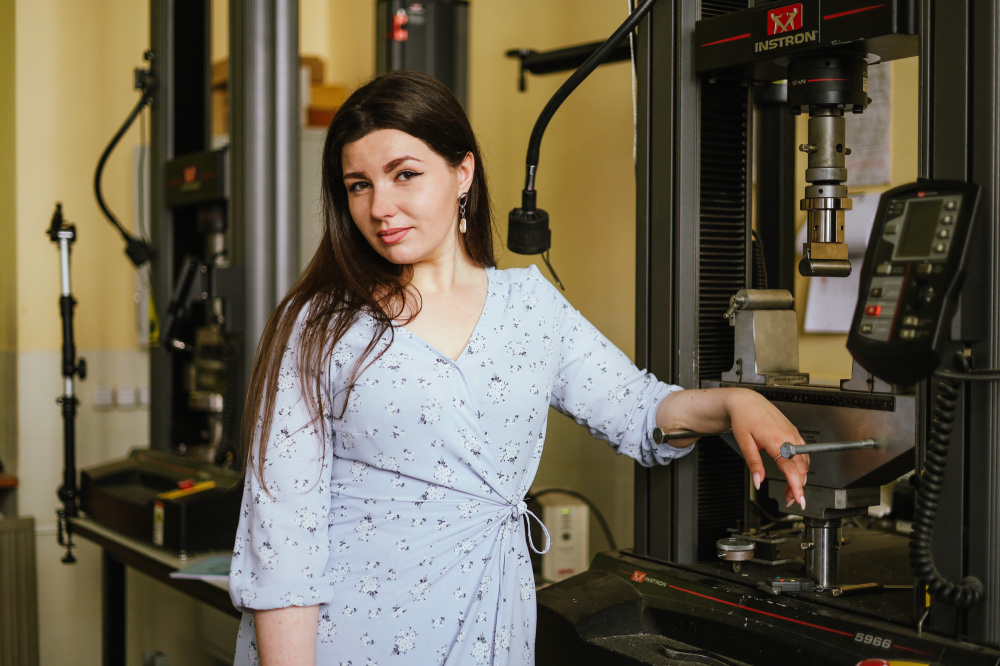
 Anastasia Denisova
The laboratory of the Saint Petersburg State University of Architecture and Civil Engineering has been conducting research into composite materials used to strengthen building structures with external reinforcement systems. The work is being conducted at the Department of Reinforced Concrete and Masonry Constructions as part of the preparation of the PhD dissertation of senior lecturer Anastasia Denisova. One of the stages of the work involved tensile testing of carbon composite laminates using a high-speed camera.
The main goal of the experiment is to study the failure mode of the composite material and determine where exactly the specimen begins to fail during tensile testing. The tests themselves play a key role in developing engineering solutions, especially when dealing with new materials or new operating conditions. In the construction industry, all decisions are directly linked to safety requirements, and safety must be substantiated either by calculations, if methods exist, or by experiments, if such methods are not yet available.
Unexpected effect of sample width
The work began with a series of mechanical tests on a composite material—carbon fiber-reinforced polymer (FRP) laminate. The researchers determined the key mechanical properties of specimens with a width similar to that used in real-world reinforcement (50 mm): tensile strength, elastic modulus, and relative deformation. However, the results of the initial tests were unexpected: the specimens failed in a manner not expected—the fracture pattern was different, and the resulting ultimate strength was lower than expected.
After testing samples with a GOST width of 20 mm, it was found that their strength characteristics matched the stated ones. This led to the hypothesis of the so-called "width effect"—the influence of sample size on the performance of FRP laminate. During the experiment, the researchers tested samples with widths ranging from 10 to 50 mm in 10 mm increments. It was found that at a width of 40–50 mm, the tensile strength decreased and the failure pattern of the material changed. However, it was not possible to visually record the onset of failure.
As Anastasia Denisova notes, FRP laminates possess a number of properties that are not always reflected in regulatory and technical literature. The "width effect" was discovered experimentally, after it became apparent that the material was not behaving as expected. This required a series of additional tests to confirm the hypothesis.
Why was a high-speed camera needed?
To precisely pinpoint the location of sample failure, the scientists used a high-speed camera with a shooting speed of approximately 3,000 frames per second. This allowed them to record the composite's failure process, which under normal conditions occurs almost instantaneously. The goal was essentially to "catch" the moment the failure began, and high-speed photography was the only solution available.
During the experiment, two sets of specimens were examined—20 mm and 50 mm wide. The imaging showed that the narrow specimens failed in the test zone across their entire cross-sectional area, as expected. However, for the wider specimens, failure began in the grip area of the testing machine, after which the specimen essentially ceased to function. Thus, the hypothesis regarding the influence of specimen width was experimentally confirmed.
Practical significance of the results
The obtained results have important implications for both laboratory testing and practical design. On the one hand, they can lead to adjustments to composite material testing methods to prevent specimen failure in grips. On the other hand, they allow for recommendations to manufacturers on improving the structure of composites, particularly by increasing interfacial strength at the fiber-matrix interface.
Research is particularly important in the context of strengthening existing structures. In this case, composite materials act as a "cure" for structures already suffering from defects and damage. Therefore, it is crucial to ensure the predictability of their performance. Understanding the mechanisms of material behavior allows not only for its correct use in strengthening projects but also for predicting its failure, which is directly related to ensuring the mechanical safety of structures.
Such studies help designers more accurately assign standard characteristics to materials and take into account possible failure mechanisms when calculating structures.
Prospects for further research
Research into composite materials at SPbGASU continues. In the future, scientists plan to use high-speed imaging to study the performance of composite-adhesive-concrete joints, as well as to analyze the failure of reinforced structures and the behavior of composites at various temperatures.
According to Anastasia Denisova, despite the widespread use of composite materials in construction, experimental research into their behavior remains insufficient. The work being conducted at the university is aimed at gaining new knowledge about the mechanics of these materials and developing a scientific basis for their wider and safer use.
Experimental research is being conducted by Anastasia Denisova, Senior Lecturer at the Department of Reinforced Concrete and Masonry Constructions (RCMC), and Egor Kuzhman, Senior Laboratory Assistant (until September 2025). Supervisor: Aleksey Shekhovtsov, PhD of Engineering Sciences and Associate Professor in the RCMS Department.