Researchers at the Saint Petersburg State University of Architecture and Civil Engineering investigated how the contamination of sandy soils with petroleum products affects their properties and, consequently, the performance of structural foundations. The findings enable engineers to account for the effects of contamination when designing foundations for sites such as oil depots, oil terminals, gas stations, and other facilities where there is a risk of petroleum product spills.
The study was conducted by Alina Kvashuk, PhD of Engineering Sciences and Senior Lecturer at the Department of Geotechnics. Rashid Mangushev, DSc in Engineering, Professor at the Department of Geotechnics, served as the research supervisor.
From an environmental problem to the design of foundations
Petroleum products can enter sandy soil, for instance, through tank leaks, damage to the tank bottom, or spills during transport. This alters the soil's physical and mechanical properties: filtration characteristics and the angle of internal friction decrease, while compressibility increases.
For the structure, this may lead to a reduction in the bearing capacity of the subgrade, increased foundation settlement, and a longer period for settlement stabilization.
Previous studies of soils contaminated with petroleum products primarily focused on engineering-geological and environmental assessments, including remediation issues. In the study conducted by SPbGASU, sandy soil was examined specifically as a foundation base. This made it possible to establish quantitative relationships between contamination characteristics and changes in soil properties, and subsequently to use the obtained data in foundation design calculations.
What happens to sand when it becomes contaminated
The study examined the effect of three types of petroleum products—A-95 gasoline, diesel fuel, and heavy crude oil—on sands of varying grain sizes, ranging from coarse to silty. The concentration of petroleum products ranged from 0% to 12% by mass.
Experiments have shown that exposure to petroleum products alters even the particle-size distribution of sand. Processes of dispersion—the breaking down of particles into smaller ones—and aggregation—their clumping together into larger formations—occur within the soil. Dispersion is the predominant process for coarse and medium sands, whereas aggregation characterizes silty sands. The most intense particle breakdown was observed with gasoline exposure, while aggregation was most pronounced when silty sand was contaminated with heavy oil.
At the same time, the water permeability of the soil decreases. Depending on the sand grain size, the type of petroleum product, and its concentration, the filtration coefficient decreased by 11–99%. For instance, fine sand became impermeable at a diesel fuel content of 10–12%, whereas contamination with heavy oil rendered it poorly permeable at a concentration of just 6%.
The study also revealed significant changes in strength and deformation characteristics. The angle of internal friction decreased by 5–22%, and the oedometer deformation modulus by 40–85%. At the same time, contamination with heavy oil could cause specific cohesion to increase by up to tenfold.
The most significant changes occurred at petroleum product concentrations of up to 6%. Further increases in concentration resulted in an additional decline in certain characteristics of no more than 10%.
Contamination affects foundation settlement
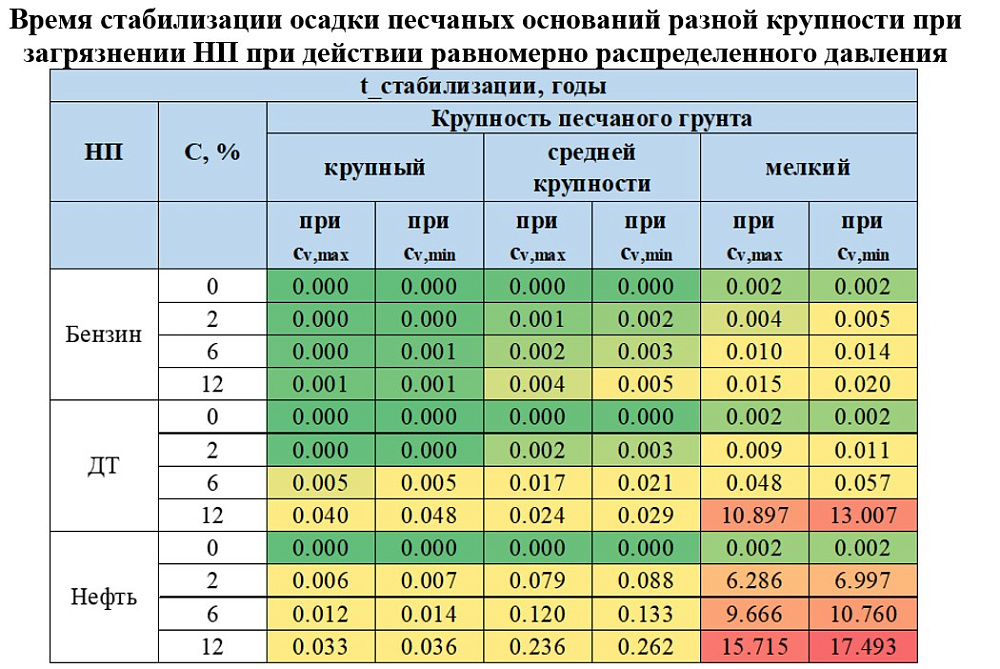
The obtained characteristics were used to evaluate the behavior of structure foundations. Calculations showed that the design soil bearing capacity could decrease by 10–40%, while the ultimate foundation settlement could increase up to eightfold. Furthermore, the time required for settlement stabilization could reach 17.5 years in certain cases.
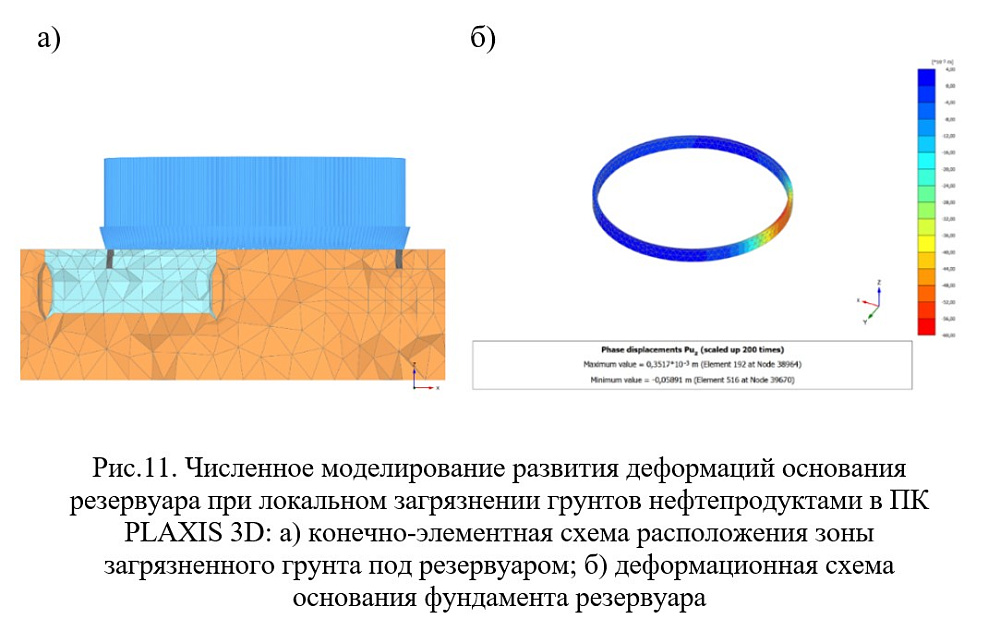
To verify the results, the researchers conducted numerical modeling using the PLAXIS 3D software suite. The study analyzed a 20,000-cubic-meter reservoir situated over a localized area of contaminated soil, with petroleum product seepage extending to a depth of 7 meters. The modeling demonstrated that differential settlement exceeded the limits established by regulatory criteria for all three petroleum products investigated.
Thus, oil contamination of sandy soil can affect not only the environmental condition of the site but also the reliability of the structure's foundation. Design considerations must account for a 17–60% reduction in the soil's ultimate bearing capacity, as well as potential increases in settlement and the time required for settlement stabilization.
"When calculating foundations based on limit states, it is necessary to account for a 17–60% reduction in the ultimate bearing capacity of the foundation soil—depending on the sand's grain size and the type and concentration of the petroleum product—as well as a decrease in the soil's design bearing capacity, the likelihood of additional settlement exceeding calculated values by several times, and longer periods for foundation settlement stabilization," notes Alina Kvashuk.
Practical application of the results
The developed recommendations are intended for use in the design of foundations on sandy soils subject to oil contamination. They may be of interest to design and construction organizations, as well as to specialists involved in the inspection of damaged storage tanks and the analysis of the causes of differential settlement.
The results of the work have already been applied by JSC Trust No. 68 during the construction of foundations at the St Petersburg Oil Terminal and the St Petersburg container terminal site.
Future research plans include expanding the list of pollutants under study to encompass fuel oil, motor oils, and their mixtures, as well as transitioning from homogeneous sand bases to the multilayered, heterogeneous soil masses typical of actual construction sites. Another area of focus involves refining calculation models for soils whose properties, under the influence of petroleum products, begin to resemble those of cohesive soils.
This news item is published based on the results of a 2026 SPbGASU grant project.