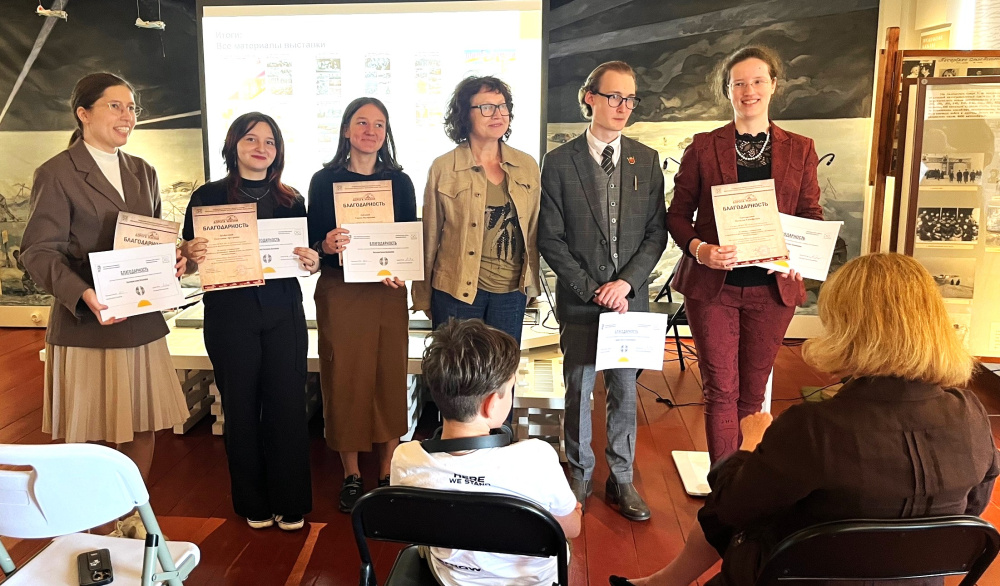
 Milena Zolotareva (fourth from left) with student participants at the conference
22 June is a special date in the history of our country. On this day, the Great Patriotic War began, becoming a terrible ordeal for millions of people. Decades pass, generations come and go, but the memory of those events remains part of our national identity. It lives on in family stories, archival documents, letters from the front, memorials, and museum exhibits. But there is another of memory keeper, one we encounter every day: the city.
The streets, squares, embankments, monuments, and historic buildings of Leningrad-Saint Petersburg have become silent witnesses to the war years. Many of them survived bombings and shelling, while many were damaged or destroyed. Behind every restored façade, behind every preserved monument, lies the work of people who, during the war and in the postwar period, preserved the city's cultural heritage.
For architects, engineers, and construction workers, the memory of the Great Patriotic War holds special significance. During the harsh war years, these professionals solved problems that affected lives and the preservation of Leningrad's historic character. They participated in the construction of defensive fortifications, worked to camouflage important structures, and developed engineering solutions to protect the city. Even during the siege, these specialists continued to think about the future, understanding that after Victory, the city would have to be rebuilt.
These pages of history were the subject of a student research conference, "Builders and Architects of Peaceful Life: From Defense to Reconstruction," organized by the Student Scientific Society of the SPbGASU Faculty of Architecture with the support of its curator, Milena Zolotareva, Associate Professor at the Department of History and Theory of Architecture and Deputy Dean for Research, and the "Road of Life" Museum and Memorial Complex. The event took place at the "Road of Life Motorists' Headquarters" museum, a space where the memory of Leningrad's heroic past is especially carefully preserved.
The choice of the conference venue is deeply symbolic: the Road of Life has forever gone down in history as the route to salvation for the besieged city. The frozen Lake Ladoga served the path for food, medicine, and fuel delivery to besieged Leningrad, and for the evacuation of residents from the city. Thanks to the dedication of soldiers, drivers, engineers, and transport organizers, hundreds of thousands of lives were saved.
Before the conference, participants toured the museum's exhibits. The tour provided an important and emotional introduction to the scientific portion of the event, allowing them to experience the events of the war not only through documents and facts, but also through the lives of certain people.
In their research, students and teachers from SPbGASU examined various aspects of the work of architects and engineers during the Great Patriotic War. They paid particular attention to the work of Leningrad architects during the siege. Despite the constant threat of artillery shelling and air raids, architects continued to fulfill their professional duties, participating in the defense of the city and the preservation of its cultural heritage.
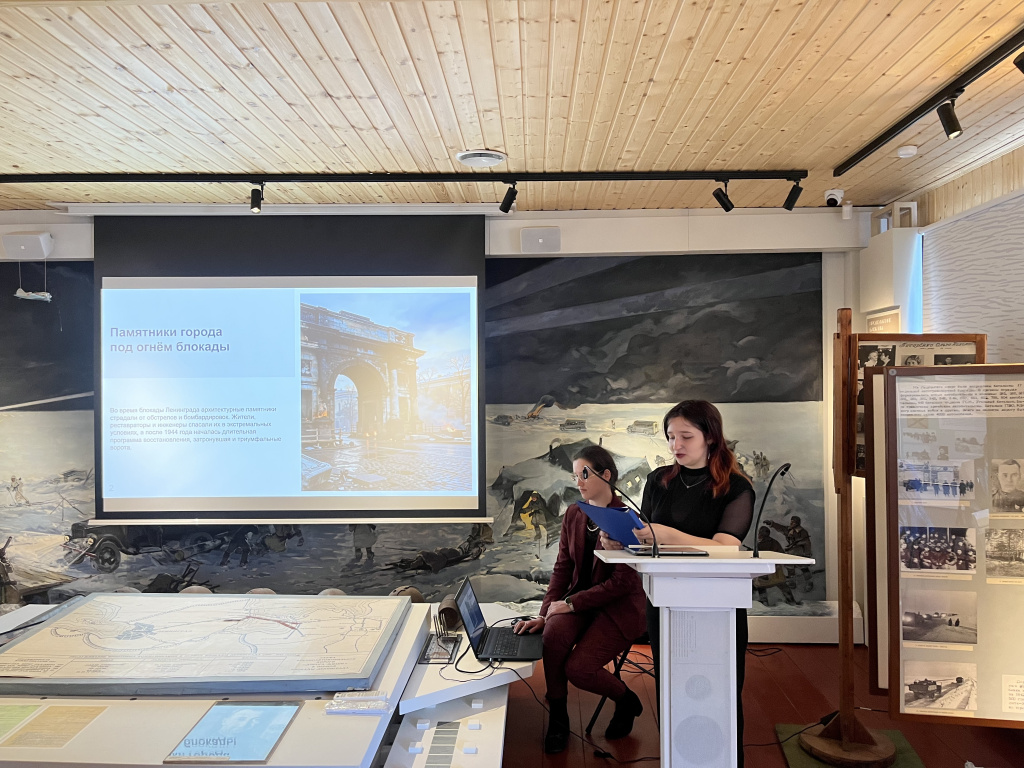 A report by Ekaterina Shubitova (at the stand) and the head of the student scientific society of the Faculty of Architecture, Natalia Grigorieva
Architectural camouflage became a key area of their work. Many recognizable landmarks in Leningrad required protection from enemy airbombing. Architects developed designs that concealed important buildings and structures, altered their visual appearance, and hindered enemy orientation. This work required not only engineering expertise but also creativity, as it was necessary to preserve the architectural value of the structures while simultaneously ensuring their safety.
Equally important was the work of recording and preserving historical memory. During the war, architects and artists created sketches, drawings, and measurements of buildings, documenting destruction and damage. Many of these materials later became the basis for restoration work. Thanks to their efforts, it was possible to preserve information about architectural monuments and prepare restoration plans.
A separate topic of the conference was the city's post-war revival. Victory did not mean the end of the trials. Specialists faced the enormous task of restoring the city's devastated economy, housing, industrial plants, and cultural monuments. Leningrad had to not only restore its lost appearance but also preserve its historical identity.
The city's reconstruction became an example of incredible professional and human achievement. Architects, engineers, and builders worked to restore palaces, cathedrals, memorials, and urban ensembles. They strove not only to repair the damage but also to preserve the historical authenticity of the monuments and pass on to future generations the cultural heritage that had survived the war.
Conference participants were particularly interested in research devoted to the restoration of architectural monuments and memorial sites in St Petersburg. This work provided a fresh perspective on the role of architecture as a tool for preserving historical memory. After all, each restored monument becomes not just a cultural heritage site, but a symbol of the resilience of the city and its residents.
The participants paid special attention to Leonid Yulyevich Galperin, a graduate of the Leningrad Civil Engineering Institute (LISI, now SPbGASU), a military engineer, architect, and one of the founders of the "Road of Life Motorists' Headquarters" museum. His life exemplifies how professional calling can be combined with service to the Motherland and the preservation of historical memory. Research into his work allowed conference participants to see the connection between the heroic past and contemporary efforts to preserve historical heritage.
The Day of Remembrance and Sorrow is not only a day of remembrance of the tragic events of the past. It is an opportunity to reflect on the price paid for preserving our cities, culture, and historical memory. For Leningrad and St Petersburg, which survived the siege, this date has special significance: it recalls the courage of the city's defenders, the resilience of its residents, and the selfless work of those who restored life to the city after the war.