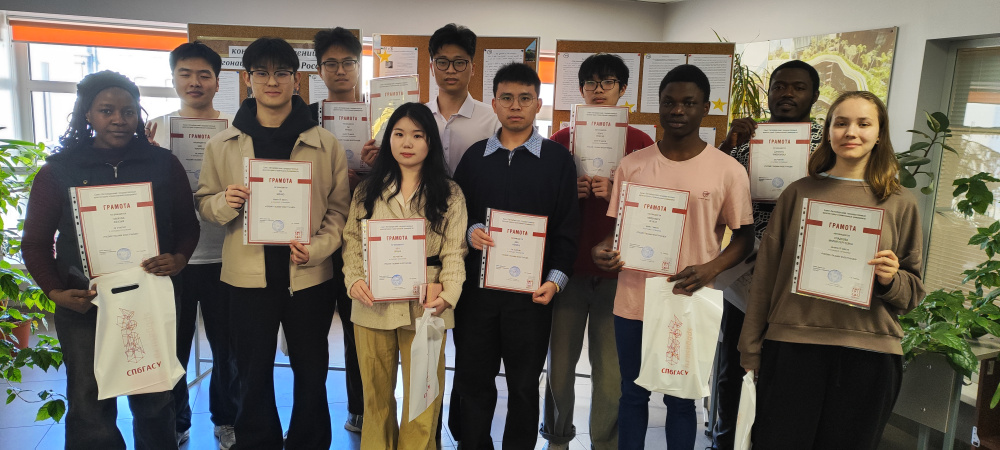
 The competition winners and participants
The Department of Intercultural Communication at the St Petersburg State University of Architecture and Civil Engineering concluded its intra-university essay competition, "Russia through the Eyes of Foreigners," dedicated to the Year of Unity of the Peoples of Russia.
This year, 16 works were submitted to the competition. According to the jury, all the essays were distinguished by their sincerity, depth of personal understanding, and genuine love for the Russian language and culture. The international participants added a special atmosphere to the competition: 14 works were written by foreign students in the Preparatory Department and master's students, and another two by Russian students.
The expert jury assessed the works according to a number of criteria, including depth of topic coverage, originality, independence of judgment, emotionality, and richness of language.
The competition results:
1st place – Wei Jiajun (China), Ernest Niyonkuru (Burundi) and Esmanur Ozturk (Türkiye);
II place – Polina Ivanova, Maria Mikova, Elizaveta Potapova (Russia) and Li Junhong (China);
III place – Li Hunbo (China), Maria Sladkova (Russia), Li Minke (China) and Hoang Ngoc Hu (Vietnam);
The Audience Award was received by Jia Chuanchuan (China) and Wei Jiajun (China).
Russia through personal experience
One of the competition's defining characteristics was the surprising sincerity of the entries. The authors shared personal stories, not abstract reflections, but sometimes touching, sometimes unexpected ones.
Thus, Wei Jiajun admits that before arriving, he imagined Russia as a "distant, cold, and somewhat inaccessible land," but actually experiencing the country completely changed this perception. Russia revealed itself to him through everyday, seemingly unnoticeable details: the kindness of strangers, genuine concern, simple words of support. He notes that a simple "bless you" warmed him "more than any heater," and ultimately concludes that true culture is manifested not in symbols, but in the human connection and respect felt in everyday life.
Language as a path to understanding
The topic of the Russian language, one of the most difficult yet significant aspects of adaptation, runs through this personal experience. Ernest Niyonkuru candidly describes his first experience of communicating, when he knew only "yes" and "no" and struggled to navigate even the simplest situations. Gradually overcoming these difficulties—from cases to pronunciation—he comes to understand that Russian is indeed difficult, but persistence and practice make it "closer and more understandable."
Hoang Ngoc Huy develops a similar idea, emphasizing that real progress begins when language ceases to be just an academic subject and becomes part of everyday life: trying to “speak not perfectly, but honestly” helps overcome fear and feel confident.
Multinational Russia through the eyes of students
An equally important theme of the competition entries was Russia's cultural diversity. For many international students, this was a true revelation. Li Hongbo calls "unity in diversity" the country's main strength, describing her experience interacting with representatives of different nationalities and learning about their traditions. Cheng Xinya (China) also notes that she initially expected a more homogeneous picture, but already at university, she encountered a diversity of cultures, languages, and customs. This manifests itself naturally in everyday life: students study, communicate, share traditions, and gradually learn to understand each other.
History, memory and personal experience
A number of works presented Russia not only as a modern space but also as a country with a deep historical memory. Reflecting on St Petersburg, Li Junhong depicts it as a city of contrasts, where the grandeur of imperial architecture coexists with the memory of the tragic pages of the past. In his perception, "the gold of palaces and the black bread of the siege" are part of a single historical experience that cannot be understood by the mind alone—it must be felt.
Russia feels home
Despite the diversity of themes and subjects, the participants' works share a common conclusion: Russia's greatest treasure is its people. It is through communication, friendship, and mutual support that the country becomes close and understandable. This is particularly movingly written about by Nakachwa Fauzia (Uganda), for whom St Petersburg gradually became a home—thanks not only to the city's beauty but also to the people who became her "family of friends."
The "Russia Through the Eyes of Foreigners" competition once again confirmed that culture and genuine interest in each other know no boundaries. Despite differences in language and traditions, it is openness, respect, and personal experience that help people find common ground—and see a new country as more than just a place to study.