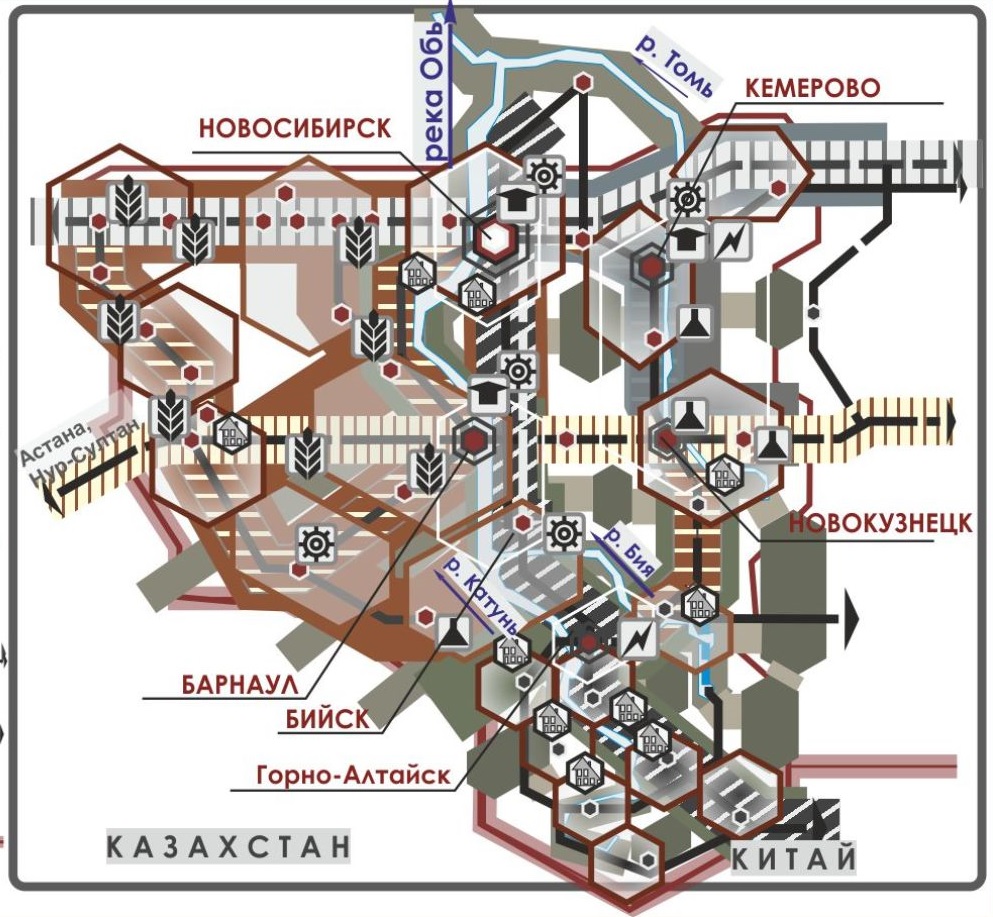
Pavel Skryabin, PhD of Architecture, Associate Professor at the SPbGASU Department of Urban Planning, has conducted research on using urban planning methods to retain and develop the territories of Southern Siberia—areas of vital importance to the country.
The relevance of this study stems from the shift in the direction of Russia’s economic development and the growing importance of the territories east of the Urals. As Russian President Vladimir Putin noted at the SPIEF plenary session on 7 June, 2024, the modern development of Siberia and the Russian Far East could not be built solely on the distribution of land; knowledge and technology are becoming the key means of production.
Pavel Skryabin’s work examines the possibility of shifting from a concentration of the population in a few major cities to a more distributed settlement system—one involving the development of a network of small and medium-sized cities and towns. The author envisions this approach as a way to create a more livable environment while simultaneously supporting the demographic development of these territories.
One of the key areas of research was the study of the relationship between the spatial organization of the urban environment and demographic dynamics. The author demonstrates that population size and natural reproduction are influenced not only by socioeconomic factors but also by the characteristics of the urban environment itself.
An interdisciplinary approach combining urban planning, landscape topology, demography, and behavioral models has been proposed to assess the urban development potential of territories. Based on this approach, a concept of "geostructural urban development" was formulated and tested using the Novosibirsk agglomeration as a case study.
The study examines specific settlement hubs: the science city of Koltsovo; the towns of Ob, Iskitim, and Berdsk; and the urban-type settlements of Krasnoobsk, Kolyvan, and Moshkovo. For these locations, assessments were conducted regarding transport accessibility, economic specialization, population dynamics, and geolandscape characteristics.
The results demonstrate a link between the spatial layout of settlements and the living conditions within them. As a case study, the author examines the compact, multifunctional structure of Koltsovo, while analyzing the linear, sprawling layouts of Iskitim and Moshkovo in terms of the associated constraints on spatial development and factors driving population outflow.
Measurable criteria for the attractiveness of the urban environment—such as time and area metrics, the ratios of functional zones, and the accessibility of facilities—became a key part of the work. The calculations were based on a methodological framework, incorporating a network-based approach, the isochrone method, gravity modeling, and geotopological measurements.
The developed tools are designed for practical application in the preparation and revision of spatial planning documents. In particular, the research findings can be utilized in developing spatial planning schemes for the Novosibirsk, Iskitim, Kochenyovo, Moshkovo, Kolyvan, Ordynskoye, and Toguchin municipal districts, as well as in revising the master plans for Berdsk, Iskitim, Ob, Koltsovo, Moshkovo, Krasnoobsk, and Kolyvan.
This work continues research into the urban development of nodal settlement systems in Siberia. Future plans include refining the boundaries of the Novosibirsk agglomeration, developing a master plan, and considering adjustments to its socio-economic development strategy using a geostructural urban development methodology.
This news item is published based on the results of a 2026 SPbGASU grant project.