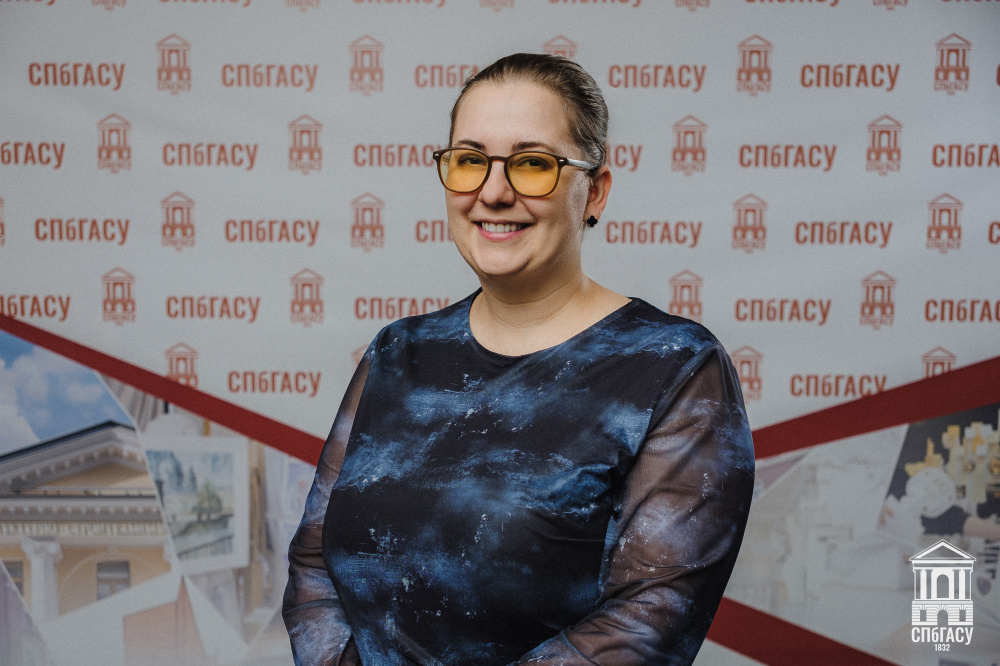
 Alena Vedernikova
Alena Vedernikova, PhD of Engineering Sciences, Acting Head of the Department of Information and Mathematical Modeling Technologies at Saint Petersburg State University of Architecture and Civil Engineering, investigated the behavior of concrete-filled tube structures in limit and post-limit states and developed an engineering method for determining their load-bearing capacity.
Concrete-filled steel tube structures consist of steel pipes filled with concrete. They are most commonly used as columns in high-rise and multi-story buildings. According to Alena Vedernikova, these structures combine cost-effectiveness, fire resistance, and uniform stability, while modern technologies allow for significantly faster construction compared to reinforced concrete structures. In addition to buildings, concrete-filled steel tubes are used in the construction of bridges, television towers, and power transmission line supports.
The relevance of the study stems, among other factors, from the need to assess the behavior of structures after reaching their limit states.
In particular, current regulatory documents lack recommendations for determining the limit states of concrete-filled steel tubular structures—information essential for analyzing the resistance of buildings and structures to progressive collapse. Yet, determining the residual load-bearing capacity of elements following a loss of strength and stability is a crucial aspect of such analyses.
One of the key outcomes of the work is an engineering methodology for calculating concrete-filled steel tube structures in both limit and post-limit states. It enables the determination of a structure's load-bearing capacity at various stages of deformation. A distinctive feature of the proposed approach is the use of a numerical-analytical method, which allows for rapid calculation results without the need for additional testing.
The developed methodology can be employed in computational software as an additional tool for result verification, cross-section selection, and optimization. This enables the rapid assessment of the residual load-bearing capacity of concrete-filled steel tubular structures.
One of the challenges encountered during the research was finding data to compare the results of the developed methodology with numerical modeling of concrete-filled steel tubes performed using specialized finite element analysis software. An internship at a specialized organization conducting such calculations helped resolve this issue.
Alena Vedernikova shared her impressions of defending her PhD dissertation: "The overriding feeling after the defense is that a major chapter of life has come to a close, accompanied by a sense that you are capable of achieving a great deal. Preparing for and defending a dissertation is a complex, multi-stage process—one that is interesting and exciting, yet demands total dedication, deep engagement, strong organizational skills, and the ability to withstand significant nervous strain."
The study opens up possibilities for further work with the results obtained for the post-limit deformation stages of concrete-filled steel tube structures. In 2026, Alena Vedernikova also published an article on this topic in the Privolzhsky Scientific Journal.
The researcher specifically highlights the role of her academic supervisor, Professor Grigory Ivanovich Bely. According to her, when working on a dissertation, it is particularly important to have a research plan, maintain contact with the supervisor, and regularly report on the work accomplished.
"I consider it important that my academic supervisor, Professor Grigory Ivanovich Bely, always finds time for his PhD students, and I am very grateful to him for his mentorship," said Alena Vedernikova.
This news item is published based on the results of a 2026 SPbGASU grant project.