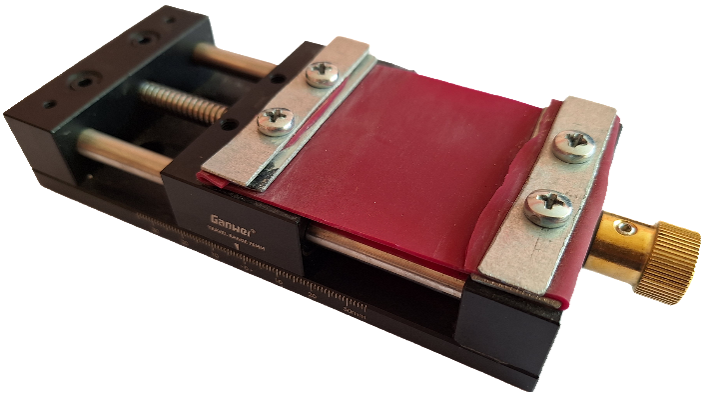
 Apparatus for determining the mixture ductility
The Saint Petersburg State University of Architecture and Civil Engineering has developed a mathematical model that makes it possible to predict the plasticity of cement paste and more accurately select the properties of construction mixtures for additive manufacturing.
The study was conducted by Georgy Khrenov, PhD of Engineering Sciences, Associate Professor at the Department of Technology of Construction Materials and Metrology under the academic supervision of Yury Pukharenko, DSc in Engineering, Professor, and Corresponding Member of the Russian Academy of Architecture and Construction Sciences (RAACS).
The work aims to address one of the key challenges in construction 3D printing: obtaining a mixture with specified plasticity characteristics.
In additive manufacturing, the material must simultaneously retain the ability to deform during deposition and ensure the stability of the formed layer. To date, however, the formulation of such mixtures has largely relied on experimental trial and error. A mathematical model developed at SPbGASU enables this process to have a more precise scientific foundation.
The model relates the ultimate extensibility of cement paste to its water-cement (w/c) ratio, as well as to the viscosity and surface tension of the liquid phase. This makes it possible to assess how changes in mixture composition affect its deformability and to predict the material's behavior prior to conducting extensive practical testing.
To verify theoretical relationships, researchers at SPbGASU developed a specialized device and a methodology for determining the ductility of finely dispersed construction mixtures. During the experiment, a thin layer of the mixture is applied to a silicone sheet, which is then stretched uniformly until the first cracks appear. This approach makes it possible to determine the material's ultimate extensibility and compare the experimental data with calculations based on a mathematical model.
The tests conducted demonstrated a high degree of agreement between theoretical relationships and experimental results. This confirms the feasibility of using the developed model to predict the behavior of construction mixtures.
The results obtained lay the foundation for the targeted control of the plasticity of materials used in construction 3D printing. In the future, this approach could facilitate more precise mixture formulation and enhance the stability of the additive construction process.
The study was conducted as part of the 2026 grant competition for academic and teaching staff at SPbGASU.