Bachelor’s and master’s final qualifying projects from the SPbGASU Department of Urban Planning were awarded first-degree diplomas at the XXXV International Review-Competition of Graduation Projects, organized by the Interregional Public Organization for the Promotion of Architectural Education (MOOSAO). The competition took place in Kazan.
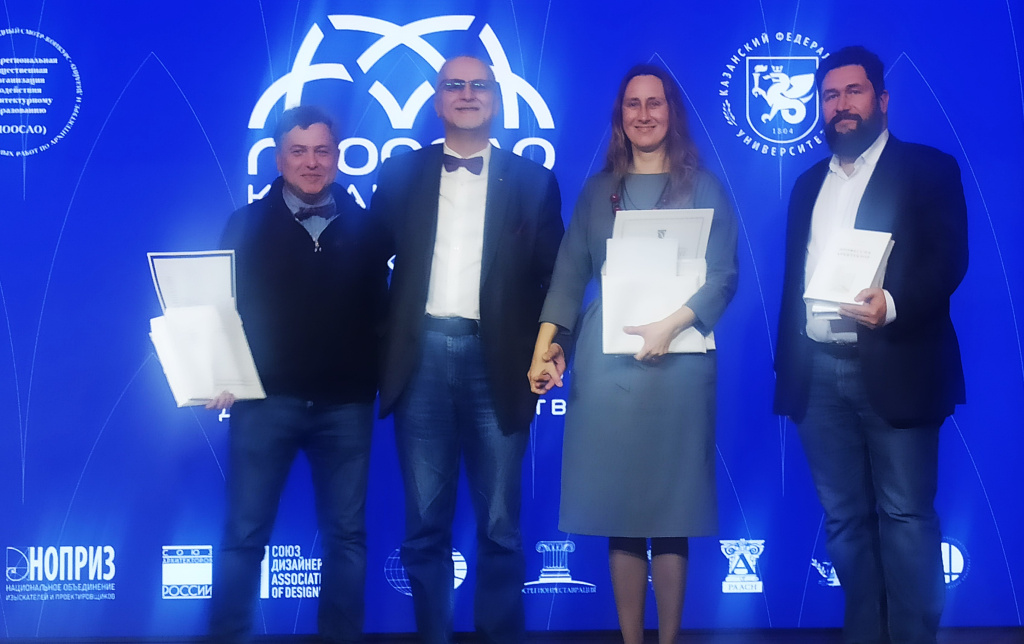 Award ceremony: Mikhail Vilensky, Chairman of the Council of MOOSAO; Fedor Korshakov; Yulia Yankovskaya; and Andrey Surovenkov, Dean of the SPbGASU Faculty of Architecture
Eleven entries were submitted for the competition: four bachelor’s theses and seven master’s theses. All of them received the competition’s top award in their respective categories.
SPbGASU was represented at the event by Yulia Yankovskaya, Head of the Department of Urban Planning, and Mikhail Vilensky, an Associate Professor at the same department.
Bachelor’s projects: from heritage preservation to environmentally sustainable districts
The bachelor’s theses covered a wide range of challenges related to the spatial development of territories—from preserving the historical identity of settlements to creating modern sports and environmental infrastructure.
Arina Akatova presented a project titled "Spatial development of historical settlements of the Volga Germans in the supra-floodplain territories of the Saratov region." The work focuses on preserving the historical environment and developing the settlement network by establishing a cultural-historical route, organizing public spaces, and creating new points of attraction.
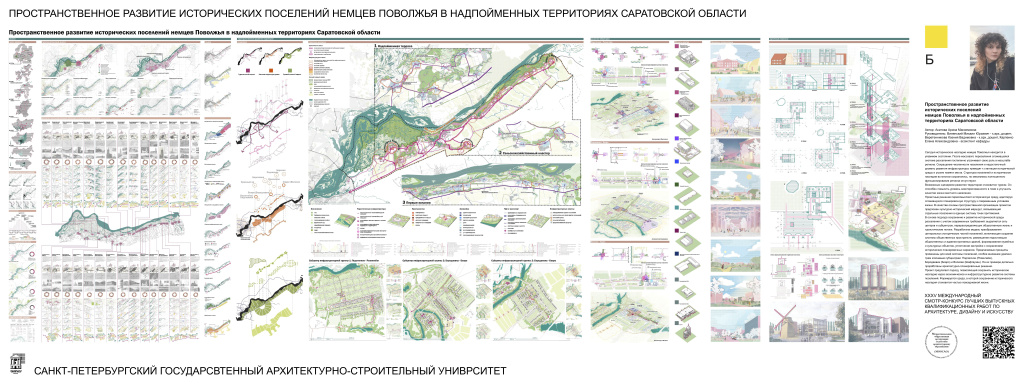 Arina Akatova. Spatial development of historical settlements of the Volga Germans in the supra-floodplain territories of the Saratov region
View in higher resolution
In his project "Development of an eco-sustainable district on a flood-prone coastal area in Sestroretsk," Gleb Ivanov proposed a residential district concept in which flood-protection engineering is integrated into the natural landscape framework. The proposed solutions include multi-level embankments, dry creek beds, floodable parks, and a research center.
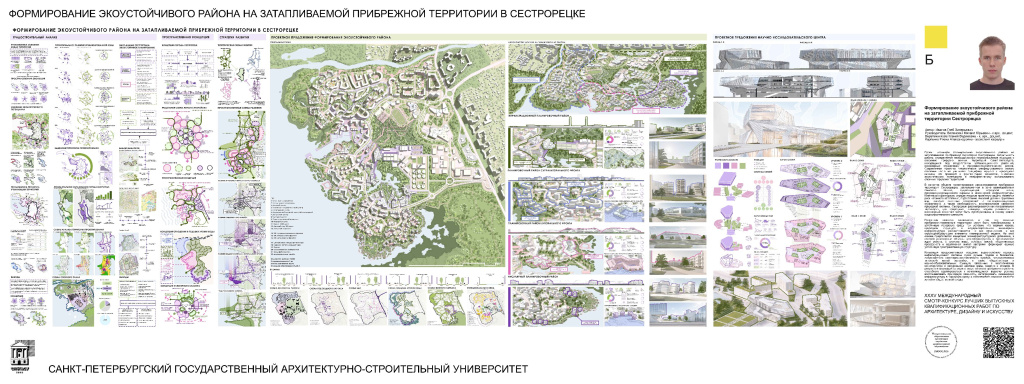 Gleb Ivanov. Development of an eco-sustainable district on a flood-prone coastal area in Sestroretsk
View in higher resolution
Ksenia Krysanova has developed a concept for improving Murmansk’s sports infrastructure. The project envisions a unified sports and recreational system—featuring ice and skiing facilities—integrated into the urban environment, with careful consideration given to the northern climate and local terrain.
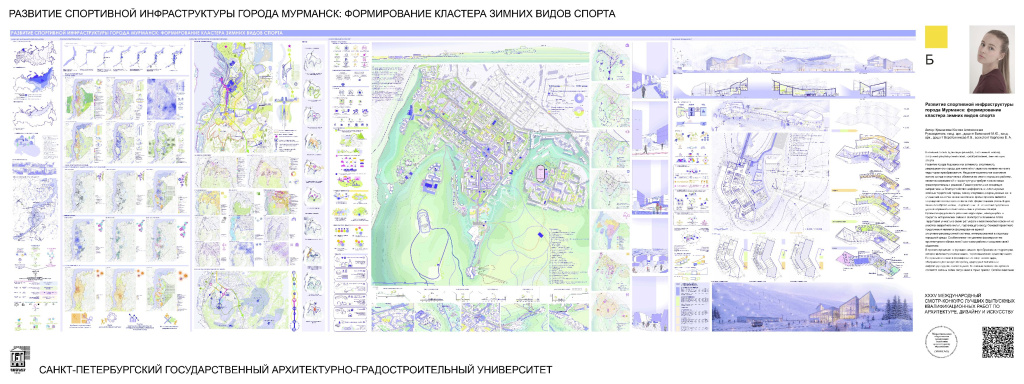 Ksenia Krysanova. Development of sports infrastructure in the city of Murmansk
View in higher resolution
Daria Bliskunova presented a project titled "Vologda: 'City of Craftsmen' creativity district." The project aims to revive traditional crafts and develop a multifunctional complex that integrates residential spaces, workshops, and tourism infrastructure. At the heart of the concept is a public space that combines exhibition, retail, educational, and craft-related functions.
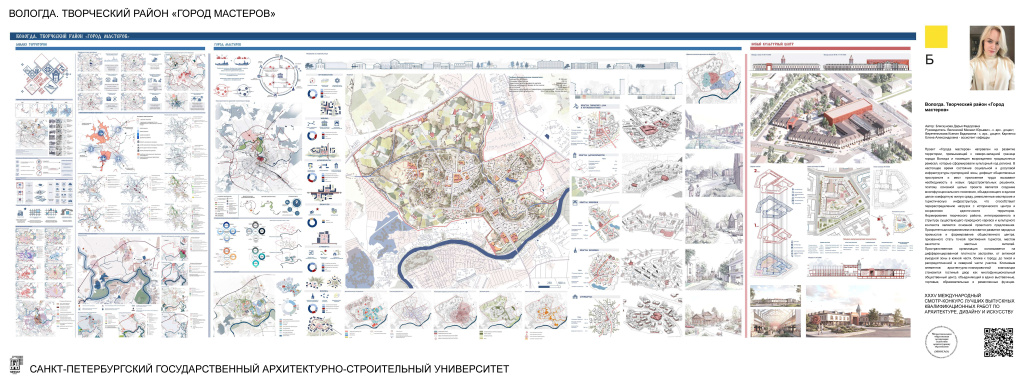 Daria Bliskunova. Vologda: 'City of Craftsmen' creativity district
View in higher resolution
Master’s research: a comprehensive approach to territorial development
The master’s theses address various aspects of the urban development of Russian cities and metropolitan areas. The researches cover the organization of urban infrastructure, the transformation of residential environments, the development of blue-green spaces, and the creation of new hubs for public activity.
Polina Kalinina investigated the distribution of leisure and educational infrastructure for children in the peripheral districts of St Petersburg. The result was a system of spatial planning and standardization that takes into account both the needs of children and the specific characteristics of the urban built environment.
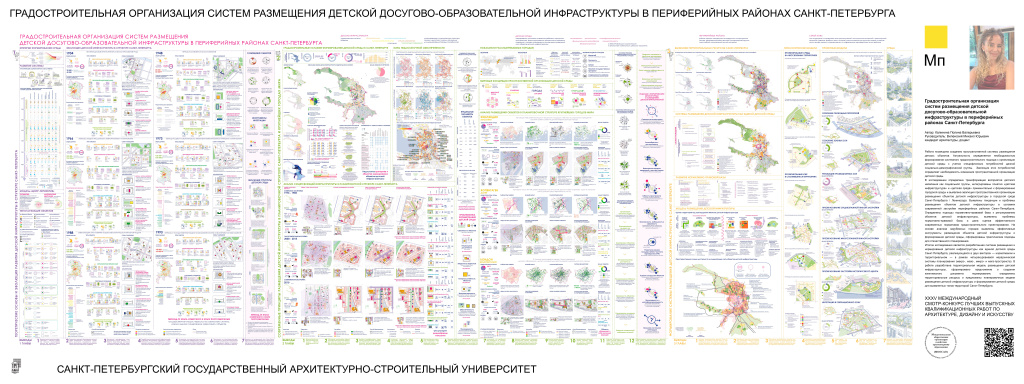 Polina Kalinina. Urban planning organization of systems for the placement of children’s leisure and educational infrastructure in the peripheral districts of St Petersburg
View in higher resolution
Elizaveta Maleeva has developed a methodology for transforming the residential environment of St Petersburg built between the 1960s and 1980s. It entails the modernization of these areas while preserving significant urban planning complexes and the historical continuity of the city’s spatial structure.
Elizaveta Maleeva. A methodology for transforming the residential environment of the 1960s–1980s in St Petersburg
View in higher resolution
Maksim Kolosov examined the principles for locating cultural and entertainment centers in a major city, using St Petersburg as an example. The research aims to develop a polycentric network of cultural spaces, which would expand access to cultural and leisure infrastructure for residents of peripheral districts.
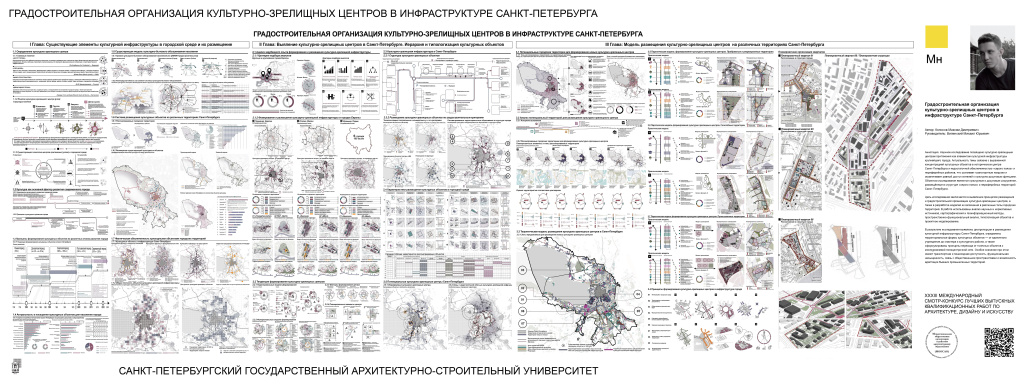 Maksim Kolosov. Urban planning organization of cultural and entertainment centers within the infrastructure of St Petersburg
View in higher resolution
The work of Milana Lonshakova focuses on optimizing the blue-green infrastructure of Perm through the revitalization of the river network within the Perm metropolitan area. The author proposes approaches for transforming riverside areas, aimed at enhancing ecological connectivity and effectively leveraging their urban development potential.
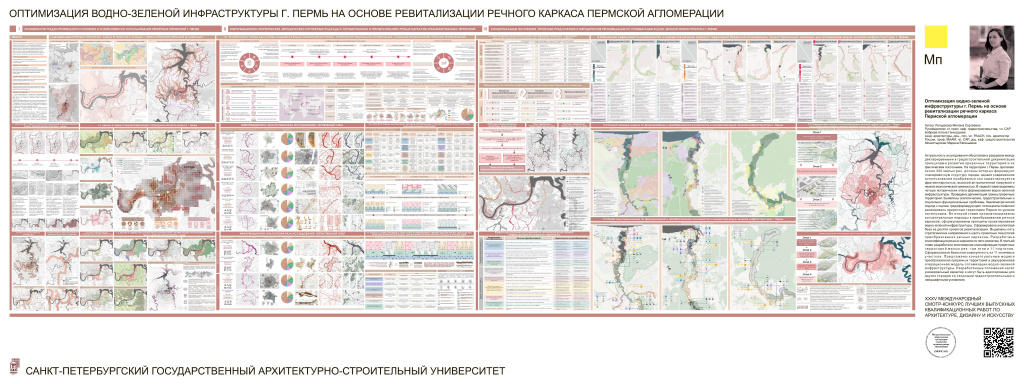 Milana Lonshakova. Optimization of Perm’s blue-green infrastructure
View in higher resolution
Elena Koshkarova has worked out a development strategy for the blue-green infrastructure of Kurgan. The project envisions the creation of an integrated system of green and aquatic spaces, the development of parks and embankments, and the incorporation of flood-mitigation solutions into the city’s urban fabric.
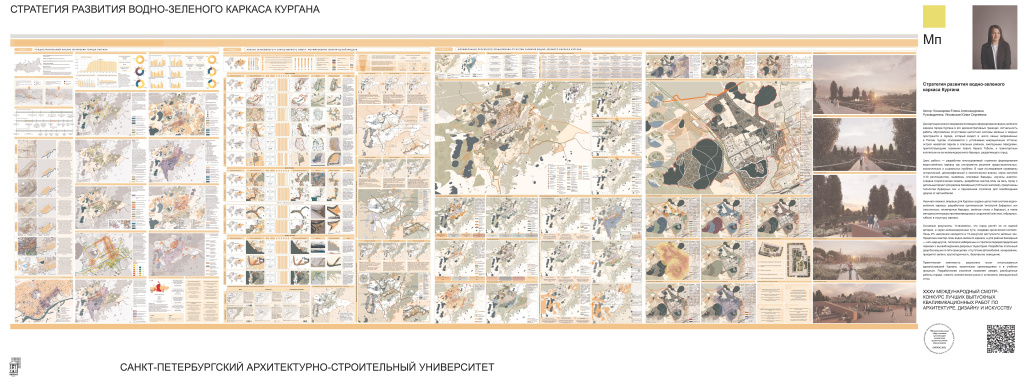 Elena Koshkarova. Development strategy for the blue-green infrastructure of Kurgan
View in higher resolution
Natalia Osina studied the reorganization of the functional-planning structure of the Vladivostok agglomeration western sector coastal zones. The work proposes models for the development of coastal territories and solutions for settlements in the Slavyansk urban district, taking into account the characteristics of agglomeration settlement.
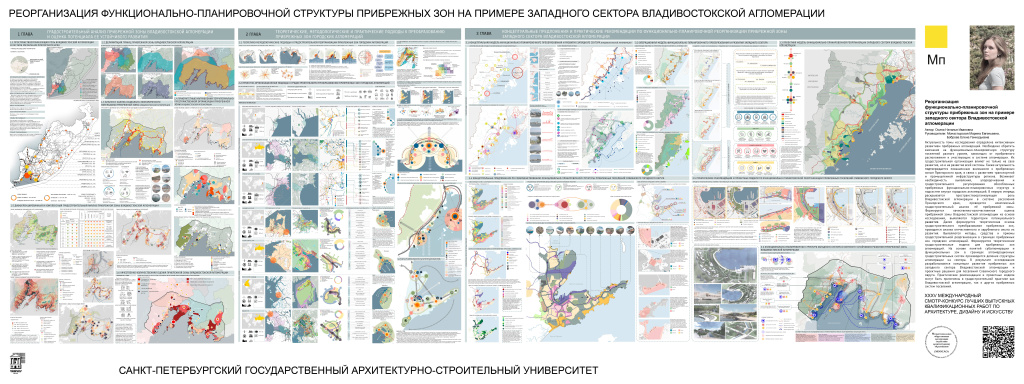 Natalia Osina. Reorganization of the functional-spatial structure of coastal zones: a case study of the western sector of the Vladivostok agglomeration
View in higher resolution
Maksim Zubarev presented a study on the principles for siting and spatially organizing non-permanent tourism infrastructure facilities, using the Volgograd-Volga agglomeration as a case study. The author developed a concept for tourism infrastructure development based on a polycentric "Volga–Don–Akhtuba" network, as well as a design for a comprehensive tourism facility within the Volga-Akhtuba floodplain.
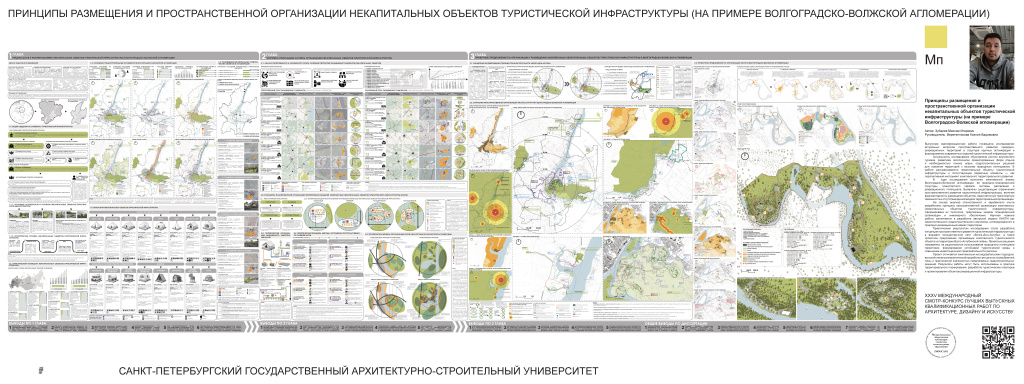 Maksim Zubarev. Principles for the siting and spatial organization of non-permanent tourism infrastructure facilities (a case study of the Volgograd-Volga agglomeration). Reorganization of the functional-planning structure of coastal zones: a case study of the western sector of the Vladivostok agglomeration.
View in higher resolution
Additional awards for graduates and supervisors
In addition to the MOOSAO first-degree diplomas, several graduation projects received special awards from professional architectural organizations and specialized universities.
Among the bachelor’s degree graduates, the following received additional diplomas:
-
Arina Akatova – diploma from the Saratov Regional Branch of the Union of Architects of Russia;
-
Gleb Ivanov and Daria Bliskunova – diplomas from the Union of Moscow Architects.
Among the master’s students, special awards were received by:
-
Elizaveta Maleeva – diplomas from the Union of Moscow Architects and the Sverdlovsk Regional Branch of the Union of Architects of Russia;
-
Elena Koshkarova – diplomas from the Union of Architects of Russia and the N. S. Alferov Ural State University of Architecture and Art;
-
Natalia Osina – diploma from the Nizhny Novgorod branch of the Union of Architects of Russia;
-
Maksim Kolosov – MARCHI diploma.
Also recognized as laureates of the competition were the supervisors of the final qualifying projects that received additional diplomas: Yulia Yankovskaya, Head of the SPbGASU Department of Urban Planning, DSc in Architecture; Associate Professors and Candidates of Architecture Mikhail Vilensky, Marina Monastyrskaya, and Ksenia Veretennikova; and Senior Lecturers Elena Bobrova and Elena Karpenko.
The results of the XXXV International Review-Competition organized by MOOSAO confirm the high level of the final qualifying projects from the SPbGASU Department of Urban Planning, as well as their relevance to the professional architecture and urban planning community.
You can view the submitted works in the gallery of diploma projects on the MOOSAO website.