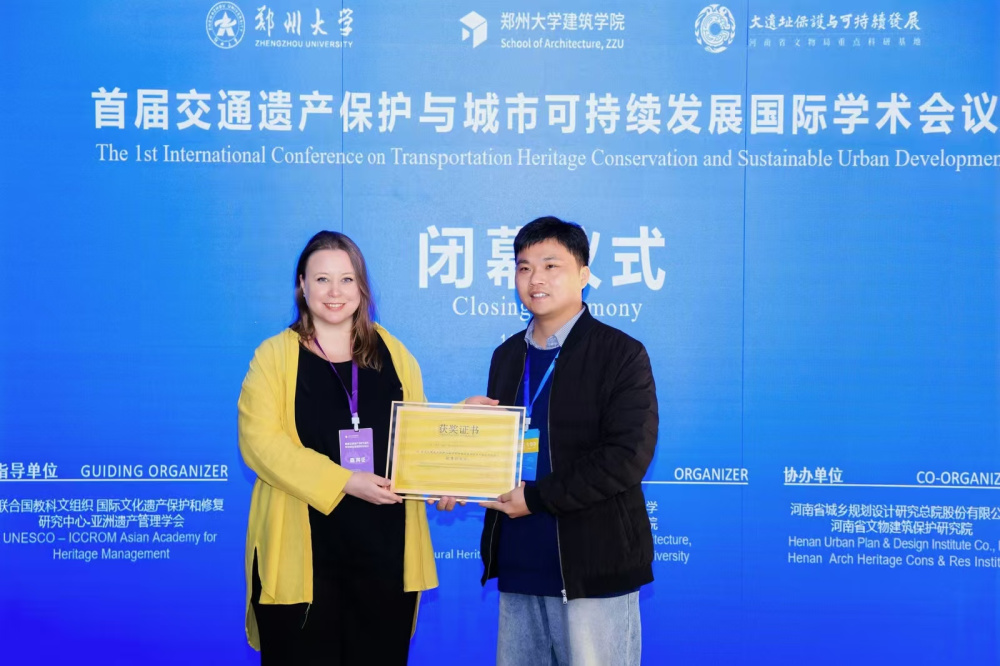
 Olga Pastukh presents a certificate to a graduate student participating in the conference
On 15–16 November , Zhengzhou University (ZZU, China), in collaboration with the Henan Provincial Cultural Heritage Committee, held an international conference, "Transportation Heritage Preservation and Sustainable Urban Development." It was attended by experts in environmental protection, cultural heritage conservation, sustainable development, and representatives of the academic community.
Olga Pastukh, Deputy Dean for Research of the Faculty of Civil Engineering at SPbGASU, Associate Professor at the Department of Architectural and Engineering Constructions, and PhD of Architecture, presented a report at the conference entitled “Architectural aspects of the development of transport routes and rail links between Russia and China in the late 19th – mid 20th centuries.” “Preservation of the historical and cultural heritage of railway strongholds according to the basic principles of reconstruction of historical territories between Russia and China is an important part of preserving history and the basis for further development of cultural communication and international cooperation. The basic principles include the comprehensive reconstruction of individual fragments of the urban environment, including individual architectural objects, taking into account modern urban-ecological norms and rules; preservation and enhancement of the positive qualities of the existing architectural and spatial environment, neutralization or elimination of dissonant development elements; continuity in urban planning and architectural design; streamlining work in the field of identifying architectural monuments; "An individual approach to each cultural heritage site; competent engineering and design support for the projects; development of reconstruction projects on a competitive basis; and development and consideration of regional urban planning norms and regulations," she noted.
Presenting reports on the situation in their countries, the plenary session participants emphasized the need for international cooperation in preserving cultural heritage, sites, and settlements formed along transportation routes, including the Silk Road and the Trans-Siberian Railway, which connected European Russia with the Far East and China. Furthermore, the speakers noted the undeniable importance of restoring intercultural interaction to preserve the national authenticity of heritage sites and conducting joint research in this area.
Thematic sections featured presentations by international specialists, as well as master's and doctoral students conducting research, archaeological, and project work in relevant areas under academic supervision. Following the section sessions, the students received certificates of honor from the conference's international guests.
At the closing ceremony, held at the Institute of Architecture at Zhengzhou University, the distinguished professor, UNESCO Fellow in Cultural Studies and Head of the Asian Association of Cultural Heritage Management (AAHM), spoke. He thanked all participants for their active discussion of the cultural heritage issues of transport cities and ways to further develop them, taking into account modern environmental standards and economic aspects within the framework of sustainable territorial development.