On 29 October, the Department of Intercultural Communication (IC) at the Saint Petersburg State University of Architecture and Civil Engineering hosted the II International Symposium, "From Traditions to Innovations in Foreign Language Teaching." The event focused on contemporary approaches and innovative methods for teaching humanities subjects within a technical university setting. Researchers from seven countries—Belarus, Kazakhstan, Kyrgyzstan, Turkey, Italy, the People's Republic of China, and Russia—participated in the symposium. The Russian audience included speakers from Saint Petersburg, Moscow, Nizhny Novgorod, Smolensk, Omsk, and Barnaul.
The goal of the event was to refine strategies and improve the quality of foreign language education, analyze existing challenges, and identify effective solutions aimed at integrating advanced pedagogical technologies.
At the opening of the symposium, the participants were welcomed by Elena Selezneva, PhD of Pedagogical Sciences, Head of the Department of Intercultural Communication, and Elena Chirkova, DSc in Pedagogics, a Professor at the same department. The head of the department emphasized the importance of professional interaction and the exchange of practical experience among educators from different countries and educational institutions.
In her presentation, Elena Chirkova highlighted the need to preserve research findings and methodologies for future generations of scholars and students. She likened research work to footprints in the sand, which can fade away over time. "May today’s symposium not be just a footprint in the sand, but rather the foundation for a new linguistic architecture," she said.
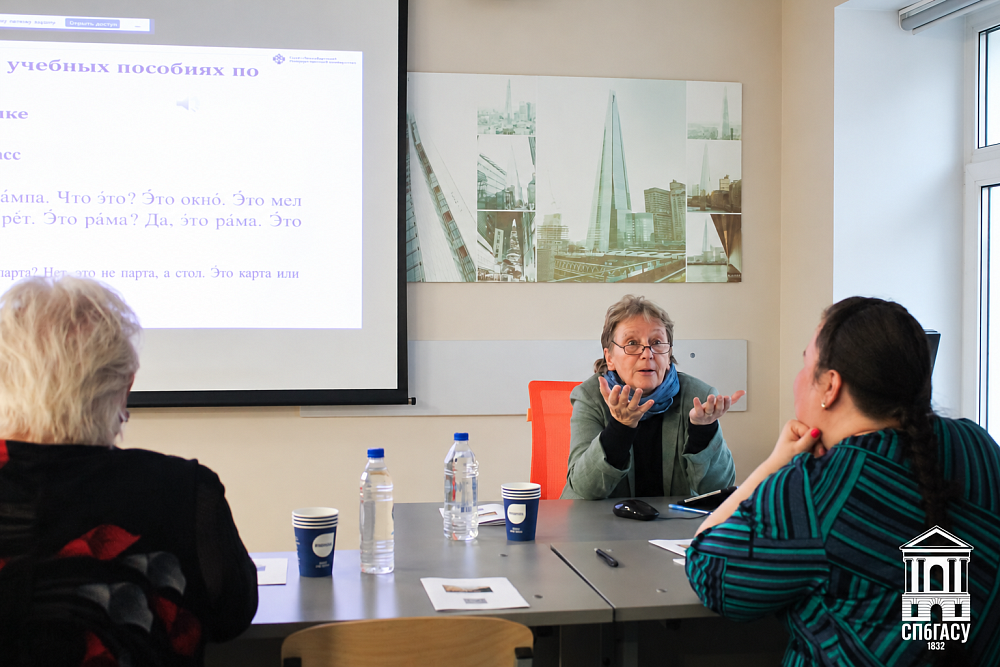
The first plenary presentation, delivered by Nina Fedotova, DSc in Pedagogics, Associate Professor at the Department of Russian as a Foreign Language and the Methodology of Its Teaching at Saint Petersburg State University, focused on the issue of reduced phonetic training in the teaching of Russian as a foreign language. This, in turn, has led to the presence of foreigners in our country who are unable to communicate effectively.
Olga Minina, Head of the Department of English for Professional Communication at the Herzen State Pedagogical University of Russia, shared an interesting experience regarding the application of a practice-oriented approach to teaching English. Students were able to apply the knowledge they gained in their adult lives—including for the purpose of launching their own startups.
Karine Chiknaverova, a regular participant in our conferences, DSc in Pedagogics, Professor at the Department of English at the Odintsovo branch of MGIMO University, presented a comparative analysis of the translation of legal terms from English into Russian.
The reports of the sectional meeting were devoted not only to linguistic and didactic topics, but also to philosophy.
Vera Lobastova, an Associate Professor at the Department of Social Sciences at Saint Petersburg State University of Industrial Technologies and Design, explored the topic of the apperceptive intentions of a word. Elena Chirkova proposed a creative approach to teaching dialogic speech in foreign language classes. She presented her paper alongside students from the university’s Faculty of Architecture.
The researchers focused particular attention on the potential of artificial intelligence and digital platforms within the educational process, the development of learning materials, and the cultivation of professional competencies. Elena Zorina, an Associate Professor at the Department of Civil Law and Procedure at the St Petersburg University of Management and Economics, presented the capabilities of AI for creating literary texts that incorporate subtle didactic elements. Daria Averyanova, coordinator of international educational projects and development for the Russian-as-a-foreign-language platform at the IPR Group of Companies, provided an example of using AI to assess written assignments.
Colleagues from the Saint Petersburg State Chemical-Pharmaceutical University—Grigory Rozhkov, Head of the Department of Foreign Languages and Intercultural Communication, and Senior Lecturer Aleksandra Efimova—shared their experience in organizing project-based activities and discussed the role of such work in the training of pharmaceutical specialists.
Svetlana Ryurikova, a young researcher and assistant at the SPbGASU Department of Intercultural Communication, delivered a presentation on defining the concept of patent discourse.
The symposium gave teachers and researchers from different countries and regions the opportunity to present their scientific and methodological developments, exchange experiences and discuss prospects for cooperation. Our university continues to develop platforms for professional dialogue that unite representatives of the scientific and educational community.