Nadezhda Batova, Senior Lecturer at the SPbGASU Department of Technosphere Safety, completed research work on the topic “Increasing the labor safety of workers performing work at height in the construction industry, based on improving the model of safe behavior” as part of a grant competition for research work by scientific and pedagogical workers of the St Petersburg State University of Architecture and Civil Engineering in 2026.
The study was based on the premise that increasing worker competence can reduce the number of accidents on construction sites caused by the human factor. Accordingly, a training methodology utilizing modern educational technologies was developed and tested to ensure the safety of workers exposed to a high risk of falling from heights. The training process algorithm devised as part of this methodology comprises a six-step cycle and serves as a guide for a sequence of actions aimed at acquiring knowledge and skills in occupational safety (Fig. 1).
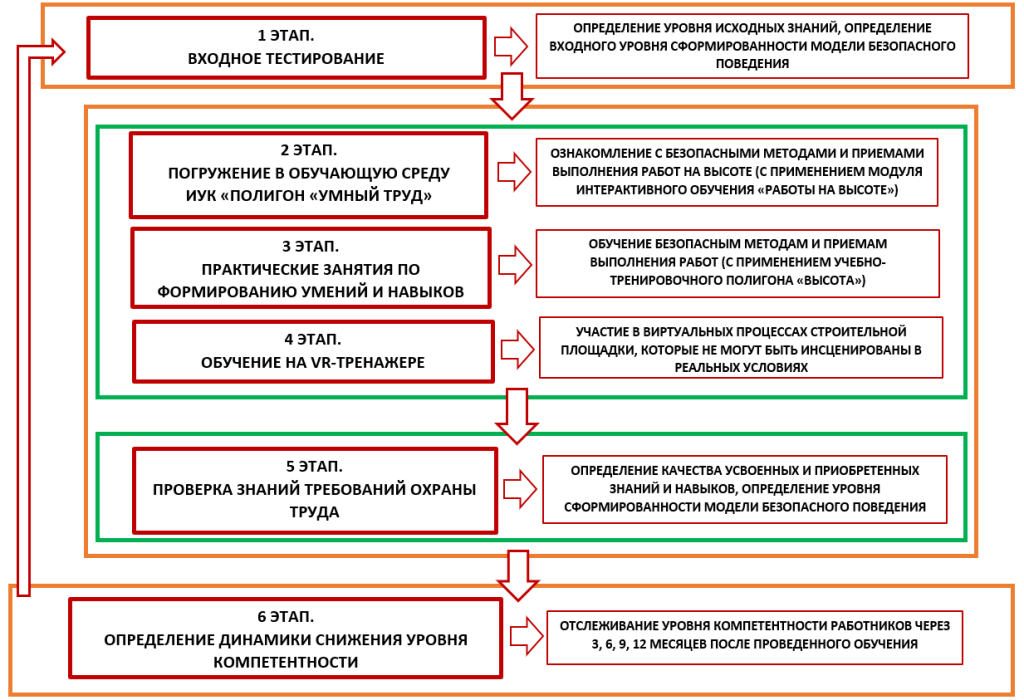 Fig. 1. Training process algorithm using modern educational technologies to ensure the occupational safety of workers at high risk of falling from heights.
One of the most important stages in the training process is verifying its effectiveness and assessing the quality of the knowledge and skills acquired. In the context of occupational safety training, this stage involves verifying knowledge of safety requirements, which makes it possible to evaluate an employee's competence and decide whether to authorize them to perform work.
Existing methods for assessing competence—based primarily on subjective expert opinions and document analysis—have limited reliability and are prone to significant errors. To enhance the objectivity and reproducibility of employee knowledge and skill assessments, a method utilizing Harrington’s desirability function has been developed; this approach enables the combination of multiple competence indicators (test results, practical skill assessments, and situational task outcomes) into a single, integrated metric.
An additional advantage of this assessment method is the minimization of the human factor: it eliminates subjectivity stemming from the personal preferences or fatigue of an expert on the knowledge-assessment panel, allowing competence to be expressed as a quantitative metric—a specific figure derived from calculations. A "safety criterion" has been established: an employee competence level of 0.37 (Fig. 2).
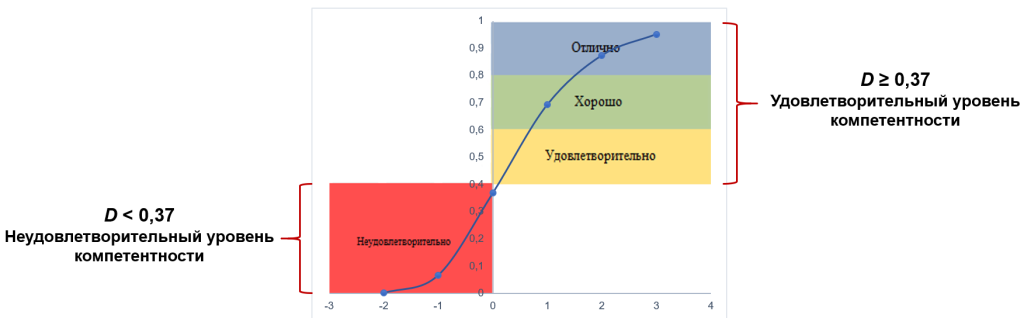 Fig. 2. Conversion of the generalized desirability coefficient value (Harrington function) into the employee's competence level.
The research project involved testing the training methodology on St Petersburg construction workers performing work at heights; the methodology’s effectiveness in maintaining workers' competence levels was confirmed, and articles were prepared for publication in journals included in the VAK list.
A model of safe behavior, developed through training based on a methodological algorithm that employs modern educational technologies for workers at high risk of falling from heights, will facilitate the long-term retention of knowledge and skills regarding safe work practices. This, in turn, will lead to a reduction in injury rates within the construction industry.