Is it possible to gain initial professional experience, build a portfolio, and find a job in your field while still studying—and then become a lead specialist after graduation? The story of SPbGASU graduate Nina Gagulina shows that it is. Her journey began with an interest in 3D modeling back in school and continued through academic projects and competitions; today, Nina helps design firms adopt information modeling technologies.
 Nina Gagulina
In 2026, Nina completed her bachelor’s program at SPbGASU, majoring in "Industrial and Civil Engineering" within the broader field of Civil Engineering, and became a lead BIM specialist focusing on architectural and structural solutions. However, she had no intention of stopping there: she is currently pursuing a master’s degree at SPbGASU in the "Programming and BIM Technologies in Construction" program and is engaged in research activities.
Her story is about how to make the most of university opportunities so that, by the time you graduate, you have not only a degree but also experience that appeals to employers.
Start with what interests you
Nina’s interest in design emerged long before she entered university. In the eighth grade, she attended the St Petersburg Academy of Digital Technologies and trained for the WorldSkills Juniors competition in the Virtual and Augmented Reality Development category.
At that time, the schoolgirl created a floor plan, built a 3D model based on it, and then developed a mobile app to view the design project. That was where she first encountered CAD systems and 3D modeling.
By the time she finished school, Nina already knew she wanted to pursue a career in design, so she chose SPbGASU.
During her first year at the university in 2022, she was introduced to nanoCAD in her computer graphics classes. The students were designing cottages, and the software gradually became a familiar tool in her coursework. Subsequently, Nina used it for her projects throughout her bachelor's degree studies.
"You don’t have to decide right away exactly who you’ll become; it’s far more important to find a field that interests you and develop within it," says Nina Gagulina.
Do not limit yourself to credit assignments
One of the projects that later won an award at the "CAD-Perspective-2026" competition began as an ordinary term project.
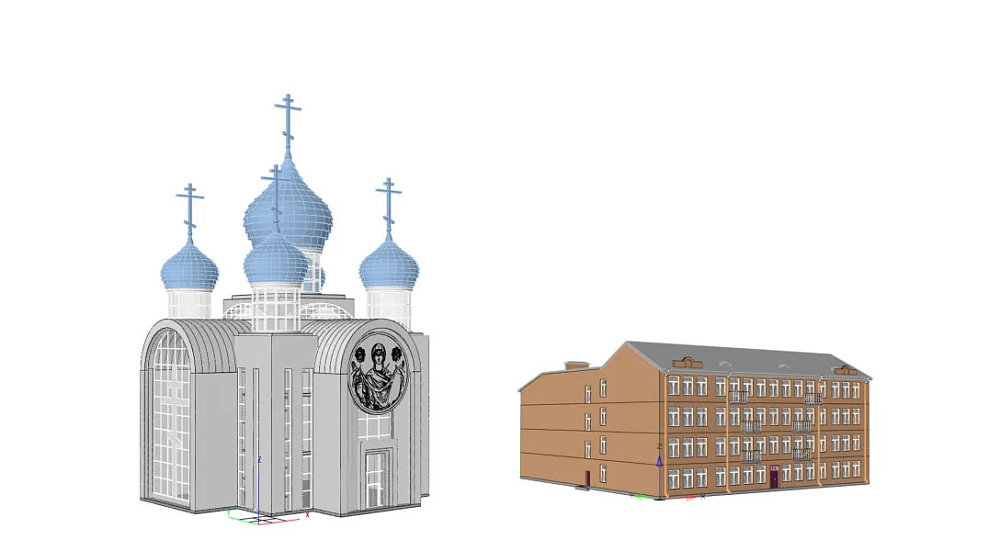
Nina, together with her fellow student Polina Filippova, conducted a survey of a St Petersburg tenement house built in 1879 at 15 2nd Krasnoarmeiskaya Street. The students worked directly at the site for several months, taking measurements, photographing the building, documenting defects, and assessing its technical condition.
Then, based on the results of the survey, they prepared a report and created an information model of the building in nanoCAD.
Moreover, modeling was not a mandatory part of the assignment. The students themselves decided to first create an information model and then generate the necessary drawings from it.
"It was interesting to watch a digital model gradually take shape based on our measurements and photographs," says Nina.
That is how a term paper transformed from a purely academic assignment into a professional project. For a student, this makes a fundamental difference: work done solely for a grade ends once it is submitted, whereas a good project can continue to work for you—in your portfolio, in competitions, or during job interviews.
Student projects at professional competitions
Nina began participating in competitions while still a student. She presented two projects at "CAD-Perspective-2026."
The first is a survey project for a revenue house, carried out jointly with Polina Filippova. The second is a graduation project for the Cathedral of the Smolensk Icon of the Mother of God in Vsevolozhsk.
For her thesis, Nina chose an unrealized cathedral project. Based on the architectural drawings, she was required to develop four sections: architectural, structural analysis and design, organizational and technological, and techno-economic.
Working with non-standard building elements proved particularly challenging. The domes, the stained-glass windows on the drums, and the bas-relief on the facade required independent modeling and the creation of custom parametric objects.
There were virtually no examples in open sources regarding the organization of cathedral construction or ready-made process charts for the installation of the dome system. Consequently, the solutions had to be developed based on regulatory documents and consultations with the supervisor.
As a result, the competition jury awarded the project a special prize “Unique architectural solution in the nanoCAD environment.” Coursework on building inspection also received an award.
According to Nina, this once again confirmed that academic work can be of interest not only to the teacher but also to the professional community.
A portfolio opens the door to the profession
Another important milestone in Nina’s story was finding her first job. It began with a nanoCAD proficiency competition organized by Nanosoft during a career day at SPbGASU. Nina participated twice: she took third place during her second year and first place during her third.
After her victory, she was asked to submit her resume. Soon after, the head of the technical department at the company where she now works contacted her to invite for an interview.
By this point, Nina already had something to show. She collected her educational projects and achievements in a portfolio, including victories in competitions.
"The manager was particularly interested in my knowledge of software products. In the end, we realized we were a good match, and I joined the team," Nina recalls.
And so, the competition—which could have remained just a line item on a list of achievements—became a stepping stone to a first job.
That is precisely why, in Nina Gagulina’s view, a student should not wait until graduation to start building a professional portfolio. A term paper, a thesis, a competition entry, or participation in a research project—all of these can become part of one’s future professional story.
You can combine study and work
Nina began working while still pursuing her bachelor's degree. Initially, she worked part-time as a CAD specialist, with tasks assigned in a way that didn't interfere with her studies; Nanosoft is supportive of employees who are continuing their education, allowing workloads to be adjusted as needed so students can keep up with their university assignments.
Nina now works as a Lead BIM Specialist for architectural and structural solutions. She conducts training, communicates with representatives of design firms, and helps specialists master information modeling tools.
At the same time, professional development did not replace formal education. After completing her bachelor's degree, Nina continued her studies in the master's program "Programming and BIM Technologies in Construction" at SPbGASU.
This creates a continuous chain: interest – study – practice – project – competition – portfolio – first job – further development.
«Give it a try!»
Nina is convinced that students should not be afraid of competitions and new challenges, even when it seems they lack sufficient experience.
"For me, competitions are an opportunity to build a reputation, learn to solve unconventional problems, and figure out what I want to do. In my view, such experience means more than just a line on a resume," she says.
Her own journey confirms this. The first competition provided experience, while the next attempt brought victory. Academic projects formed the foundation of her portfolio, which helped spark an employer's interest. Working gave her the opportunity to gain practical experience even before completing her bachelor's degree. And after graduating, Nina was able to advance to the next professional level.
"Therefore, you don’t necessarily have to wait until you graduate to start your career. Sometimes, the first step is simply going beyond the mandatory curriculum—trying your hand at a competition, taking a course project a step further than required, or creating work you can be proud of. It is precisely through such small steps that a professional path gradually takes shape," concludes Nina Gagulina.