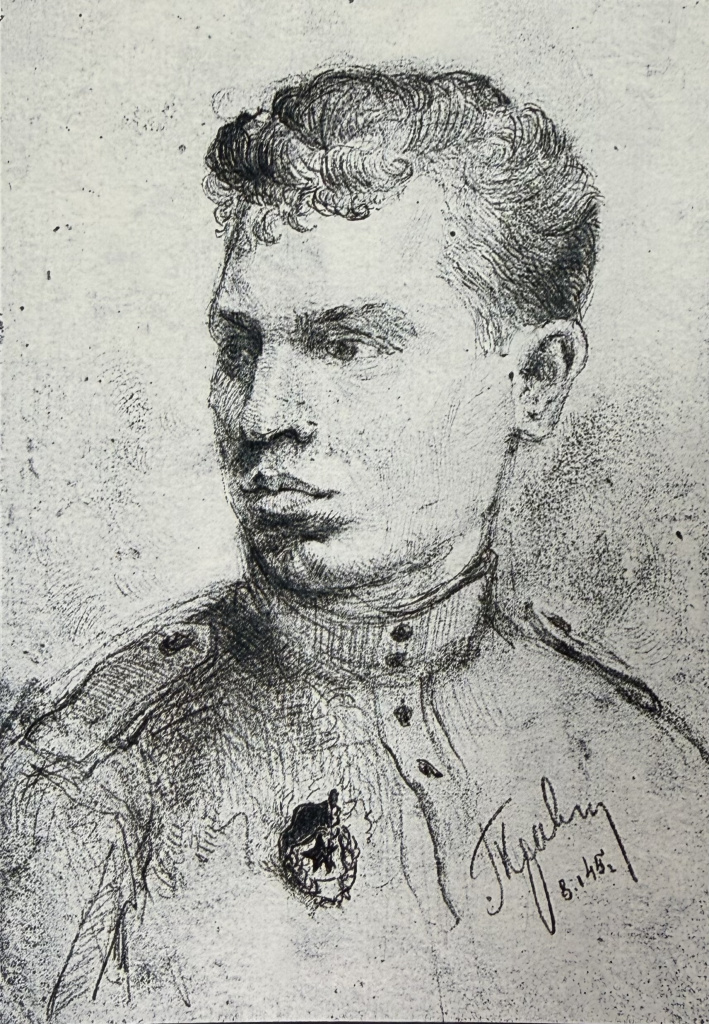
 Gennady Kravets. Self-portrait (1945)
 On Victory Day, the Saint Petersburg State University of Architecture and Civil Engineering once again remembers the destinies of its students and graduates, whose lives were forever changed by the Great Patriotic War. The story of Gennady Ivanovich Kravets, a pre-war student at the Leningrad Institute of Civil Engineering, is not only a chronicle of the frontline roads, but also a profound testimony to human resilience, compassion, and choice.
Presentiment and the beginning of war
The family memory preserves a remarkable episode: on the eve of the war, the family grandmother Antonina Yakovlevna had a disturbing dream—a looming black cloud from which there was no escape. Only prayer stopped the disaster. Later, this dream was perceived as a symbol of the trials to come.
Gennady Ivanovich himself received the news of the war's outbreak without realizing its scale. Recent military conflicts had seemed familiar. But with the fall of major cities, it became clear: catastrophe laid ahead.
Blockade and the fight for life
The war found Gennady Kravets as a student in the Faculty of Architecture of the Leningrad Institute of Civil Engineering (LISI, now SPbGASU). Despite being exempted from military service due to poor health, he remained in the besieged city.
With food rapidly disappearing, resourcefulness saved lives. One day, he bought linseed and walnut oils at an art store—not the kind for cooking, but for painting. These supplies helped him survive the first, most difficult winter.
Students assisted teachers, repaired broken windows, patrolled the city, and extinguished incendiary bombs. During one of his shifts, Gennady Ivanovich suffered a concussion—the first of many.
Hunger drove people to desperate measures: they boiled wallpaper, ate wood glue, and experimented with food substitutes. One such experiment cost the life of his comrade. These tragic episodes became part of everyday life in the besieged city.
"Father recalled how they repaired the broken windows of one of the professors' apartments. They had nothing suitable, so they had to resort to folders containing his works, manuscripts, and expert reports. It was clear that those materials were dear to him as mementos, but what could they do? The apartment urgently needed to be insulated..." (from the memoirs of N. G. Kravets, Gennady Ivanovich's son).
Frontline roads
After evacuation and a brief stint in the Urals, Gennady Ivanovich volunteered for the front. From 1942, he served as a wireman in the 32nd Guards Rifle Division.
His combat path took him through the Northern Caucasus, Kuban, Crimea, Sevastopol, the Baltics, and East Prussia. His work as a wireman required constant risk: under fire, he restored the communication lines upon which the battle depended.
For his courage, Gennady Kravets was awarded the Medal "For Military Merit" and the Orders of Glory, 2nd and 3rd degree. The award documents noted that he repaired dozens of cable faults under constant fire, often risking his life.
"...Before the assault on Sapun Mountain, a very powerful artillery barrage was carried out. G.I. recalled: "the ground shook beneath our feet...", but the infantry, mounting the attack, constantly ran into active machine-gun nests, which they could not suppress. At this most difficult moment, a group of scouts managed to reach the ridge of Sapun Mountain and plant a red banner there. My father said: as soon as they saw the red banner on the ridge, everything changed: everyone moved at once, suppressed the machine-gun emplacements, drove the Germans from their trenches, and took this seemingly impregnable line..." (from the memoirs of N.G. Kravets, Gennady Ivanovich's son).
Between life and death
A frontline soldier's memories are fragmentary, but they contain the living fabric of war. They include terrifying images of bombings, tragic accidents, and rare moments of respite.
He survived severe wounds, including during the assault on Königsberg, where he insisted on surgery without anesthesia to save his leg. He suffered concussions and worked through pain and fatigue.
But even in war, there was still room for humanity: a random mouse that helped him while away the night in a dugout, the music of the waltz "Autumn Dream" that suddenly reminded him of peaceful life, the drawings he created for his comrades.
"During the two years spent at the front, people became accustomed to the war, trying to distract themselves from it, even in small ways... My father was an excellent draftsman, and finding a sheet of thick paper in one of the houses, he drew a self-portrait. His fellow soldiers liked the drawing, so he had to depict each of them. The portraits were sent home to relatives; perhaps they were preserved in the families of veterans – my father's fellow soldiers..." (from the memoirs of N. G. Kravets, Gennady Ivanovich's son).
Victory and return
After treatment in Kranz (now Zelenogradsk, Kaliningrad region), Gennady Ivanovich returned to Leningrad and completed his studies at the institute, interrupted by the war.
His fate is an example of a generation that has gone through inhuman trials and managed to preserve its dignity, humanity, and the desire to create.
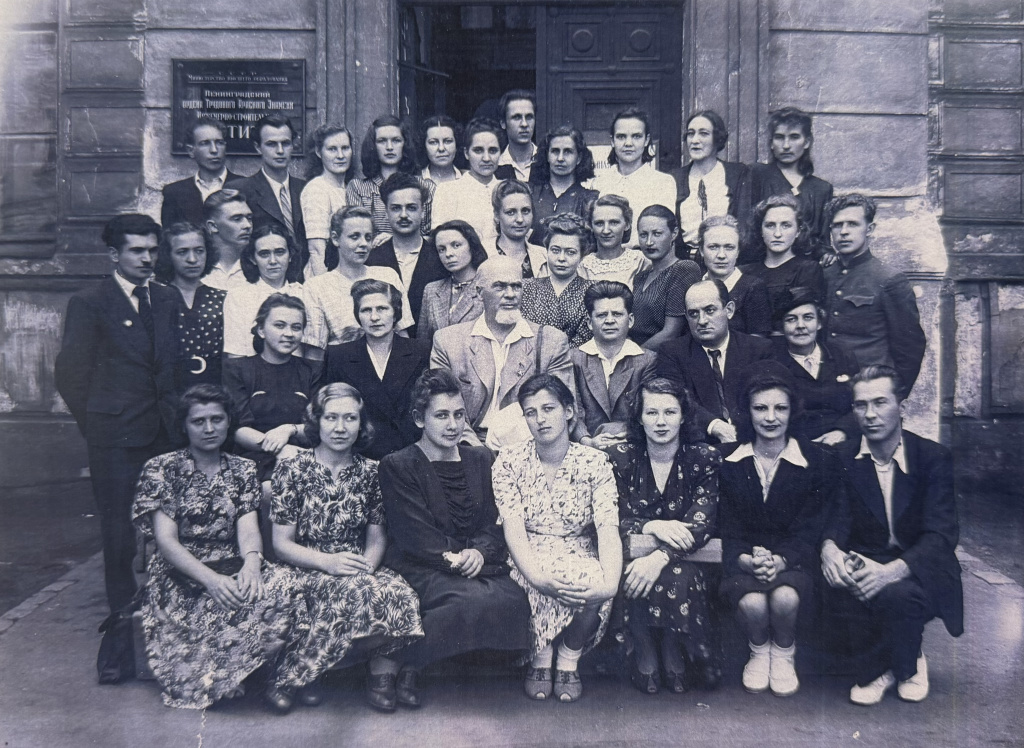 Class of 1949, Faculty of Architecture. Gennady Kravets is first from the left in the top row. In the center is the architect and professor Aleksandr Nikolsky and professor Nikolai Khomutetsky , director of LISI in 1948–1952
Memory that unites generations
The story of Gennady Ivanovich Kravets is just one of many, but it is precisely from such personal testimonies that the university's living memory of the war is formed. LISI students and teachers contributed to both the defense of Leningrad and the subsequent reconstruction of the country.
Today, SPbGASU continues to preserve this memory, passing it on to new generations. Because Victory is not only a military triumph, but also the heroism of those who managed to return to civilian life and rebuild the country.
And this is precisely the special mission of an engineering university: to connect the memory of the past with responsibility for the future.
Other materials of the "Scientific Regiment" project
Our Graduate Built the Road of Life
Front Line of the Architect Aleksandr Nikolsky
Researcher who Developed Science in Besieged Leningrad
Fights of Student Klinov
Engineer of the 3rd Belorussian Front
Nineteen-Year-Old Gunner Stormed Berlin
Path of a Volunteer: from Front-Line Roads to Space Development
Ivan Solomakhin: "The Most Memorable Battle was for this Devil's Hill!"
Fiery Dnieper of the Hero of the Soviet Union Aleksandr Prygunov
Approaching to the Victory
Fedor Komal's Front: from the War Start to the Victory
Junior Political Instructor Boris Gubanov: “Shells Were Whizzing, and the Ground Took off Nearby”
Viktor Kvyatkovsky, Radio Reconnaissance Operator of the Baltic Fleet
How the Chief Architect Nikolai Baranov Kept Leningrad "Hidden" from the Enemy
Architect Nikolai Khomutetsky: Four Years at the Forefront
Semyon Shifrin Thwarted Nazi Plans to Leave Leningrad Waterless
LISI in the Post-War Years
LISI Graduate Mikhail Zherbin, Design Engineer and Composer
Abdulla Mangushev: Four Years at the Front and the Whole Life in Science
Architects Zazerskys Built and Defended the City on the Neva River
Worked His Way Up From a Lieutenant Technician to the Galaxy of Mathematicians
Konstantin Sakhnovsky: From Cadet Of the Russian Empire to Academician of the USSR
Military Architect Of The Front Line Defense And Engineering Intelligence
World-famous scientist, outstanding engineer and national champion
An Outstanding Urban Planner Who Lived And Worked In Besieged Leningrad
Projects by Architect Sergey Evdokimov: from Defensive Structures and City Restoration to Metro Stations
Volunteer Mikhail Laletin: “After the front – to the university, and then, perhaps, to become an officer”
Architect Aleksandr Sokolov preserved and restored cultural heritage
David Goldgor, The Architect And The Sapper
Tamara Smirnova: LISI First-Year Student And The Intelligence Officer
Georgy Shubnikov, a Major Engineer in the Great Patriotic War and a Builder of the First Cosmodromes