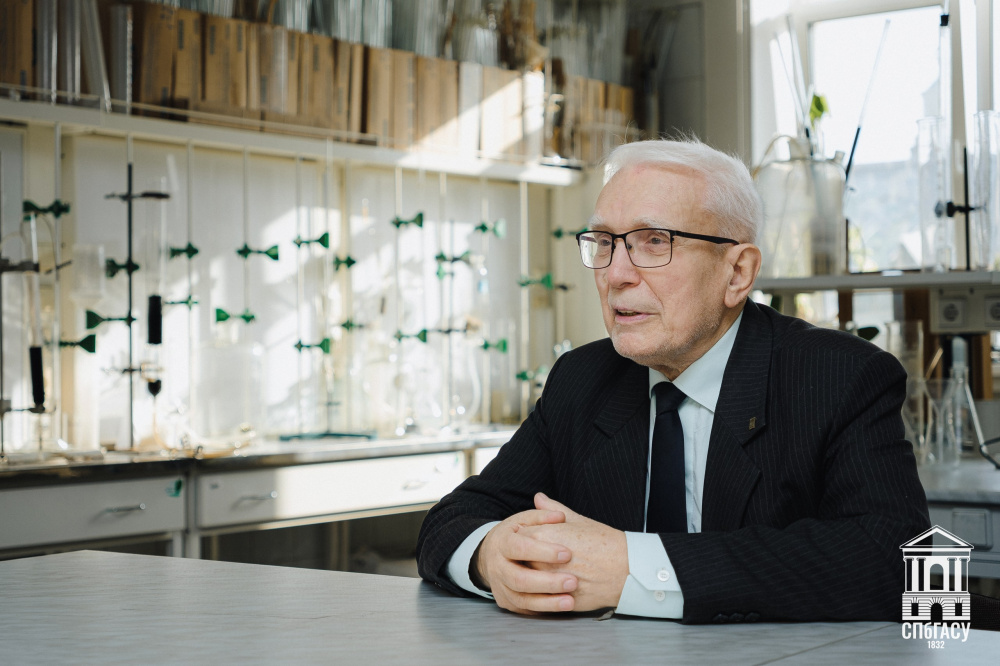
 Yury Feofanov
Professor at the Department of Water Use and Environment of the SPbGASU Faculty of Environmental Engineering and Municipal Services (FEE&MS), DSc in Engineering Yury Aleksandrovich Feofanov shared memories of his scientific career, talked about working with students and explained how the water supply system of St Petersburg was structured.
Yury Feofanov has been working at the university for over sixty years. He began his scientific work immediately after graduating and devoted his time to researching water supply and water treatment systems.
"I've always enjoyed scientific work. Every study is a leap of faith, a search for new solutions. Today you're working on one problem, tomorrow on another, and there's no routine," the professor said.
Over the years, the scientist participated in numerous research and industrial projects. In particular, he developed water treatment systems for closed-loop fish farming facilities. These developments were implemented in production and received international recognition.
"We developed systems for water purification in recirculating systems. These technologies were patented in several foreign countries, and I received a silver medal from VDNKh for one of the developments," noted Yury Feofanov.
The professor places great emphasis on working with students and young researchers. He says there are always those among the students who are truly committed to pursuing science.
"There are people who are drawn to research, and it's very interesting to work with them. But science requires total commitment: if someone decides to pursue science, they must dedicate themselves to it," he emphasized.
Speaking about developing a scientific career, Yury Feofanov notes that it is important for young researchers to maintain an interest in the profession and not be afraid of complex challenges.
"If you are passionate about science, you need to pursue it and move forward, despite the difficulties," the professor believes.
During the conversation, the scientist also discussed the structure of St Petersburg's water supply system and the technologies used to prepare drinking water.
According to Yury Feofanov, the city's main water supply is the Neva River: approximately 98% of drinking water comes from it. Another 2% comes from underground springs in the northern districts and Zelenogorsk.
Water goes through a multi-stage purification system at water supply stations.
"The main process is coagulation. A special reagent is added to the water, which forms flocs and binds suspended solids, organic compounds, and other impurities. The water then passes through settling tanks and filters," the professor explained.
Modern water treatment technologies also include ozonation, activated carbon, and dual disinfection with chlorine and ultraviolet light. These methods ensure high-quality drinking water even when the water conditions in the Neva Basin fluctuate.
The total length of St Petersburg's water supply networks currently exceeds 7,000 kilometers. Nearly 200 booster pumping stations operate to maintain stable pressure in the system, and the network itself is constructed using a ring-shaped design, ensuring water supply remains constant even during emergency situations in certain sections.
The professor also discussed hot water supply. Russia is gradually transitioning from open systems, which use water from district heating networks, to closed systems. In these systems, cold water is heated through heat exchangers and does not mix with the heating fluid.
"According to modern requirements, hot water must meet sanitary standards for drinking water and have a temperature of 60 to 75 degrees," noted Yury Feofanov.
The scientist highlights infrastructure modernization as one of the industry's key tasks. Many of St Petersburg's water supply stations were built in the first half of the 20th century and are gradually being upgraded.
"A program to modernize wastewater treatment facilities through 2035 is currently in effect. New technologies are being introduced and equipment is being upgraded as part of this program," the professor explained.
In closing, Yury Feofanov noted that the conservation of water resources largely depended on the environmental culture of society.
"The simplest thing anyone can do is conserve water and avoid polluting water bodies. Respect for nature begins with everyday habits," he emphasized.
To become a next-generation engineer in the field of public utilities infrastructure (water supply, heat and power engineering, electric power engineering, heat and gas supply, and ventilation), in the field of environmental management, land management, and cadastres apply at the SPbGASU Faculty of Environmental Engineering and Municipal Services.
Application deadline: 17:00 25 July!