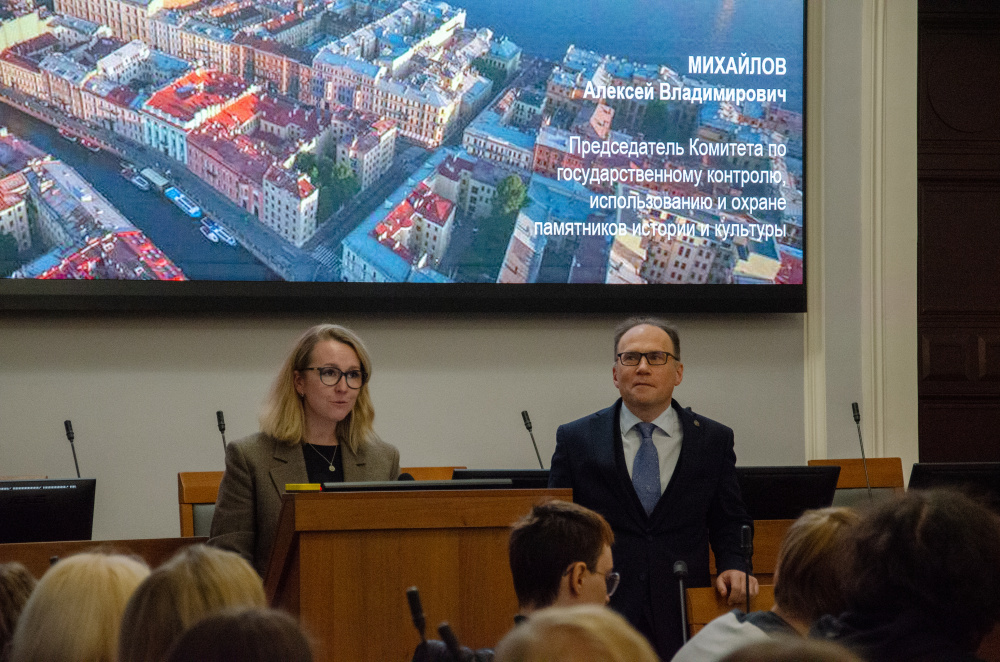
 Viktoria Vinogradova and Aleksey Mikhailov
SPbGASU has launched a lecture series as part of the "Digital Revival of Architectural Heritage Sites in the Leningrad Region" project; a lecture titled "Fundamentals of Cultural Heritage Site Protection" was held with the participation of the corporate department established jointly with the Committee for State Control, Use, and Protection of Historical and Cultural Monuments of the St Petersburg Government (KGIOP).
The first speaker was Aleksey Mikhailov, Chairman of KGIOP, PhD of Architecture, member of the Russian National Committee of the International Council on Monuments and Sites (ICOMOS).
Viktoria Vinogradova, SPbGASU Vice-Rector for Continuing Education, delivered welcoming remarks to the project participants, highlighting the importance of such educational events for both the university and the industry.
The lecture by the Chairman of KGIOP focused on the system for protecting cultural heritage sites and the history of its development in Russia and worldwide. In addition, the audience learned about competitions and other initiatives organized by the committee to foster the development of the cultural heritage restoration sector.
Aleksey Mikhailov paid special attention to the "Code of St Petersburg" educational and outreach project, launched with the support of KGIOP. The project focuses on the unique architectural, natural, and spatial characteristics of St Petersburg’s historic center—the first Russian site to be inscribed on the UNESCO World Heritage List.
The lecture was attended by more than 150 students and teachers from SPbGASU, as well as students from the St Petersburg College of Architecture and Civil Engineering.
"Undoubtedly, a vast layer of culture and the human world of perception are embodied in architecture. Architecture reflects a specific period in human history, a person's sense of place in the world, and the way individuals perceive these architectural structures. Therefore, it is important to preserve the building in such a way that it 'lives on' for many more years while retaining all the layers of time," noted Aleksey Mikhailov.
The lecture was followed by a Q&A, allowing the audience to discuss their questions in greater detail.
Later on, participants in the "Digital Revival of Architectural Heritage Sites in the Leningrad Region" project can look forward to regular lectures by representatives of educational and research institutions, the professional restoration community, and developers of domestic engineering solutions.
 1.jpg)
 1.jpg)
 1.jpg)
 1.jpg)