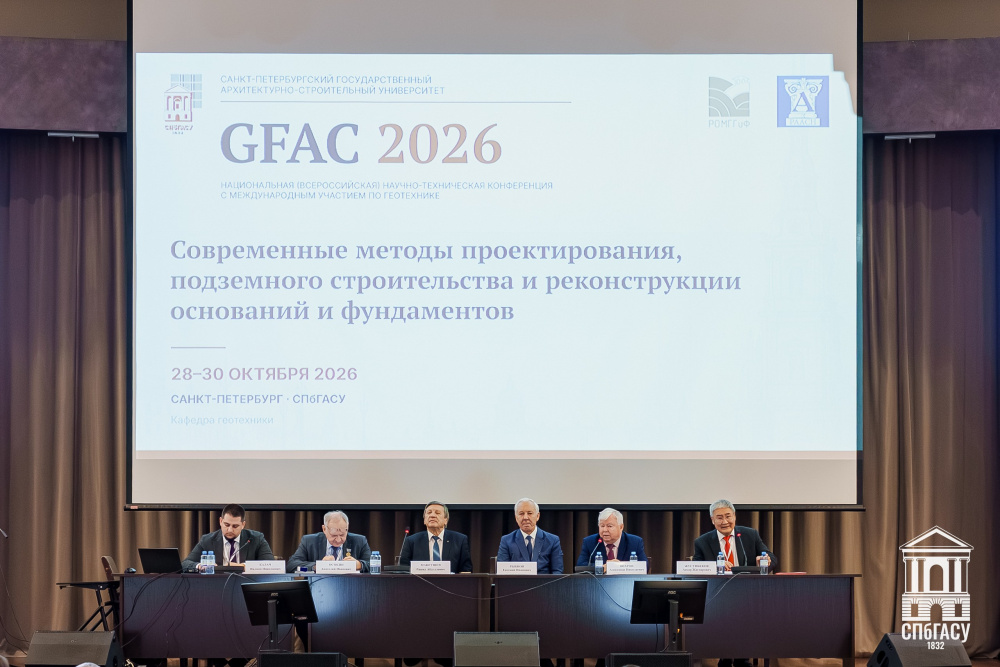
 On the conference presidium are: Philip Kalach, Anatoly Osokin, Rashid Mangushev, Evgeny Rybnov, Evgeny Vikhrov and Askar Zhussupbekov
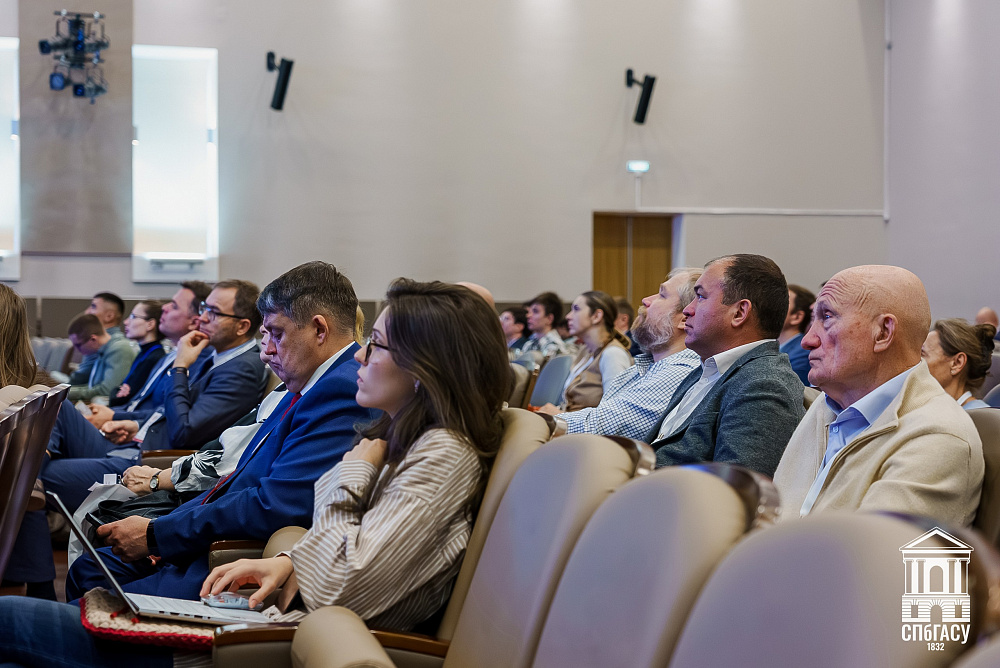
On 28 October, the Saint Petersburg State University of Architecture and Civil Engineering has started the National (All-Russian) Scientific and Technical Conference with international participation, titled "Modern Methods for Design, Underground Construction, and Reconstruction of Foundations and Substructures." Over the course of three days, geotechnical experts are discussing pressing scientific challenges, as well as contemporary calculation methods and technologies used in construction practice.
Welcoming remarks were delivered to the conference participants by Evgeny Rybnov, Rector of SPbGASU, Professor, DSc in Economics, PhD of Engineering Sciences; Askar Zhussupbekov, Chairman of the Kazakhstan Geotechnical Association, Professor, DSc in Engineering; and Aleksandr Vikhrov, representative of the National Association of Surveyors and Designers (NOPRIZ) in the Northwestern Federal District, Associate Professor, and PhD of Economic Sciences.
The first plenary session was opened by Rashid Mangushev, Director of the Scientific and Production and Consulting Center for Geotechnologies, Professor at the SPbGASU Department of Geotechnics, DSc in Engineering. In his presentation, titled "Modern research by the SPbGASU Department of Geotechnics and its implementation in construction practice," he outlined the department’s primary areas of focus, as well as research findings and developments currently being applied to address practical engineering challenges.
One of the key areas of the department’s research is the study of how construction technologies affect the deformation of soil foundations and surroundings. Specifically, experts investigate how the installation of pile foundations and retaining systems for deep excavations impacts the condition of the soil and nearby buildings. The findings help refine calculation methods, estimate additional settlement, and develop recommendations for mitigating risks during construction in complex engineering-geological conditions.
The report places particular emphasis on research into weak, water-saturated clay soils, the effects of dynamic loading on foundations, frost heaving, and the thawing of permafrost. Scientists are also investigating how the properties of sandy soils change when contaminated with petroleum products, as well as methods for reinforcing the foundations of existing buildings. The findings from this work help refine approaches to foundation design and the forecasting of soil behavior under various conditions.
An important component of the research involves the development of numerical modeling methods for geotechnical processes. Department staff create mathematical models and computational algorithms that account for the non-linear behavior of soils, seepage processes, consolidation, and temperature-related changes. These developments expand the capabilities for assessing the performance of soil foundations and structural footings under complex conditions.
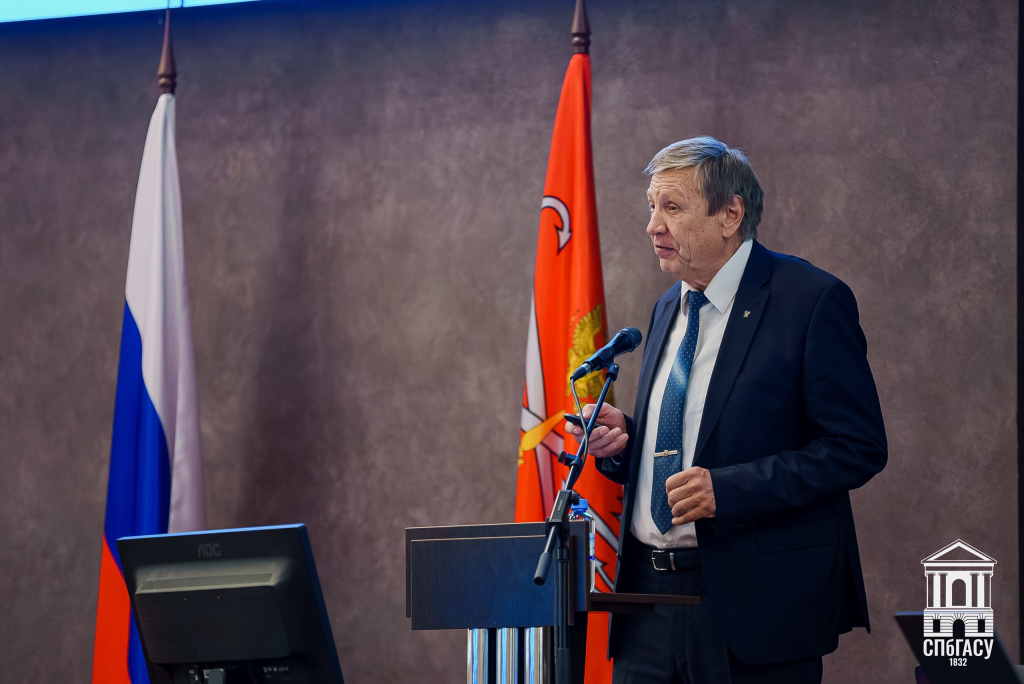 Rashid Mangushev
An important area of focus for the Department of Geotechnics is the training of highly qualified researchers. Since 2005, 13 PhD students have successfully defended their PhD theses under the supervision of Rashid Mangushev, including Nguyen Quang Hung from Vietnam. Those who have completed their PhDs include Elena Gorodnova (2005), Vadim Ermolaev and Sergey Lanko (2013), Aleksandr Gursky and Dmitry Sapin (2016), Ivan Manyakhin (2018), Ivan Dyakonov (2019), Vyacheslav Polunin (2022), Andrey Boyarintsev (2023), Olga Denisova (2024), and Alina Kvashuk and Ivan Bashmakov (2025). Two other postgraduate students—Filipp Kalach and Daria Paskacheva—have also completed their PhD theses.
The works by Sergey Lanko, Aleksandr Gursky, Dmitry Sapin, Ivan Dyakonov, Vyacheslav Polunin, and Olga Denisova have contributed to the development of a new research focus within the department: "The impact of technological interventions on additional settlement and the stress-strain state of the foundations of buildings and structures." Under the scientific supervision of Rashid Mangushev, three doctoral dissertations were also successfully defended, covering the following topics: the foundations of structures on weak, water-saturated soils; the design of foundations and substructures on collapsible soils in Mongolia; and the scientific and technical support of underground construction in weak soil conditions.
The report also presented promising developments from the research group. These include a method for monitoring soil and soil-cement foundations using geophysical techniques, an investigation into foundation deformation under cyclic loads from rail transport, and a study on the interaction between a colloidal silica-based gel and the weak, water-saturated soils found in St Petersburg. Another area of focus involves analyzing the performance of reinforced soil cushions on frozen ground, as well as assessing the impact of pile groups on the soil mass and retaining structures during excavation work.
Advancing scientific research requires a modern experimental infrastructure. Rashid Mangushev described new instruments recently acquired by the Department’s laboratory, including automated equipment for soil oedometer tests, direct shear tests, and triaxial compression tests. This instrumentation enables laboratory analysis of the mechanical properties of soils and the study of their behavior under static and dynamic loading. The professor expressed his gratitude to the university managers for their support in developing the laboratory facilities.
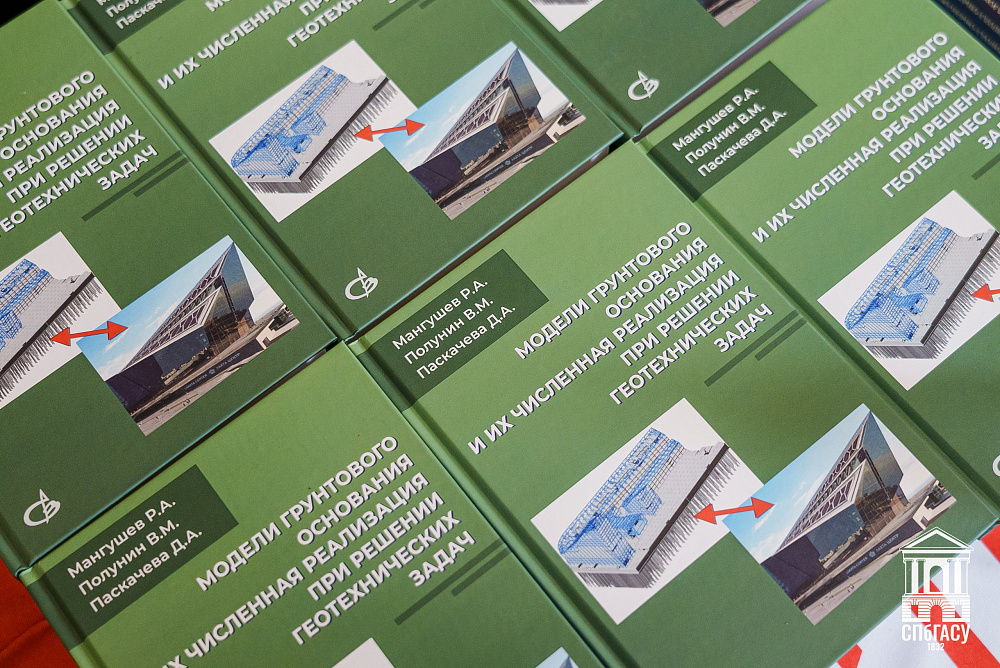
In addition, the report discussed scientific and educational publications prepared by department staff and their colleagues. These include works on settlement of buildings and structures caused by underground construction, numerical analysis in geotechnical practice, and the reference book "Geotechnics: Foundations, Footings, and Underground Structures." The latest edition of this reference book was published in 2024, and an English translation was prepared in 2025. Work is currently underway on a Chinese translation.
The conference will continue on 29 and 30 October. The program includes plenary and breakout sessions focused on the design of pile foundations, the dynamics of soil foundations, underground construction, the modeling of soil properties, and soil stabilization technologies.
The plenary session on the second day will begin with a presentation by Anatoly Osokin, Associate Professor, DSc in Engineering, Head of the SPbGASU Department of Geotechnics, who will discuss the department’s academic school and its future development plans. On the final day, 30 October, technical site visits are planned for participants, featuring projects in which SPbGASU specialists were involved during construction.
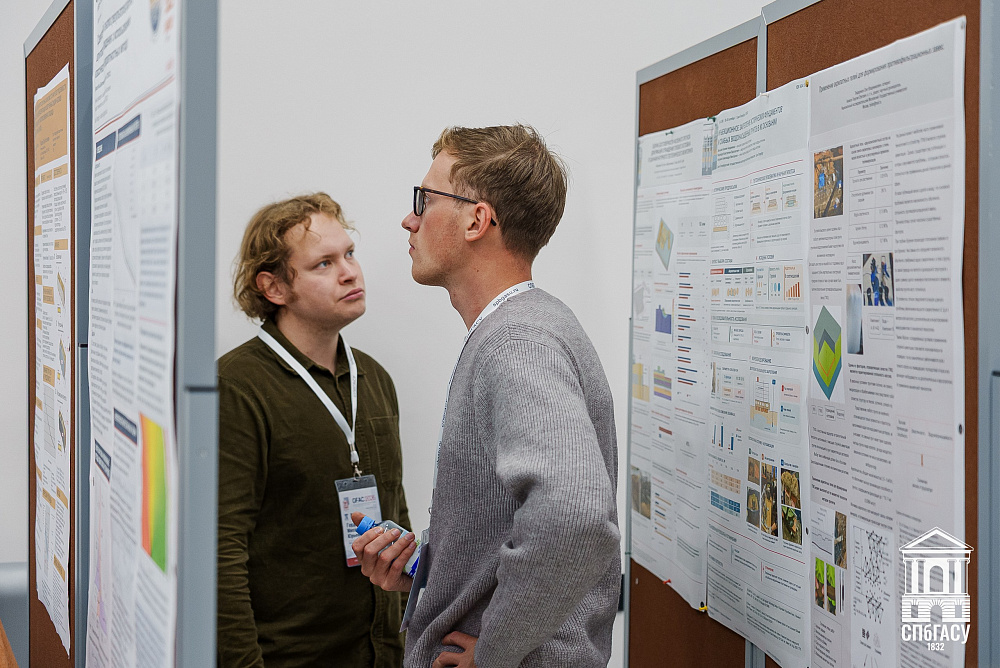
The university’s balustrade also features a poster exhibition, which brings together 45 presentations.
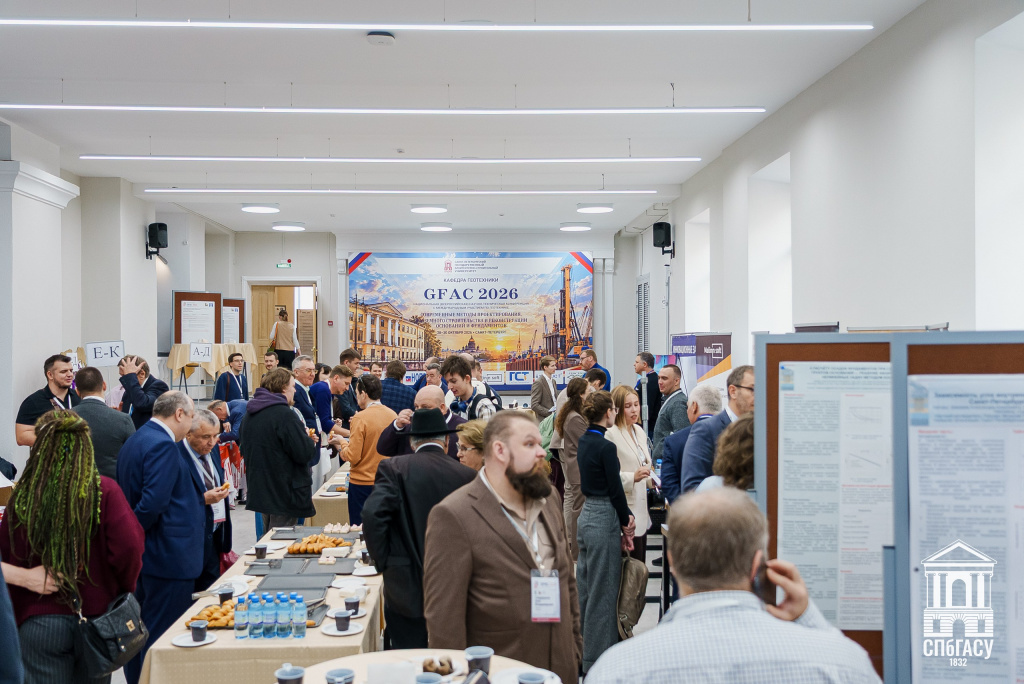 Exhibition on the balustrade as part of the conference
During the conference, an exhibition titled "The Department of Geotechnics Scientific School", dedicated to the history of Russian geotechnical science and the scholarly and methodological works of the department's staff, is on display at the SPbGASU Scientific and Technical Library.