The Saint Petersburg State University of Architecture and Civil Engineering has developed a methodology for assessing the emergent properties of the investment and construction sector. The research was conducted by Timur Ablyazov, PhD of Economic Sciences, Associate Professor at the Department of Construction Economics and Housing and Utility Infrastructure, under a grant for research activities by SPbGASU academic staff in 2026.
The methodology makes it possible to identify and measure the effects that arise in the construction sector from the interaction between clients, contractors, and other market participants.
Emergent properties of a system are those not possessed by any of its individual elements. In construction, examples include the benefits derived from the coordinated work of long-term partners or, conversely, the chain reaction of non-payments cascading from clients to contractors and suppliers. Such effects impact construction schedules and costs; however, existing assessment methods focus either on individual organizations or the construction sector as a whole, failing to reveal where an effect originates or how it propagates across different levels.
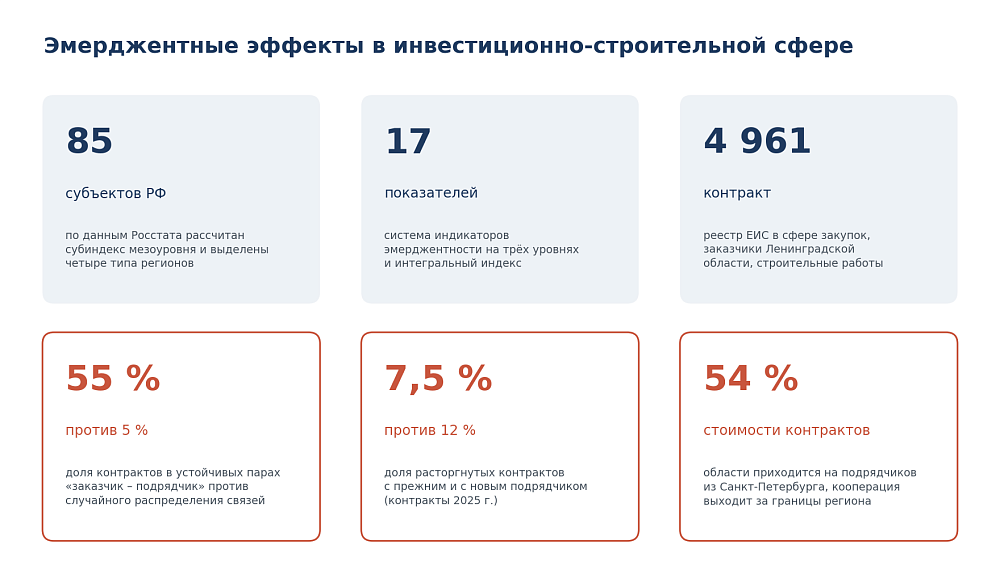
The study develops criteria to distinguish genuine interaction effects from random coincidences, scale effects, or general external shocks. The investment and construction sector is analyzed at three levels: projects and organizations, regional markets, and the construction industry as a whole. A mechanism for comparing effects across these levels, a diagnostic algorithm, and a system of 17 indicators—combined into an integral emergence index—are proposed.
The methodology was validated using Rosstat data for Russia’s 85 regions and data from the Unified Information System in the field of procurement’s contract registry. An analysis of 4,961 construction contracts awarded by clients in the Leningrad Region revealed that 55% of the contracts were concluded within stable "client–contractor" pairs; under a random distribution of connections, this figure would not have exceeded 5%.
Contracts with a previously engaged contractor are terminated 1.5 times less frequently—7.5% compared to 12% for new pairings. This difference persists even when accounting for contract price and contractor experience. Since St Petersburg-based companies account for more than half of the region's total contract value, it is appropriate to assess construction-sector cooperation at the metropolitan area level rather than within a single region.