Saint Petersburg State University of Architecture and Civil Engineering has developed a combined technology for treating oil-contaminated wastewater from motor transport enterprises. The research was conducted as part of a grant competition for research projects to be carried out by SPbGASU academic staff in 2026. The project is led by Elena Korneeva, Senior Lecturer at the Department of Water Use and Environment.
Why a new technology is necessary
Wastewater from motor transport facilities contains petroleum products, suspended solids, and other contaminants. When only a single filtration stage is used, the fibrous material is subjected to a significant oil load, which can lead to more rapid fouling.
To reduce the load on the filter element, the study proposes a combined purification scheme: preliminary removal of the bulk of the petroleum products via dissolved air flotation, followed by tertiary treatment of the water using a fibrous polymer separator.
What SPbGASU proposed
As part of the study, an experimental setup was developed comprising a compact dissolved air flotation unit and a replaceable fibrous polymer separator. During the dissolved air flotation process, water is saturated with air; upon a subsequent drop in pressure, fine bubbles form, facilitating the removal of oil contaminants. The effluent then flows to the fibrous separator for further purification.
The researchers compared two schemes: direct feeding of oily water to a polymer separator and pretreatment of the water using dissolved air flotation.
Research results
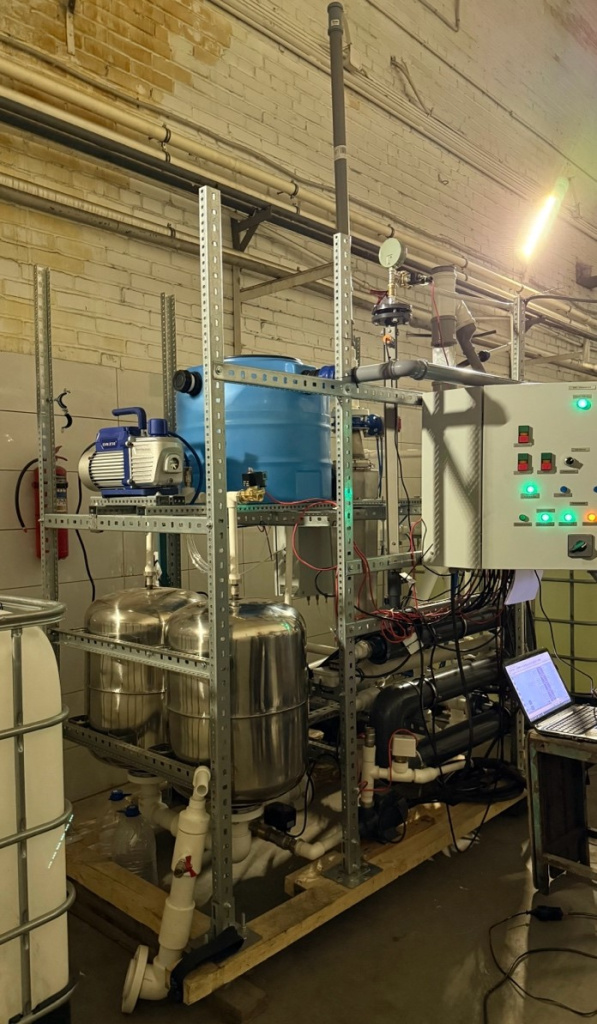
Experiments demonstrated that preliminary flotation reduces the oil load on the subsequent treatment stage. When pressure flotation and a fibrous polymer separator were used in series, the average concentration of petroleum products after treatment was 2.8 mg/L. In the series of experiments conducted, this figure was 4.0 mg/L when the separator was used alone. The calculated average removal efficiency for the combined treatment scheme reached 93.5%.
Additional optical microscopy analysis made it possible to assess changes in the dispersion of oil droplets. When using only the polymer separator, droplets approximately 15–20 µm in size were observed, whereas droplets of about 5–10 µm predominated after preliminary flotation and subsequent filtration.
The results obtained demonstrate that the preliminary removal of petroleum products via pressure flotation reduces the load on the fibrous polymer material and creates conditions for the subsequent treatment stage.
Practical significance of the development
The developed scheme can be applied to improve local wastewater treatment systems at motor transport enterprises. The sequential use of the two methods allows the load to be distributed among the treatment stages, while the replaceable fibrous element can be utilized within compact equipment.
Future research will focus on studying the filtration and regeneration cycles of the fibrous material. This will make it possible to assess the separator's service life and determine the conditions for its effective use within a combined purification system.
The study was conducted under a 2026 SPbGASU grant on the topic "Improving the technology for treating oily wastewater from motor transport enterprises using a compact pressurized flotation unit with a chemical defoamer and a fibrous polymer separator with a composite structure."