Saint Petersburg State University of Architecture and Civil Engineering has refined the methodology for reconstructing traffic accidents involving motorized two-wheeled vehicles. This development enhances the accuracy of forensic automotive analyses by accounting for motorcycle braking parameters in greater detail.
The study was conducted by Ilya Brylev, PhD of Engineering Sciences, Associate Professor at the Department of Land Transport and Technological Machines. The work focuses on refining the calculated parameters of braking dynamics used to reconstruct the circumstances of traffic accidents and determine whether the driver had the technical capability to prevent them.
The relevance of this study stems from the fact that the current regulatory framework for calculating the braking dynamics of motorized two-wheeled vehicles was established in the 1980s. However, modern motorcycles feature diverse braking systems—including optional anti-lock braking systems (ABS)—and braking behavior depends significantly on the vehicle load and road surface conditions. Relying on outdated reference values can lead to an underestimation of the calculated travel speed, thereby affecting expert conclusions regarding whether the rider had the technical capability to prevent a traffic accident.
To refine the design parameters, experimental tests were conducted on 24 motorcycles from six different brands. The study covered vehicles with various types of braking systems, including those equipped with ABS and those without. The tests were carried out on road surfaces with varying coefficients of adhesion and under different load conditions.
The results showed that the actual steady-state deceleration values were, on average, 20–25% higher than the reference values. At the same time, the deceleration rise time was found to be two to three times greater than the standard values. These parameters were taken into account when developing a refined methodology for traffic accident reconstruction.
The methodology is based on adjusting the standard values for steady-state deceleration and its rise time using empirical coefficients. An algorithm has been developed to determine these coefficients, taking into account the braking system type, motorcycle load, presence of ABS, braking mode, and road surface condition.
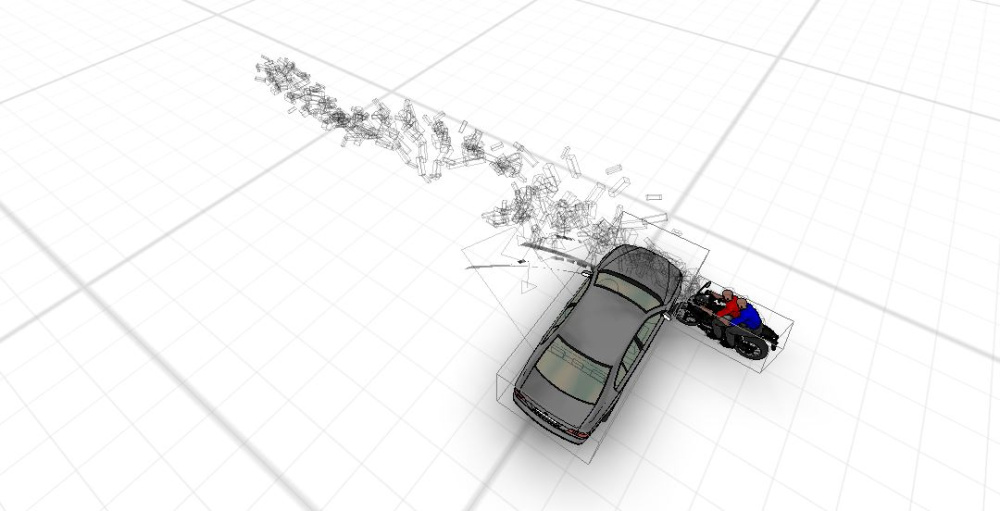
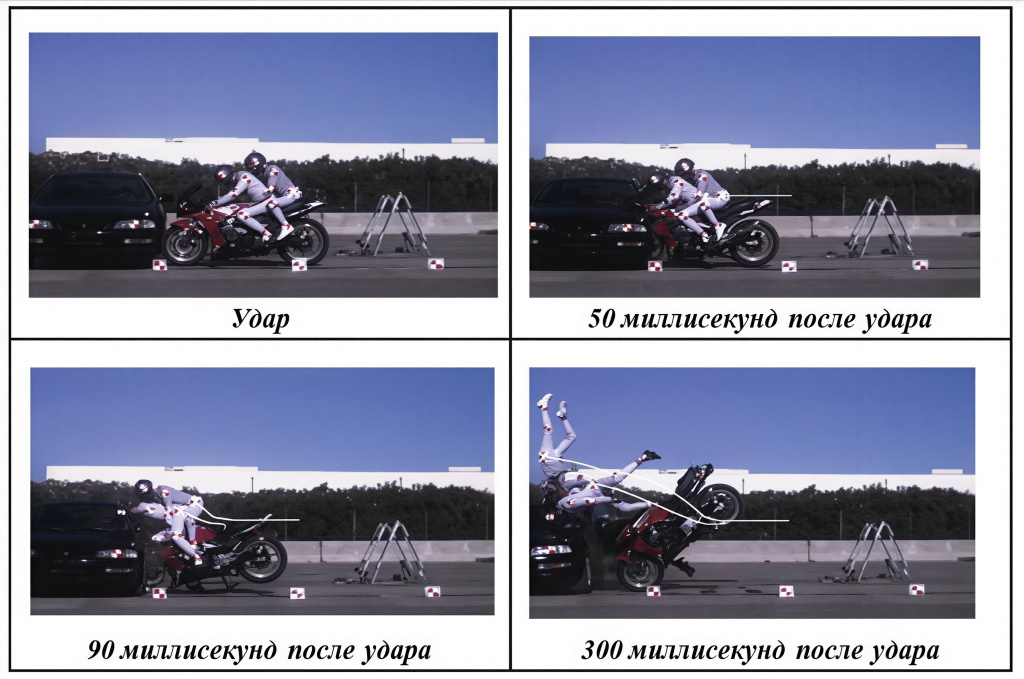
A distinct area of research focuses on the application of model-based reconstruction (MBR) methods. This approach enables a quantitative analysis of accident dynamics and the calculation of the motion parameters of the parties involved. As part of the study, a mathematical framework was developed to determine the trajectories along which the driver and passenger are thrown, as well as HIC injury indices, as a function of vehicle speed.
High-precision regression models have been developed for key parameters, with a coefficient of determination R² exceeding 0.9. This enables the use of the established relationships to reconstruct traffic accident dynamics with minimal calculated error.
"The developed methodological framework makes it possible to eliminate subjectivity and non-definitive conclusions from expert practice. The use of parametric models provides a deterministic computational basis for establishing critical parameters, such as the point of impact and vehicle speeds," noted Ilya Brylev.
The research findings have already been implemented in the expert practice of the SPbGASU Institute for Traffic Safety. The developed approaches are also utilized in the university's educational process for training forensic automotive experts.
The study was conducted under a grant for research activities to be carried out by academic staff of SPbGASU in 2026.